
The demo day Q&A is short, unscripted and where investors decide whether they want a second meeting. Prepare for it by listing the 20 or so questions your deck invites, writing a first-sentence answer to each, backing every answer with one number or customer fact, and rehearsing against people who will push back. This guide covers what investors ask, how to answer on traction, market, competition and money, what to say when you don't know, and how to practice under real pressure.
TL;DR
- The goal of demo day is a follow-up meeting, not a check, so the Q&A should make the investor want more time with you.
- Expect questions on the problem, customer, market size, business model, competition, traction, and what the money will achieve.
- Answer first, explain second. One direct sentence, then one proof point.
- If you don't know, say so, and commit to following up. Never bluff.
- Practice against people who will interrupt and challenge you, and record the sessions.
Table of Contents
- What the Q&A is really for
- The questions investors ask most
- How to answer: the structure that holds under pressure
- Answering on traction, market and competition
- Answering on revenue, projections and use of funds
- What to do when you don't know the answer
- How to practice demo day Q&A
- Perspective: why polite feedback doesn't prepare you
- Run your Q&A through a tougher room first
- A checklist for the day itself
- FAQ
- Sources
What the Q&A is really for
Most founders treat the pitch as the main event and the Q&A as the cleanup. Investors tend to see it the other way around. A two-to-three-minute pitch gives them a story. The questions show whether you understand your own business.
A demo day is typically a structured event with five to ten minutes on stage followed by three to five minutes of Q&A. That is a very small window, and often the Q&A at the event is only the start. The informal conversations afterward, over coffee or in the hallway, repeat the same questions in a less structured form.
The immediate goal is also narrower than most founders assume. As one Techstars-linked account puts it, the objective is usually to generate follow-up meetings rather than an immediate check, where investors can look harder at the company, team, customers and competitors. Accelerator guidance says the same thing from the founder's side: a five-minute presentation is generally not enough for an investment decision, so its job is to start conversations that can lead to feedback, advice, investment or customer introductions.
That changes how you should answer. You are not trying to win an argument. You are trying to show that a second, longer conversation with you would be worth an investor's hour.
There is a second layer to every question. Investor questions often carry subtext: they can be a way to test market knowledge, surface risks, or see whether a founder is grounded or overly optimistic. "How big is the market?" is partly a question about market size and partly a question about whether you think in numbers or in slogans.

The questions investors ask most
Q&A questions cluster in a handful of categories. A post-pitch question guide from a US university's startup program says the Q&A tests whether founders understand the customer problem and solution, target market, market size and business model. The same guide lists typical questions on customer discovery, bottom-up sales and revenue forecasts, and why the business will matter in ten years.
A bank that works with startups describes the same ground from the investor's side: the problem, product differentiation, market size, competition, revenue and growth models, team capability, and the money, time and milestones needed to reach a point that supports further investment.
Here is a working list, grouped the way investors tend to move through them.
Problem and customer
- Who exactly has this problem, and how do you know?
- How many customers have you spoken to, and what did they say that surprised you?
- What do they do today instead of using you?
- Who is the buyer, and who is the user?
Why you, why now
Investors often probe for "why now," "why you," and a specific target market as signs of strategic clarity and commitment. Prepare a single-sentence answer to each. "Why now" should name something that changed: a regulation, a cost curve, a platform shift, a behavior. "Why you" should name something specific to your team, such as years inside the problem, a technical edge or a distribution advantage.
Market and competition
- How big is the market, and how did you calculate it?
- Who else does this, and why do customers pick you?
- What stops a larger company from copying you?
Business model and traction
- How do you make money, and what does a customer pay?
- What is your current revenue, pipeline or usage, and how fast is it growing?
- What does it cost you to acquire a customer, and what do you earn from one over time?
Money and milestones
- How much are you raising, and what will it get you?
- What will be true in 18 months that isn't true today?
- What is the biggest risk, and how are you spending against it?
Write these on cards. Then add the questions specific to your company: the one weak slide, the metric that looks odd, the pivot you made last spring. Those are the ones that will actually be asked.
How to answer: the structure that holds under pressure
The simplest rule is the one that works: state the direct answer first, then give supporting context, and avoid jargon and rambling. Investors on stage or in a hallway have a few minutes per founder. If your answer starts with background, they will have stopped listening before you reach the point.
A reliable pattern in three beats:
- Answer in one sentence. "We charge $400 a month per seat, and 11 of our 14 pilots converted at that price."
- Give one proof point. A number, a customer name you have permission to use, or a specific event.
- Stop, or bridge. Either stop and let the investor ask the next question, or add one line that connects to the next thing you want to discuss.
The example figures above are illustrative, not benchmarks. Use your own.
Tempo matters too. Advice passed around among founders preparing for accelerator interviews is to be substantive, get to the point, avoid filler words and match the interviewers' tempo. If an investor asks quickly, answer quickly. If they slow down and think, give them room.
Don't defend, explain
A hostile-sounding question is usually a test, not an attack. "Isn't this just a feature?" invites you to explain why the problem is big enough to be a product. Resist the urge to say "no" and defend. Say what you know about where the boundary sits and why customers pay.
Answering on traction, market and competition
These three areas decide most Q&As. Each rewards the same habit: show the logic, not just the number.
Market size
Big top-down numbers ("a $50 billion industry") invite skepticism. A stronger answer builds the market from the bottom. One widely cited investor guide advises founders to explain market size by showing how many users or customers there are, how that number grows, and what each is worth.
Worked example with made-up numbers: "There are about 40,000 independent dental practices in our target segment. At $300 a month, capturing 5% is $7.2 million a year, and we expect the segment to add 3,000 practices a year." The investor can disagree with your assumptions, but they can see them, which is the point.
Also avoid pitching an enormous market too early. Investors prefer a deep, focused understanding of a smaller initial target market as the base for later expansion.
Traction and validation
Have the three or four numbers that prove demand ready and be able to say how each is defined. "Active users" means different things to different people, and an investor who finds the loose definition will doubt your other numbers. If you are pre-revenue, lead with customer discovery: how many conversations, what pattern emerged, who committed to pilot.
Founders also need to show they have validated the model by knowing what customers are willing to pay for the solution. A price someone has actually paid beats a price you hope they will.
Competition
Name real competitors, including the unglamorous ones: spreadsheets, agencies, in-house teams, doing nothing. Then explain how you differ in a way a customer would notice. Saying you have no competitors reads as either naivety or a market too small to matter. The investor guide above says to identify competitors and explain how you differ.
Business model
Keep it simple. Y Combinator's pitch advice is to explain the model plainly and avoid offering a potpourri of models. If you are still testing two pricing approaches, lead with the one you believe in and mention the experiment as evidence of learning.
Answering on revenue, projections and use of funds
Financial questions are where unprepared founders lose the most credibility, because the numbers should be in your head, not on a slide.
The cleanest answer to "What will you do with the money?" ties spending to outcomes. Show on a simple timeline how you will spend the money to achieve specific milestones. A bank that advises startups says founders should be ready to state which milestones, especially growth and revenue milestones, they will reach, when, and how much capital and time it takes.
A structure that works:
- The raise: the amount and the runway it buys, in months.
- The split: roughly how much goes to product, hiring and go-to-market.
- The milestone: the specific metric you will hit and by when.
- The next step: what that metric allows you to do, such as raise a larger round.
Be ready for the follow-up on unit economics: what one customer costs to acquire, what they pay, how long they stay and what it costs to serve them. If your numbers are early, say how many data points they rest on. Investors forgive small samples that are labeled honestly. They don't forgive confident numbers that fall apart on a second question.
What to do when you don't know the answer
You will get a question you can't answer. Plan for it, because the moment is a character test.
The guidance is consistent: don't bluff or guess. Honesty about what isn't yet known is a sign of integrity and self-awareness, and the recommended move is to admit the gap and commit to following up with the right information. Vinod Khosla's view, as relayed in an accelerator interview, is that investors aren't necessarily looking for the perfect answer but for the quality of your thinking on a hard or unfamiliar question.
A three-part response:
- Say it plainly. "We haven't measured that yet."
- Show how you'd think about it. "My guess is it's lower in the enterprise segment because of procurement cycles, and here is how we plan to test it."
- Commit to a follow-up. "I'll send you the numbers by Friday." Then actually send them. That email is often your second meeting.
How to practice demo day Q&A
Reading a list of questions is not practice. Practice means saying answers aloud, to someone who interrupts.
One method is a "murder board": a group of mentors, co-founders or advisors who pose difficult, uncomfortable questions while you record the sessions. This builds muscle memory and desensitizes the team to the pressure of a live setting.
A practice plan that fits into a week:
- Day 1: Write every question you dread. Ask a co-founder to add ten more.
- Day 2: Draft one-sentence answers and one proof point for each.
- Day 3: First live round with a co-founder. Record it. Count filler words and rambling answers.
- Day 4: Rehearse with an outsider who knows startups. Ask them to interrupt.
- Day 5: Rehearse the three questions you answered worst, until they are boring.
- Day 6: Full run, pitch plus Q&A, timed.
Two habits improve results fast. Rotate who plays the investor, since each person probes differently. And watch the recording for body language as well as content: crossed arms, long pauses before hard questions and answers that trail off.
The weakness of friendly practice is friendliness. Teammates and mentors know your story and soften their questions. That is where an adversarial rehearsal tool earns its place, and it is why we built one.
Perspective: why polite feedback doesn't prepare you
We built Dialectic because the feedback founders usually get before an investor meeting is too kind to be useful. Friends, advisors and general-purpose AI tools tend to say the deck is strong and suggest a few tweaks. Then a partner asks one question about your take rate or your churn, and the room changes.
Our view is that a pitch should be stress-tested the way an investor would test it: by looking for the fragile assumption, the blind spot, the number that doesn't reconcile. That is what our platform is designed to do. You upload a deck or memo, we scrutinize it with partner-style questions, score its fragility and risk, and list the weaknesses in a structured way, so you can fix them before the meeting rather than discover them during it.
Then comes the part that Q&A depends on: rehearsal. We believe you only learn to defend an answer by defending it, out loud, against pressure. Our boardroom rehearsal puts tough questions to you in real time and grades your defense, so the first time you hear the hardest question is not on demo day.
If a weakness is real, we would rather you find it on a Tuesday with us than in front of the investor you most wanted.
D
Run your Q&A through a tougher room first
If you want the hard questions before demo day, you can upload your deck or memo to Dialectic and see what an adversarial partner would press on. The Tactical Audit is a one-off at $25 per audit, a good fit if you have one deck and one event. Founder Pro is $49 per month for founders who want to iterate and rehearse repeatedly. Venture & Studio 5 Seats is $149 per month for teams or studios preparing several companies at once.
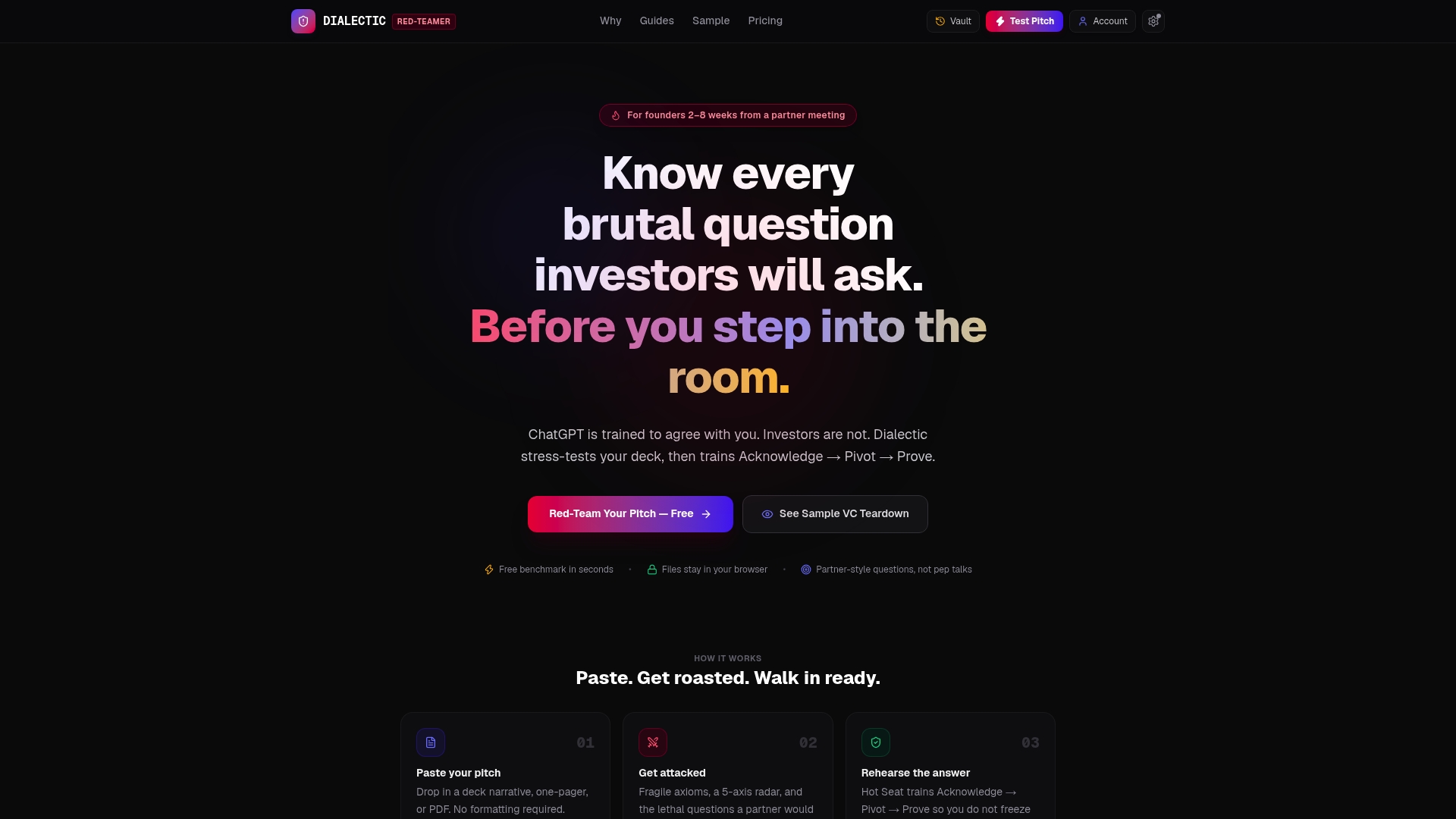
You can stress-test your pitch deck with Dialectic and see the structure of an audit in our forensic teardown of a board memo.
A checklist for the day itself
- Know your five core numbers cold: revenue or pipeline, growth rate, customer count, price, runway.
- Have one-sentence answers for why now, why you, and who the first customer is.
- Bring a short backup list of customer names you can mention, with permission.
- Answer first, then support. Stop when you're done.
- Treat each question as interest. A question means the investor is engaged.
- Write down every question asked. Each one tells you what the next deck should address.
- Follow up within 48 hours on anything you promised, and ask for the next meeting directly.
That last point matters most. If the purpose of demo day is to earn meetings, the Q&A is where you earn them, and the follow-up is where you collect.
FAQ
How long is the Q&A at a demo day?
It is usually short. A common format is five to ten minutes of pitching followed by three to five minutes of questions, though formats vary by program. The real Q&A often continues informally afterward, so prepare for both.
What are the most common questions investors ask after a pitch?
They cluster around the problem and solution, target customer, market size, business model, competition, traction and use of funds. A university startup-program guide lists customer discovery, bottom-up forecasts and market size among them. Add the questions your own deck makes obvious.
What should I say if I don't know the answer?
Say so, briefly, then explain how you would find out or how you think about it, and promise a follow-up by a specific day. Guidance on investor questions warns against bluffing and guessing. Then send the answer on time.
How do I practice demo day Q&A?
Write out the questions you dread, draft short answers, then rehearse aloud with people who will interrupt and challenge you. Record the sessions and review them. Use a mix of co-founders, outside mentors and an adversarial tool so the pressure is not all friendly.
Sources
- What Is a Demo Day? Meaning, Formats and How to Run One
- Pitch to Get a Meeting, Not a Check
- What are some tips for Demo Day?
- How to Respond to Investor Questions
- Typical Questions that Judges Ask Teams after they pitch
- What Investors Look For & Questions They Will Ask
- Demo Day Advice - From a VC Turned Entrepreneur
- How to Present to Investors
- Seven Practical Tips to Raise Money for Your Startup
- How to Pitch Your Company
- Vinod Khosla: VC Discounting
- Show HN: iPG - YC Interview Simulator