
Use a four-part structure: problem, solution, proof, ask. Keep it to 30 to 60 seconds, roughly 50 to 200 words, and stop there. The pitch has one job: earn a follow-up conversation, not to close the deal in the elevator. Everything else in this guide is about how to draft, tailor, and rehearse those four moves until they sound like you talking, not a script.
TL;DR:
- A single proof point, such as a customer success story or growth metric, is most effective in an elevator pitch to make it memorable.
- Tailoring the pitch involves emphasizing concrete details like pain points and validation signals relevant to investors, hiring managers, or prospects.
- Practice should focus on timing, tone, and responding confidently to hostile questions to avoid sounding scripted or uncertain.
- Stress-testing your pitch with adversarial questions helps expose weak assumptions before engaging with real investors or clients.
- Using a proven template that covers problem, solution, proof, and ask ensures clarity and focus in your brief introduction.
Table of Contents
- What Is an Elevator Pitch, and Why Does Structure Matter?
- Which Elevator Pitch Framework Should You Use?
- How Do You Write and Edit an Elevator Pitch?
- Elevator Pitch Templates and Examples You Can Adapt
- What Changes When You Tailor Your Pitch to Different Audiences?
- How Do You Rehearse an Elevator Pitch So It Doesn't Sound Scripted?
- Why Adversarial Rehearsal Beats Rehearsing Alone
- Practice Beats Perfect Scripting
- Want Your Pitch Stress-Tested Before the Real Meeting Does It for You?
- Sources
- FAQ
What Is an Elevator Pitch, and Why Does Structure Matter?
An elevator pitch is a short, spoken introduction that tells someone who you are, what you do, and why it matters, delivered in about the time it takes to ride an elevator with a stranger. Harvard Catalyst's writing center pegs the ideal length at 30 to 60 seconds, which lands around 50 to 200 words depending on how fast you talk.
The goal is narrower than most people assume. You're not trying to explain your entire business model or your full career history. MIT's Communication Lab frames the real objective as securing permission for a longer conversation, nothing more. A pitch that tries to do everything usually does nothing well; the listener nods politely and forgets you by the next hallway.
That's exactly why an elevator pitch structure matters more than clever wording. A clear framework keeps you from rambling into details the listener doesn't need yet, and it makes you sound confident even when you're nervous. You'll use this structure constantly:
- Networking events, when someone asks "so what do you do?"
- Interview openings, when you're asked to introduce yourself
- Investor intros at demo days, conferences, or cold outreach
- Sales conversations, when a prospect asks what your company does
- Casual introductions where a real opportunity might be hiding
Which Elevator Pitch Framework Should You Use?
Two frameworks cover almost every situation, and picking the wrong one is the most common structural mistake people make.
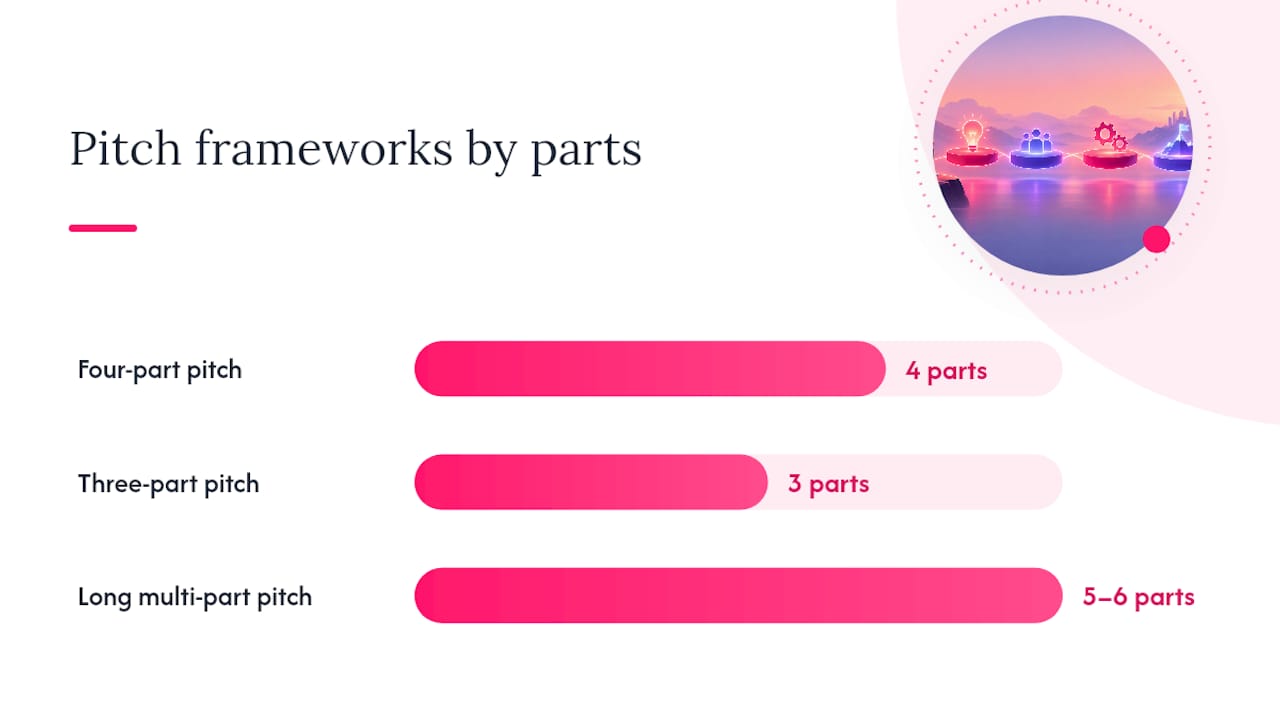
The four-part structure, problem, solution, proof, ask, is the standard for startup and investor-facing pitches. Stanford's pitch guidance recommends keeping this short version distinct from a full deck: the elevator version creates interest, while the deck (with market sizing, business model, traction, and team) does the convincing later. Here's how the four parts break down:
- Problem: name the pain and who feels it, in one sentence
- Solution: state what you built and how it solves that pain
- Proof: one concrete data point, customer name, or result
- Ask: the specific next step you want
A three-part variant works better for job seekers and casual networking: what you do, why it matters, why you (or your solution) will win. It's leaner because there's no company to validate, just a person or an idea worth a second look.
One data point worth internalizing: Stanford's lecture notes stress using exactly one proof point in the short pitch, not three, not five. A single named customer, a growth number, or a pilot result does more work than a wall of stats because the listener can actually hold one fact in their head as they walk away.
Longer multi-part frameworks, the kind with five or six sections covering market size, competitive landscape, and financial projections, don't belong in an elevator pitch at all. That's deck content. If you're building a longer format for a fundraising meeting, address it separately from the 30 to 60 second version you use to open the conversation.
How Do You Write and Edit an Elevator Pitch?
Writing a tight pitch is less about inspiration and more about ruthless cutting. Follow this sequence:
- Define your outcome and your listener first. Before writing a word, decide exactly what you want the listener to do next, an intro, a meeting, a resume request, and picture the specific person you're talking to.
- Draft four sentences, one per structural part. Write a problem/value sentence, a solution sentence, a proof sentence, and an ask sentence. Don't polish yet; just get the content down.
- Cut anything that isn't load-bearing. Remove your mission statement, your company's origin story, and any jargon a stranger outside your industry wouldn't recognize instantly.
- Enforce one audience and one ask. A pitch trying to serve investors and customers at once, or asking for both a meeting and a referral, will confuse and dilute. Pick one.
- Time it out loud. Most people speak at roughly 130 to 150 words per minute conversationally, so a 45 second pitch lands around 100 to 110 words. Read it aloud with a stopwatch, then cut again.
- Test with the Atlassian listener-reconstruction method, described in the next section, before calling it finished.
Pro Tip: Write your ask sentence first, then work backward. If you don't know exactly what you want from the listener, you'll bury the request in vague language, and vague asks get vague responses.
The editing pass is where most pitches actually get good. A first draft almost always runs long and defensive, packed with qualifiers and background nobody asked for. Trim until every sentence is doing one job.
Elevator Pitch Templates and Examples You Can Adapt
The fastest way to write a solid pitch is to start from a proven skeleton rather than a blank page. Atlassian's team playbook offers a fill-in template that works across most professional contexts:
"For [audience] who struggle with [problem], [name] is a [category] that helps them achieve [outcome]. Unlike [alternative], we [differentiator]. [Proof]. I'd like to [next step]."
Adapt that skeleton by audience:
- Job seeker: strongest skill or accomplishment, up front, followed by what role you're targeting and a specific ask for advice or an introduction.
- Founder/investor: named customer pain, your solution, one traction metric, and an ask for a follow-up meeting or a one-pager send.
- Salesperson: the cost of the prospect's current problem, your fix, a result from a comparable client, and an ask for a short demo.
- Networking: conversational tone, no pitch-speak, ending in an open question rather than a hard ask.
A few short examples in practice:
Job seeker: "I spent four years managing supply chain logistics for a regional retailer, cutting delivery delays by tightening vendor communication. I'm now looking for an operations role at a growth-stage company. Would you be open to an introduction to anyone on your ops team?"
Founder to investor: "Small clinics lose thousands of dollars a month to no-show appointments. We built a scheduling tool that predicts no-shows and automatically fills gaps, and one clinic chain cut no-show losses by double digits in the first quarter. I'd love fifteen minutes to walk you through the model."
Networking: "I help early-stage founders figure out their pricing before they raise. It's a problem most people don't think about until it's already hurting them. What are you working on these days?"
Notice each example swaps in a different proof format, a percentage, a client story, a personal result, but keeps the same underlying shape. That's the point of a template: it forces discipline without forcing sameness.
What Changes When You Tailor Your Pitch to Different Audiences?
The four-part skeleton stays fixed. What changes is which details you plug in, and MIT's guidance on starting general and adding technical depth only if the listener follows up applies to every version below.
For investors, name the customer and the specific pain point they feel, not an abstract market. Include exactly one traction or validation signal, revenue, a pilot result, a signed letter of intent. Make the ask a concrete next step: a fifteen-minute follow-up or a one-pager sent by email, never "let me know if you're interested."
For hiring managers, lead with your single strongest selling point rather than a chronological résumé recap. NIH's career guidance recommends adding one concrete accomplishment with a number attached, then stating what role or path you're aiming for. End with a specific, low-friction ask, advice, a referral, or a short call, never a vague "keep me in mind."
For sales prospects, shift the proof point toward outcome and cost of inaction: what does the problem cost them per month if it stays unsolved? Ask directly for a demo or a scoping call.
For networking contacts, drop the sales register entirely. Use conversational language and close with an open-ended question instead of a formal ask. That single change, question instead of request, is often what separates a pitch that feels natural from one that feels like a sales script wearing a friendly hat.
How Do You Rehearse an Elevator Pitch So It Doesn't Sound Scripted?
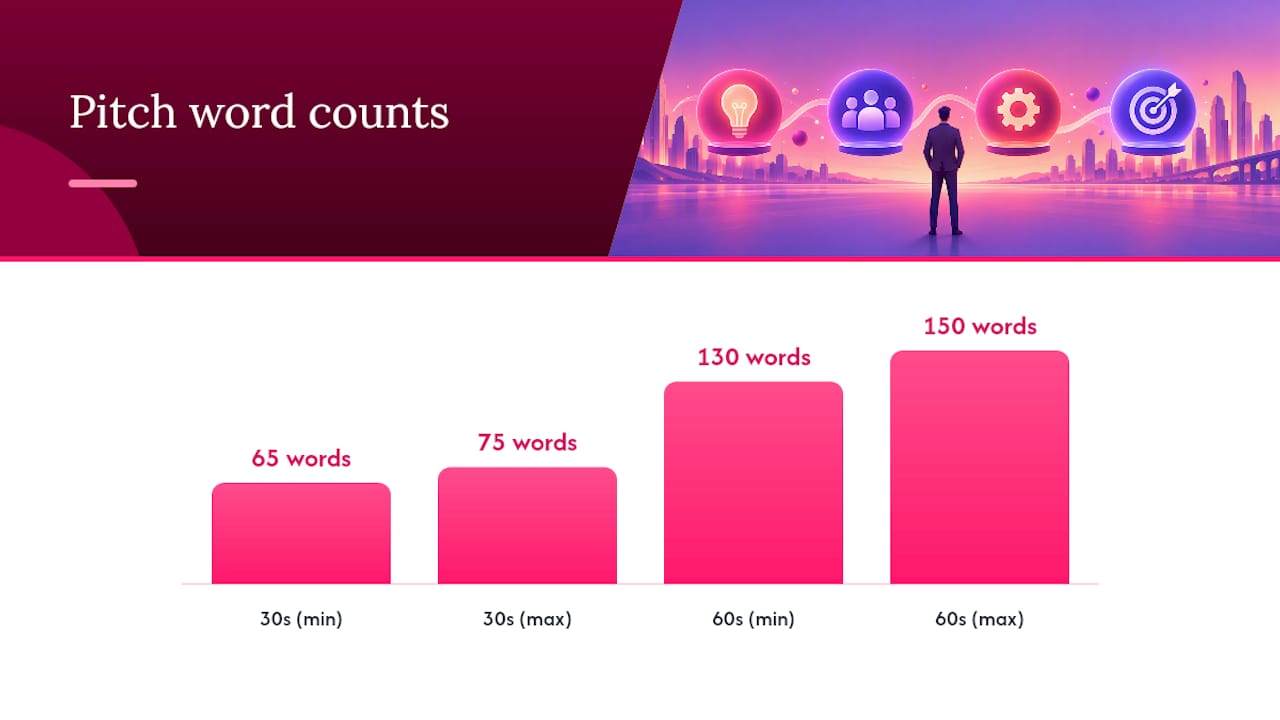
Timing and tone separate a pitch that lands from one that makes the listener's eyes glaze over. At a conversational pace of roughly 130 to 150 words per minute, a 30 second pitch runs about 65 to 75 words, and a 60 second version runs 130 to 150 words. Write to that count before you ever say it out loud.
- Record yourself on your phone and listen back. You'll hear filler words and pacing problems you can't detect while speaking.
- Practice in front of a mirror to check that your body language matches your energy, YALI's guidance specifically recommends this to catch a flat or nervous delivery before it becomes a habit.
- Run mock hostile follow-ups. Ask a friend or colleague to interrupt with a skeptical question right after your ask. Can you answer without losing your composure?
- Apply the listener-reconstruction test. After hearing your pitch once, can that person repeat back who you help, what the problem is, what you do about it, and what you're asking for? If they can't, the pitch needs trimming or reframing, not more words.
Pro Tip: If your listener can only reconstruct three of the four parts, the missing one is almost always the ask. People remember problems and solutions naturally; the specific request is what gets lost in a rambling delivery.
NIH's career resources note that a pitch which sounds memorized actually reduces credibility rather than boosting it. The fix isn't less rehearsal, it's rehearsing until the structure is internalized and the wording can flex naturally.
Why Adversarial Rehearsal Beats Rehearsing Alone
Practicing in a mirror catches delivery problems. It won't catch a fragile assumption sitting underneath your proof point, the kind an experienced investor spots in the first ten seconds. Stanford's pitch materials recommend stress-testing investor pitches with hostile but fair follow-up questions specifically because that pressure surfaces weak assumptions before a real meeting does.
A useful red-team rehearsal checklist looks like this:
- Can you defend your single proof point if someone questions the sample size or timeframe?
- Does your "why now" survive a pointed question about competitors already in the space?
- Can you answer "why you" without falling back on enthusiasm instead of evidence?
- Does your ask hold up if the listener pushes back with "why should I care right now"?
This is the level of scrutiny a Dialectic style stress test is built around, and the Nexus Take-Rate Teardown shows what that adversarial questioning looks like against a real board memo.
Practice Beats Perfect Scripting
The founders who pitch best aren't the ones with the most polished script. They're the ones who've heard their weakest assumption challenged enough times that they stopped being surprised by the question. Structure gets you in the room; honest rehearsal is what keeps you there.
— D
Want Your Pitch Stress-Tested Before the Real Meeting Does It for You?
A mirror won't ask you why your customer acquisition cost is climbing. A friend rehearsing with you won't push back on your traction number the way a tough investor might. Some services run your deck or memo through adversarial, partner-style questioning designed to expose fragile assumptions and blind spots a polite reviewer would let slide.
If you want a single gut-check before a specific meeting, the Tactical Audit runs $25 as a one-off. Founders preparing for an ongoing fundraising cycle typically use Founder Pro at $49 a month for repeated rehearsals as the pitch evolves, while teams raising together can use Venture & Studio 5 Seats at $149 a month. Start by uploading your current deck or memo and see exactly where a real investor would push back first.
Sources
- Giving a Great Pitch (Stanford lecture)
- Elevator pitch (Atlassian playbook)
- Creating an Effective Elevator Pitch (NIH OITE)
- Elevator pitch (MIT Communication Lab)
FAQ
What Are the Four Parts of an Elevator Pitch?
The four parts are problem, solution, proof, and ask: name the pain point, explain your fix, back it with one concrete proof point, and close with a specific next step. This problem-solution-proof-ask structure is the standard for investor and startup pitches; job seekers often use a leaner three-part version instead.
How Should an Elevator Pitch Be Structured?
Structure it around a single audience and a single ask, delivered in 30 to 60 seconds, or roughly 50 to 200 words. Open with who you are and what you do, state the problem or opportunity, back it with one proof point, and end with a clear request for what happens next.
What Is the Format of an Elevator Pitch?
The format is spoken, conversational, and brief, not a memorized script read word for word. A practical fill-in format is: "For [audience] who struggle with [problem], [name] is a [category] that helps them achieve [outcome]. Unlike [alternative], we [differentiator]. [Proof]. I'd like to [next step]," a structure Atlassian's playbook uses to keep every part accounted for.
What Is the Framework of an Elevator Pitch?
The most common framework is problem, solution, proof, ask for investor and business contexts, while job seekers typically use a what you do, why it matters, why you'll win framework instead. Both frameworks share the same underlying goal, which MIT's Communication Lab frames as earning permission for a longer conversation, not closing anything on the spot.