
The single most important move after an investor meeting is sending a concise thank you with a one-paragraph recap and any requested materials within 24 hours, while proposing clear next steps and logging every commitment in your tracker. Everything else, templates, cadences, objection handling, builds on that first action.
TL;DR:
- Use three touches: send deliverables on Days 3 to 5, then a timeline reminder on Days 10 to 14 if the investor has not replied.
- Track each meeting’s requested deliverable, promise owner, due date, status, and next action; review open items weekly with one designated tracker owner.
- A request for cohort data, customer references, or contracts suggests internal diligence; silence beyond a week signals lower priority, not necessarily rejection.
- When the same objection appears across three investor conversations, revise the pitch rather than answering it repeatedly; respond to each specific concern with matching evidence.
- After three unanswered updates, slow the cadence; every later message should include a deliverable, metric change, customer win, or real deadline.
Table of Contents
- Your Immediate Follow-Up Checklist After the Meeting
- Build a Follow-Up Sequence With Templates You Can Reuse
- Track Every Commitment Before It Falls Through
- What to Expect From Investors After the Meeting
- How Adversarial Pitch Prep Shortens the Follow-Up Loop
- Handling Objections and Questions That Surface After the Meeting
- Staying on an Investor's Radar Without Becoming Noise
- Turning Post-Meeting Conversations Into a Sharper Pitch
- When to Bring in Your Team on Follow-Up
- What Founders Who Closed Rounds Say About Follow-Up
- Reduce Post-Meeting Friction With a Pitch That Already Holds Up
- FAQ
- Sources
Your Immediate Follow-Up Checklist After the Meeting
What you send in the first day shapes how an investor remembers the meeting. A sharp, fast follow-up signals that you run a tight operation. A sloppy or delayed one raises doubt before diligence even starts.
Here is the sequence that works:
- Open with one line of genuine thanks that restates why your company fits what that investor cares about, not a generic "great meeting you."
- Add a 2 to 3 bullet recap of the main points discussed and any decisions made, so there is a written record both sides can reference later.
- Attach or link the exact materials requested, labeled with a version name or date so nobody opens an outdated file.
- Name the next step explicitly: propose a date and time for the follow-up call, data room access, or reference check, and say who owns each action.
- Send within 24 hours of the meeting, and faster, sometimes same day, when you walked out of a partner meeting where a decision could land quickly.
That last point matters more than founders think. Partner meetings often end with a same-day debrief, with firms aiming to get back to founders within 24 hours. If the partnership is discussing your deal while you are still drafting an email, you want your recap already in their inbox.
The recap itself should be short enough to read in under a minute. Three bullets covering the core thesis you discussed, the question that generated the most back and forth, and the specific ask you are making (an intro, a follow-up call, a data room link) does the job. Avoid restating your whole pitch. The investor was there. A recap that repeats the deck reads as filler, not discipline.
Materials deserve the same precision, as outlined in this SaaS Due Diligence: A Practical Readiness Checklist. If a partner asked for your cohort retention data, send exactly that, not a bundled data room link that forces them to hunt for it. Name the file something they can find again in three weeks: "Acme_Retention_Cohorts_Mar2026.xlsx," not "Updated deck v3 FINAL."
Closing with a specific next step removes ambiguity. "Let me know if you have questions" invites silence. "Can we hold 20 minutes next Tuesday or Wednesday to walk through the unit economics with your partner?" invites a calendar response. Assign an owner to every open item, whether that is you sending a reference list or the investor looping in a partner, so nothing drifts because it was unclear whose turn it was.
Pro Tip: Draft your thank-you and recap in the car or on the train right after the meeting, while the details are still fresh, then polish and send once you're at a laptop.
Build a Follow-Up Sequence With Templates You Can Reuse
A single thank-you email is not a strategy. What moves a deal is a predictable cadence that keeps you visible without becoming noise.
A simple three-touch sequence covers most situations:
- Day 0: thank-you, recap, and next-step proposal, sent within 24 hours.
- Day 3 to 5: deliverable follow-up with the specific materials or data requested, packaged cleanly with context.
- Day 10 to 14: a light reminder or soft-deadline nudge if you have not heard back, framed around your process timeline rather than pressure.
Each stage has its own template.
Template 1, the Day 0 recap: "Thanks for the time today, especially the questions on [specific topic]. To recap: we discussed [point one], [point two], and [the ask or decision]. I'll send [requested item] by [date]. Would [date/time options] work for a follow-up with [partner name]?"
Template 2, the deliverable email: "Attached is [specific document], covering [what it contains] as of [date]. I've flagged [one relevant detail, like a cohort trend or a contract term] that connects to the question you raised about [topic]. Happy to walk through any of it live if that's faster."
Template 3, the soft-deadline reminder: "Wanted to check in as we move toward closing this round, we're targeting [date] for the next round of commitments. No pressure on your timeline, just want to make sure you have everything you need before then. Let me know if another data point would help."
- Personalize each message with something specific from the meeting, a name, a number, or a concern the investor raised, instead of sending identical copy to every contact.
- Keep subject lines literal: "Follow-up: [Company] retention data" beats anything clever.
- Never let a template substitute for reading the room. An investor who went quiet after a tough question needs a different Day 10 message than one who asked for a reference call.
The cadence itself borrows from how experienced fundraisers structure meeting schedules: lining up conversations in a similar window creates momentum, and the same logic applies to follow-up timing. If you are running five investor conversations at once, synchronized touchpoints keep the whole process moving together instead of fragmenting into five disconnected threads.
Track Every Commitment Before It Falls Through
Fundraising stalls more often from dropped follow-through than from a bad pitch. A spreadsheet or CRM field with six columns prevents most of that.
Track these fields for every meeting:
- Meeting date and investor name
- Deliverable requested and by whom
- Who promised it (you or the investor)
- Due date
- Status (sent, pending, overdue)
- Next action and owner
A dedicated "Action items" column in your CRM, or a shared spreadsheet tab if you are not using one yet, keeps this visible to your whole team instead of living in one founder's inbox. Set a recurring reminder, weekly works for most early-stage rounds, to review every open item and flag anything overdue.
This matters as much for what investors promised you as for what you promised them. An intro to a portfolio company, a reference check, a warm handoff to another partner: these commitments are easy for a busy investor to forget, and a gentle, specific nudge ("just checking on that intro to [name] you mentioned") moves things along without seeming pushy.
Pro Tip: Assign one person on your team as the single owner of the tracker. Shared ownership with no single owner is how commitments quietly die.
What to Expect From Investors After the Meeting
Timing reveals intent. Many VC decisions happen fast after a partner meeting, with firms frequently debriefing the same day and often circling back within 24 hours. A quick response, good or bad, is normal, not a red flag.
Partner meetings move faster than founders expect: many firms debrief the same day and aim to respond within 24 hours. That compressed timeline is exactly why your Day 0 follow-up needs to land before the partnership meeting ends, not after.
Read the signals:
- A fast, warm reply usually means genuine interest and you should propose the next meeting immediately.
- A request for specific diligence materials (cohort data, customer references, contracts) signals the deal is advancing internally.
- Silence beyond a week often means lower priority relative to their other deals, not necessarily a no.
Scheduling your meetings in a tight window creates a natural race dynamic: when multiple investors know you are talking to others on a similar timeline, term sheets tend to cluster instead of trickling in one at a time, which preserves your negotiating leverage. Propose your close date early and reference it consistently across conversations rather than setting a new deadline for each investor.
Press when an investor has gone quiet past their own stated timeline. Give space when they have just asked for more material, since that usually means they are actively working the deal internally.
How Adversarial Pitch Prep Shortens the Follow-Up Loop
Most post-meeting friction traces back to the same root cause: an assumption in the pitch that did not hold up under questioning. A partner probes your retention number, finds it softer than it looked, and now you owe a follow-up email explaining cohort methodology instead of just sending a thank-you note.
Rehearsing against realistic, adversarial questions before the meeting surfaces those fragile points early, while you still have time to fix the underlying data or the explanation, rather than discovering them live in front of a partnership. That is the premise behind our platform at Dialectic: we stress-test a pitch deck or memo against the kind of scrutiny a seasoned VC partner would apply, flagging fragile assumptions and blind spots before an investor ever sees them.
A forensic teardown of a board memo can turn a vague internal metric into a defensible, specific claim, the kind of clarity that prevents a follow-up request in the first place.
Our Nexus Take-Rate Teardown shows what this looks like in practice: a CFO-style red-team pass on a take-rate assumption inside a board memo, exposing exactly where the logic needed tightening before it reached a real audience.
Before your next meeting, stress-test these specifically: your retention or churn methodology, how you define your addressable market, the math behind your unit economics, and any claim that depends on a single customer or cohort. Fixing those in rehearsal means your post-meeting deliverables are already sitting in a folder, ready to send, instead of being built from scratch under deadline pressure.

Handling Objections and Questions That Surface After the Meeting
Tough questions rarely end when the meeting does. A partner often raises a sharper objection days later, after internal discussion exposed a gap nobody voiced out loud in the room.
Treat a post-meeting objection as useful information, not a setback. Respond directly to the specific concern rather than re-pitching the whole company: if the question is about customer concentration, answer with customer concentration data, not a broader growth narrative.
Speed matters here too. A same-day or next-day response to a hard question shows you have the answer readily available rather than scrambling to construct one, which itself answers an unstated question about how well you know your own business.
When you genuinely do not have a clean answer yet, say so and commit to a date: "That's a fair point on [X], give me until [date] to get you a precise number rather than a rough one." A specific commitment beats a vague reassurance every time, and it gives you a natural reason for your next follow-up touch.
Keep a running note of which objections came up across multiple investor conversations. A concern that surfaces with three different firms is not three isolated questions, it is a pattern in how your story lands, and it belongs in the next version of your deck, not just the next email reply.
Staying on an Investor's Radar Without Becoming Noise
Multiple follow-ups are normal in a round that takes weeks or months to close. The line between persistent and tiresome is thinner than founders assume, and it usually comes down to whether each touch carries new information.
Every message after the first should earn its place in the inbox. A deliverable, a metric update, a relevant customer win, or a genuine deadline all qualify. "Just checking in" with nothing attached does not, and repeated versions of it train an investor to skim past your name.
If you have sent three updates with no reply, that is a signal to slow down, not escalate.
Give investors a reason to stay engaged between major updates: a short note when you hit a milestone, a relevant press mention, or an invitation to a product demo keeps the relationship warm without asking for anything. The goal is a steady, low-friction presence that makes saying yes later feel easy rather than overdue.
Turning Post-Meeting Conversations Into a Sharper Pitch
Every investor meeting generates data, not just about your business, but about how your pitch performs under real scrutiny. Which slide generated the most questions. Which number investors pushed back on. Which explanation landed cleanly on the first try.
Track this the same way you track commitments: a simple log of which objections, questions, and requests came up in each meeting. After five or six conversations, patterns emerge. If three separate investors question the same market-sizing slide, that slide needs to change before your next meeting, not your tenth.

Use this feedback loop actively rather than passively. If a particular framing of your unit economics consistently shortens the Q&A and speeds up the next-step conversation, that framing belongs earlier in the deck. If a specific data point keeps triggering a follow-up request, send that data point proactively in your Day 0 recap going forward instead of waiting to be asked.
This is also where structured rehearsal pays off twice: once before the first meeting, and again as you refine the pitch between meetings based on what real investors actually pushed back on.
When to Bring in Your Team on Follow-Up
Solo founders can run their own follow-up process, but once a cofounder, head of growth, or finance lead was in the room, their voice often belongs in the follow-up too, especially when the investor's question was specifically in their domain.
If a partner asked a detailed technical question your CTO answered best live, a short note from that same person on the technical follow-up carries more weight than a paraphrase from the CEO. The same applies to a head of sales following up on pipeline specifics or a finance lead sending updated projections.
Keep one person as the single point of contact for scheduling and overall relationship management, usually the CEO, even when a specialist sends a specific deliverable. Mixed messages from multiple team members with no clear lead create confusion about who owns the relationship. A quick heads-up to the rest of your team before anyone else emails an investor avoids duplicate or conflicting messages landing in the same inbox on the same day.
What Founders Who Closed Rounds Say About Follow-Up
Founders who have been through a full raise tend to agree on one thing: the pitch gets you the meeting, but follow-up is what gets you the term sheet. A "maybe" after a partner meeting often turns into a yes because the founder sent exactly what was promised, exactly when they said they would, with nothing missing.
The behavior changes experienced founders recommend are consistent. Send a single clean attachment instead of a folder of loosely related files. Designate one person as the owner of every follow-up thread so nothing falls between two people who each assumed the other was handling it. Hold yourself to strict self-imposed deadlines, even when the investor has not set one.
Investors read follow-up discipline as a direct signal of execution ability, treating it as a kind of problem-solving hygiene check. How you handle the small, unglamorous work after the meeting tells a partner more about how you will run their capital than any slide in the deck.
— D
Reduce Post-Meeting Friction With a Pitch That Already Holds Up
Clean follow-up starts with a pitch that does not generate fifteen clarifying questions in the first place. That is what we built Dialectic for: an adversarial stress test that puts your deck or memo through the kind of partner-style scrutiny a real VC meeting delivers, before you walk into the room.
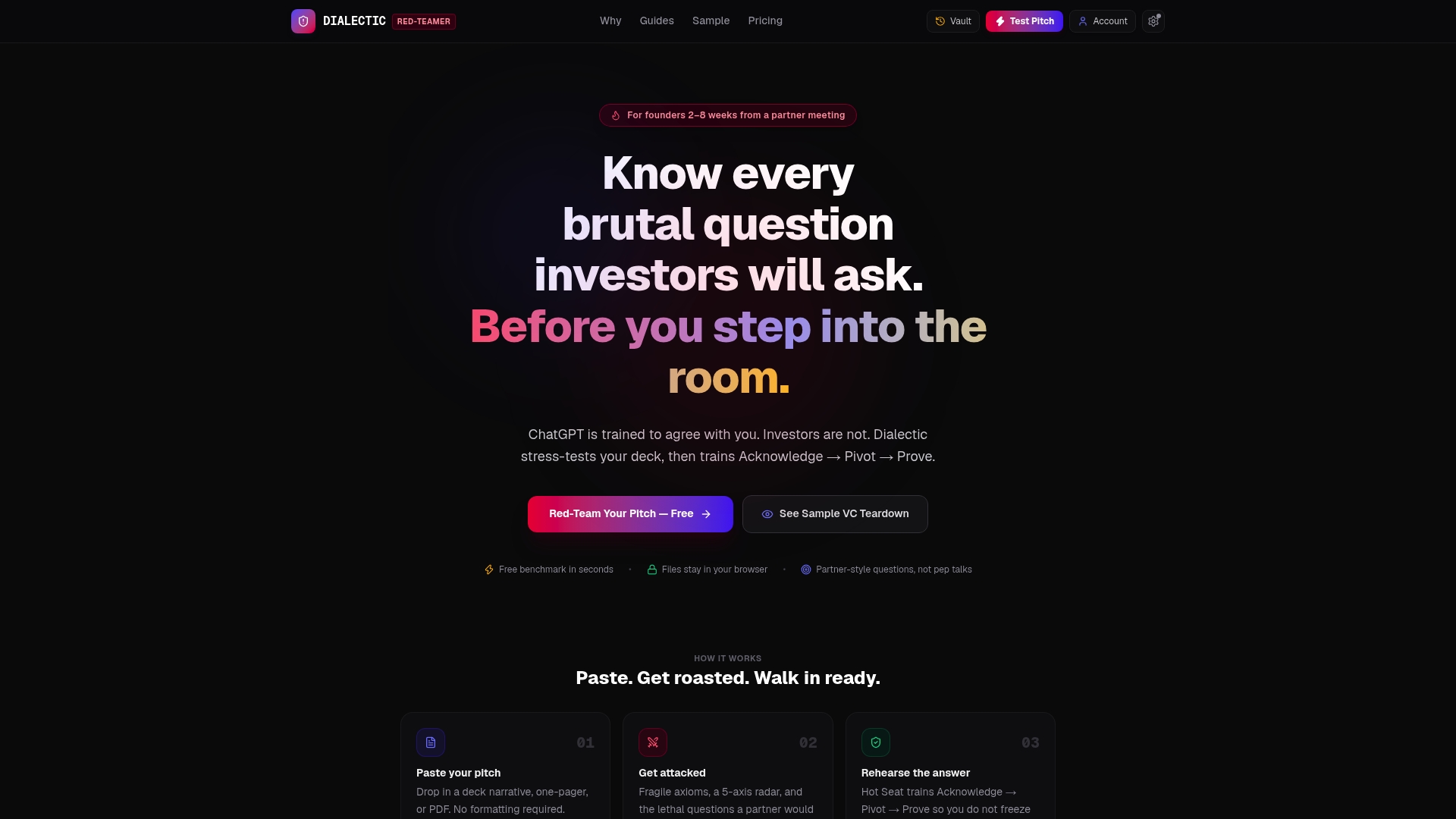
- Our Tactical Audit runs a one-off pitch stress test, flagging fragile assumptions and blind spots before you send a single deck.
- Our Founder Pro plan gives you ongoing rehearsal against tough, realistic investor questions as your pitch evolves.
- See the approach in action on our Nexus Take-Rate Teardown proof page, then start your own audit at Trydialectic.
Fewer fragile assumptions in the room means fewer open questions after it, and a follow-up sequence built around deliverables you already have ready to send.
FAQ
What does "potential investors" mean?
Potential investors are individuals or firms who have not yet committed capital but fit your profile for stage, sector, or check size and could realistically invest. The term covers everyone from a warm introduction you have not yet pitched to a firm actively in diligence on your round.
What is the 10% investor rule?
Confirm the specific definition with your attorney or investor before relying on it in a term sheet.
What is follow-up in a meeting?
Follow-up in a meeting context means the actions taken after a meeting ends to confirm outcomes, deliver promised materials, and move agreed next steps forward. In an investor meeting specifically, that means a prompt thank-you, a recap of key points, and clear next steps with a proposed timeline.
What is the 7 5 3 1 rule in investing?
The phrase mentioned is not a standard, widely documented rule in venture fundraising or investor follow-up practice. If you encountered it in a specific context, check that source directly, since no established definition applies broadly across fundraising.
How soon should I send a thank-you email after an investor meeting?
Send your thank-you, recap, and any requested materials within 24 hours of the meeting, and same day when possible, since partner meetings often produce same-day decisions. Speed signals that you run a disciplined process.