
A useful investor memo critique reads your memo the way a skeptical partner will: hunting for the assumption that breaks the case, not for what is already working. Do it in six passes (thesis, market, differentiation, evidence, financials, ask) and then rehearse the answers out loud. Polite feedback from friends or a supportive AI tool rarely gets you there. Adversarial scrutiny does, and that is what Dialectic is built to apply to a memo or deck before the meeting.
TL;DR
- A founder's investor memo is the document a VC will lean on when writing the internal memo that decides your deal, so every weak claim in yours gets inherited.
- Critique it in six passes: thesis, market size, differentiation, evidence and traction, financials, and the ask with use of funds.
- Name bad news yourself (a churn cohort, a longer sales cycle) with what you changed. Investors treat that as more credible than silence.
- For each claim, find the question behind the question and write the answer before anyone asks.
- Reading your own memo is not enough. Make someone, or something, attack it, then defend it out loud.
Table of Contents
- What an investor memo is, and what "critique" means here
- Why your own read misses the problem
- The six-pass critique
- A quick table: weak signal, what the investor hears, the fix
- Name the bad news before they do
- Find the question behind the question
- Treat diligence like an audit you run first
- From critique to rehearsal
- Perspective: why we built Dialectic around hostile reading
- Where Dialectic fits in your critique
- FAQ
- Sources
What an investor memo is, and what "critique" means here
An investor memo is a written narrative of your company: the problem, the solution, the market, traction, business model, team and risks. Pitch decks rely on visuals and brevity, while memos prioritize narrative depth and logic, which lets an investor judge the opportunity on their own time, before or after a meeting.
It helps to separate two documents that share a name. The first is yours, the founder's memo. The second is the VC's internal investment memo: a comprehensive document prepared by the deal team that serves as the firm's internal case for backing a company. You will rarely see that one, because it is the output of the firm's diligence, not an input to it.
That is why your memo matters so much. The partner who likes you has to carry your story into a room of skeptics. Your memo is the raw material. If it contains a soft assumption, the partner either fixes it for you, privately, or the committee finds it.
A critique, then, is not proofreading. It is a deliberate attempt to break the argument before someone with money on the line does. This guide covers that for the founder: the people building the memo, not the analysts writing the internal version.
Why your own read misses the problem
You wrote it, so you read what you meant. Your co-founders share your assumptions. Friendly advisors want you to feel good. And a general-purpose AI assistant tends to return encouraging notes with a few mild suggestions.
Investors are paid for the opposite instinct. At the firm, the point of a formal memo process is to force independent thinking among partners and reduce groupthink and confirmation bias. In other words, the other side of the table is organized to disagree with you. A critique that only confirms what you believe prepares you for a meeting that will not happen.
Dialectic was built around that gap: it applies partner-style questioning and fragility detection to your pitch deck or memo, rather than supportive feedback. We go deeper on the difference in why ChatGPT won't roast your pitch.
The six-pass critique
Work through the memo in this order. Each pass has one job: find the sentence a skeptical investor would underline.
Pass 1: The thesis
A memo is a thesis, not a report. Practitioners describe the goal as connecting data points to explain why this moment makes the opportunity underpriced. Test yours with one sentence: "This company wins because ___, and it is possible now because ___."
Where it goes wrong:
- The "because" is a feature list, not a reason.
- "Why now" is a trend (AI, remote work) with no mechanism tying it to your company.
- Different sections quietly argue different theses.
A strong founder memo covers an investment thesis, market timing, market sizing, traction, business model, team, and a clear section on risks and mitigations. If any of those is missing, you have found your first gap.
Pass 2: Market size
Top-down numbers ("a $50 billion market, and we only need 1%") are the first thing a partner discounts. The sturdier approach is validating market size bottom-up: how many buyers exist, what each pays, and how many you can realistically reach.
Worked example (illustrative numbers): you sell compliance software to regional credit unions. Write down the count of credit unions you can serve, your realistic annual contract value, and the share you can win in three years. If the result is small, the memo needs a credible expansion path, not a bigger top-down figure. If you cannot state the count of buyers, a partner will notice before you finish the paragraph.

Pass 3: Differentiation
Name the incumbents and the substitutes, including the spreadsheet or the manual process customers use today. Then say plainly why a customer switches. Ask of every claim: would a skeptical buyer agree, and what stops the incumbent from copying it in two quarters?
Warning signs: "no direct competitors," a comparison table where you win every row, and differentiation that depends on being first.
Pass 4: Evidence and traction
Traction claims are where memos are quietly weakest. Check each number for three things:
- Definition. Is "customers" paying accounts, pilots or signed letters of intent?
- Period. Is growth measured month over month from a tiny base?
- Quality. What does retention look like by cohort, not blended?
There is also a timing question. First Round's guidance is to wait to raise until you have hit milestones that represent a real step-change for the company, and it cautions that founders often mistake friendly vibes from investors for serious interest. If your evidence section reads thin, that is useful information about the memo and about the timing.
Pass 5: Financials and unit economics
Investors test projections by asking whether the assumptions are thoughtful and the model supports the story. So lay out the revenue drivers, unit economics, burn, runway and the assumptions behind each, as recommended for testing a financial model.
Consistency is the quiet check. A good forecast model starts with an overview sheet that explains the business in numbers the same way the memo and deck explain it. Cross-check:
- Does the customer count in the model match the memo's traction section?
- Does the gross margin in the model match what you say in the business model section?
- Does the revenue growth assume a sales cycle you have actually observed?
Where an assumption has no evidence behind it, mark it as an assumption and say how you will learn the real number. That is stronger than presenting it as fact.
Pass 6: The ask and use of funds
The ask should explain the milestones the round funds and what the next round will look like. A list of budget categories (engineering 40%, sales 30%) does not do that. A milestone does: "this round takes us from $X to $Y in recurring revenue, which is the threshold the next investor will want."
Check that the runway the round buys reaches those milestones with room to spare. If the money runs out before the evidence arrives, the memo has a hole, however good the product is.
A quick table: weak signal, what the investor hears, the fix
| What your memo says | What an investor hears | Stronger version |
|---|---|---|
| "We have no real competitors" | You have not looked, or the market is not real | Name incumbents and substitutes and say why customers switch |
| "1% of a huge market" | No bottom-up logic | Count buyers, price and reachable share |
| "Growth of 40% month over month" | Tiny base, short window | State the base, the period and cohort retention |
| Risks section is two lines | The founder is hiding something or is blind to it | Name each risk with a specific mitigation |
| "Funds will go to hiring and marketing" | No milestone logic | Tie spend to the milestones the round funds |
Name the bad news before they do
The most counterintuitive part of a good critique is deciding what to volunteer. The advice from practitioners is consistent: name bad news, such as a churn cohort or a longer sales cycle, and explain what happened and what you changed. The same source says the strongest founders give investors the risks themselves, with mitigations attached, before being asked. TechCrunch makes the same point: predicting objections by naming known weaknesses is more credible than hiding them.
A simple format for each risk in the memo:
- The risk, in one plain sentence.
- The evidence that it is real (the cohort, the lost deal, the slipped timeline).
- What you changed.
- What you will measure to know whether the change worked.
If you cannot fill in line 3, you have found a weakness worth fixing before the meeting rather than after.
Find the question behind the question
When an investor asks "How big can this get?", the underlying concern may be whether you can build a venture-scale business or only a good small one. First Round's advice for preparing is to identify the question behind the question, so you address the real concern and not just the literal one.
As you critique, annotate each section with the three hardest questions a partner could ask, and what each is really testing:
| Literal question | Likely underlying concern |
|---|---|
| "Why hasn't a bigger company done this?" | Is the opportunity defensible, or is it a feature? |
| "What happens to CAC at scale?" | Does growth depend on a channel that will saturate? |
| "Who on the team has sold to this buyer?" | Can you actually get distribution? |
| "What if your largest customer leaves?" | How concentrated and fragile is revenue? |
Our guide to VC diligence questions that kill seed rounds goes through the questions that most often end conversations, and the Sand Hill Road pitch standard shows what tier-one US firms expect to see.
Treat diligence like an audit you run first
Codecademy's Zach Sims described the useful mindset: treat diligence like an audit and use it to look at the business from a higher altitude and find areas to improve. The same piece notes that the most valuable investor feedback often comes from people who dig deep into the product and ask hard questions about how it was built.
Apply that to your memo. Run your own audit before theirs: take each claim, ask "what document or data would prove this?", and make sure you can produce it. Founders who have already done this walk into diligence with answers rather than scrambling.
It also pays to pre-write the key sections of the memo an investor would later write about you. Doing so helps investors capture your story and may improve your odds in the fund's internal approval process. Writing in plain language has a side benefit too: it sharpens your thinking, and that skill carries over to recruiting and customer conversations.

From critique to rehearsal
Finding a weakness on paper is half the job. The other half is saying the answer out loud while someone pushes back, because a memo defense fails most often in delivery: the hedging, the pause, the answer to a different question.
A workable rehearsal loop:
- Pick the five weakest points from your critique.
- Write a 30-second answer to each, with one number and one piece of evidence.
- Practice with someone who will interrupt and follow up.
- Rewrite the memo wherever you could not give a clean answer.
- Repeat until the follow-ups stop surprising you.
If the meeting is close, the last-minute VC pitch checklist covers the final 24 hours.
Perspective: why we built Dialectic around hostile reading
We see the same pattern in founder materials again and again. The memo is clear and well written, and it rests on two or three assumptions the founder has never had to defend. Nobody close to the company will press on them, because the people who read the memo first are the ones who want it to be good.
That is the reason Dialectic is designed to behave differently from supportive AI feedback. You upload your pitch deck or memo, and the platform scrutinizes it the way a seasoned VC partner would: it looks for fragile assumptions, blind spots and the questions that sink rounds, then scores fragility and risk and structures the weaknesses so you can fix them in order.
Then comes the part a document review cannot give you. Real-time boardroom rehearsal puts you in front of tough, realistic investor questions, and your defense is graded. We believe the founders who do best are not the ones with the most polished memo. They are the ones who have already heard the hard question and answered it several times.
D
Where Dialectic fits in your critique
If you want the six passes above applied by something designed to be adversarial, upload your memo or deck to Dialectic. It returns structured weaknesses and blind spots, with fragility and risk scoring and actionable feedback, and its boardroom rehearsal lets you practice the defense against partner-style questions.
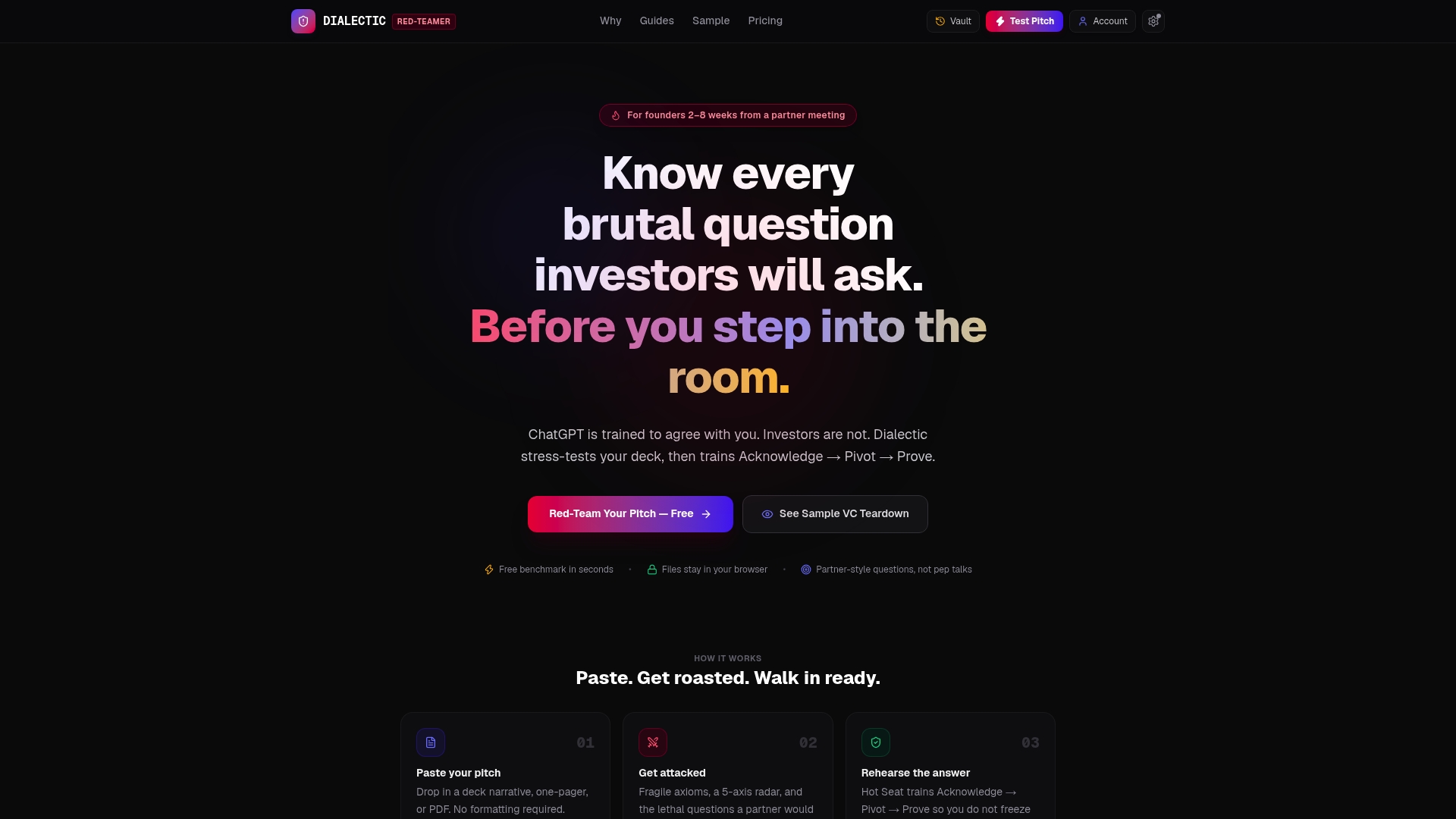
There are three ways to start. The Tactical Audit is $25 per audit, one-off, suited to a single memo before a single meeting. Founder Pro is $49 per month for founders iterating through a raise. Venture & Studio 5 Seats is $149 per month for teams and studios. You can see all three on the Dialectic pricing page. To see how a forensic, memo-level teardown reads, look at the Nexus take-rate teardown, and for the method itself, read our guide to red-teaming your pitch deck.
FAQ
What is the difference between an investor memo and a pitch deck?
A deck is visual and brief, built to open a conversation. A memo is narrative and carries the reasoning, so an investor can judge the logic on their own time. Many investors now ask for one or both, and they should tell the same story with the same numbers.
Should a founder write their own investment memo?
Yes. Writing it forces you to explain the problem, solution, market and go-to-market in plain language, and it lets you control the narrative instead of leaving it to the investor's later internal write-up. The critique passes above are how you make that memo hold up.
How long should my investor memo be?
Long enough to cover thesis, market, traction, business model, team, financials, risks and the ask, and no longer. Clarity matters more than page count: each section should make one argument and support it with evidence you can produce. Cut anything that does not help an investor decide.
Should I really list my risks in the memo?
Yes, with mitigations attached. Naming a churn cohort or a longer sales cycle and explaining what you changed reads as credibility. Investors will find these issues in diligence anyway, so it is better that they hear them from you first.
When is my memo ready to send?
When every major claim has a number and a source behind it, the deck, memo and model tell the same story, and you can answer the hardest follow-up to each section out loud without hedging. If you cannot, fix those first.
Sources
- Investment Memo: Template, Examples, and How to Write One
- Inside the VC Decision-Making Process: What Founders Should Expect
- Investment Decisions at Connect
- VC Investment Memo: What Gets Deals Done
- Series A Investment Memo: A Founder's 12-Section Template
- Pitch Deck vs Investment Memo: A Founder's Guide to the Two
- What the Seed Funding Boom Means for Raising a Series A
- The Pitch You're Not Practicing
- Getting serious about Series B: 3 documents that will help founders control the narrative
- Here's What You Can Really Expect When Pitching Your Seed-Stage Startup
- Zach Sims of Codecademy on Lessons in Raising $12.5 Million
- How VCs make decisions: the IC memo deconstructed
- Why Founders Should Write Memos