
The best investor pitch rehearsal puts you under the same pressure the meeting will: interruptions, skeptical questions, and numbers you have to defend out loud. Design agencies polish slides, and friendly run-throughs build comfort. Neither shows you where your reasoning breaks. Dialectic is built for that gap. You upload your deck or memo, it scrutinizes the pitch the way a seasoned VC partner would, and then you defend your answers in a graded boardroom rehearsal. A Tactical Audit costs $25 per audit.
This guide explains what rehearsal services really offer, how to run a rehearsal that resembles a partner meeting, which questions to drill, and how to turn each session into a better pitch.
TL;DR
- Search results for this topic are mostly deck design shops. A rehearsal is a different job: it tests how you think and answer under pressure, not how your slides look.
- A useful rehearsal is adversarial. It interrupts you, asks questions unrelated to the slide on screen, and keeps pushing on every claim.
- Drill the questions you fear most: market size, retention, acquisition cost, margins, burn, use of funds. For each claim, be ready to say how you know it.
- Record every session and write down what broke, so each rehearsal improves the next.
- Dialectic combines a pitch audit with a real-time boardroom rehearsal and graded defense: $25 per audit, $49 per month for Founder Pro, or $149 per month for the five-seat Venture & Studio plan.
Table of Contents
- What investor pitch rehearsal services actually are
- Why rehearsal beats rereading your deck
- How to run a realistic rehearsal, step by step
- The questions worth drilling
- Finding weak assumptions before an investor does
- Turning feedback into a better pitch
- How to tell you are ready
- Where Dialectic fits: pricing and plans
- Perspective: rehearse against the hardest room you will face
- FAQ
- Sources
What investor pitch rehearsal services actually are
A search for this phrase mostly returns pitch deck design and writing services. Those are real services, and some packages start in the thousands of dollars. They fix how a deck looks and flows. They do not tell you how you sound when a partner says, "Why would this not be a $20M business?"
It helps to separate three kinds of help:
| Type of help | What it improves | What it leaves untested |
|---|---|---|
| Deck design and writing | Visual clarity, story order, slide polish | Your live answers and your reasoning under challenge |
| Friendly run-throughs with peers | Comfort, timing, obvious gaps | Hard objections, since friends tend to be kind |
| Adversarial rehearsal | Weak assumptions, fragile numbers, verbal defense | Nothing in the pitch is exempt from scrutiny |
The third row is what Dialectic does. Its platform takes your pitch deck or memo, applies scrutiny modeled on the lethal questions VC partners ask, scores fragility and risk, lists structured weaknesses and blind spots, and then lets you rehearse your defense in real time with grading. The point is that feedback arrives in the form the investor will deliver it, before the investor does.
If you want the longer argument for why polite feedback falls short, we cover it in why a general chatbot won't roast your pitch.
Why rehearsal beats rereading your deck
A deck is a document. A pitch meeting is a conversation, and it rarely follows your slide order. First Round's account of seed-stage partner meetings says to expect interruptions and questions unrelated to the slide you're presenting, and to practice moving between your key points. You can't practice that by reading slides silently.
Time allocation matters too. In a TechCrunch interview, investor Melissa Bradley suggested that in a 30-minute virtual meeting, about a third of the time goes to the pitch and two-thirds to questions and conversation. If that ratio is anywhere near right, most of your meeting is Q&A, so most of your rehearsal should be Q&A as well.

How to run a realistic rehearsal, step by step
1. Prepare the material the room will probe
Before you rehearse, have the building blocks ready. The Holloway Guide to Venture Capital suggests an outline built around the pain point and solution, the team, the data, and how you get to market. Context Ventures adds that founders should be able to explain their business model, customer pain, go-to-market approach, use of funds, runway, and why now is the right time to raise.
Where it goes wrong: founders prepare the story and skip the numbers behind it. Retention, acquisition cost, and burn are the figures that get probed first.
Where we help: upload your deck or memo to Dialectic and the audit surfaces the weak spots in those claims before you pick which answers to practice.
2. Build short and long versions
Partners may give you five minutes or an hour, and they may cut you off either way. Prepare both a short and a long version, as First Round recommends. Practice the short one until you can deliver it without notes.
Where it goes wrong: the long version becomes the only version, and you lose the thread the moment someone interrupts.
3. Write down the questions you fear most
The Holloway guide recommends writing down the questions you most fear, preparing answers, and giving them to rehearsal participants so they can interrupt your pitch with them. That is the right instinct: your fears are a map of your weak spots.
Where it goes wrong: you only list the questions you already half-answered. The dangerous ones are the questions you have not thought to ask yourself.
Where we help: Dialectic generates the lethal questions from your own material, so the list is not limited to what you already know to fear. Our guide to diligence questions that kill seed rounds shows what those look like.
4. Rehearse out loud under pressure
Silent review does not train your voice, your pacing, or your recovery after a hard question. In Dialectic's boardroom rehearsal, you defend your pitch in real time and your answers are graded. You find out in private which answers wobble.
Where it goes wrong: a friendly audience nods along. Founder Collective suggests setting up two or three dress rehearsals with friendly investors and advisors, treating them seriously, and even rehearsing the logistics, such as talking while connecting a laptop. Those sessions are most valuable after an adversarial run has already exposed what to fix, so the humans spend their time on polish and not on discovering basics.
5. Record it and review it as the investor
Outlander's guidance is to record your pitch and watch it from the investor's side, then fix delivery problems you could not hear while speaking. You can also share the recording for time-stamped comments, which lets more people give more detailed feedback.
Where it goes wrong: founders record once, wince, and never watch again. Watch it with a list: where did you hedge, ramble, or use jargon?
6. Repeat with changes
One rehearsal is a diagnosis. Three are a trend. Change the weakest answer after each session, rehearse again, and see whether the grade moves. That loop is the point of the structured audit: find a fragile assumption, fix it, test it again.
The questions worth drilling
You do not need a list of 100 questions. You need the ones that expose structural problems. A widely circulated investor-question checklist spans market size, customer, timing, retention, growth, competition, acquisition costs, lifetime value, burn, margins, use of funds, risks and milestones. Group them into five clusters and rehearse each cluster out loud:
- Market and customer. Who exactly buys, why now, and what changes about their behavior? Bradley's view, as reported by TechCrunch, is that investor confidence comes more from understanding the market, customer, competition, and changing customer behavior than from huge headline numbers. A top-down market figure with no customer logic behind it is an easy target.
- Traction and retention. What do users do after week one? Which numbers are real, and which are projections?
- Unit economics. Acquisition cost, lifetime value, margins, payback. If you cannot explain how each number was calculated, expect to be asked.
- Competition and moat. Not "we have no competitors," but who a customer uses today and why they would switch.
- The raise. How much, what it buys, what milestones it reaches, and how long the runway lasts.
For the financial side, our teardown of a board memo shows how a forensic CFO-style review picks apart a take-rate assumption. It is a useful picture of how numbers get probed.
Hear the question behind the question
First Round recommends identifying the "question behind the question" and, when useful, asking what underlying concern the investor has. "How big is the market?" often really means "Can this become a venture-scale company?" If you answer the literal question and miss the real one, the partner will ask it again, more sharply.
Say what you don't know
No founder has every answer. The Holloway guide advises answering honestly when you do not know something and explaining how you plan to get the missing signal rather than inventing certainty. Practice that sentence until it sounds calm: "We don't know yet. Here is how we will find out, and by when."
Finding weak assumptions before an investor does
The most useful single question in rehearsal is "How do you know that?" The Holloway guide calls it a central pitch stress test: for each claim, ask what data supports it, including how many people you have spoken to and plan to speak to. If you can't support a claim, rethink it, reword it, or rework it.
A quick way to apply this to your own deck:
- Highlight every number and every superlative ("fastest," "largest," "no one else").
- Next to each, write the source: customer interviews, your own data, a published report.
- Any highlight with no source is a fragile assumption. Either find evidence or soften the claim.
- Rank the fragile ones by how much of your story collapses if they are wrong. Rehearse those first.
Bradley also stresses being transparent about weaknesses and assumptions and showing a mechanism for checking what is and is not working. A founder who names the weak spot first and shows how they are testing it sounds more credible than one who is caught out.
This is where an adversarial audit does the heavy lifting. Dialectic scores fragility and risk across the pitch, then lists the blind spots and tactical pivots that would turn a weakness into a defensible position. You get a ranked list instead of a hunch.
Turning feedback into a better pitch
Feedback only helps if it changes the next session. Three habits make that happen.
Capture questions as they come. Founder Docs recommends recording every investor question and overall feedback, then developing concise answers to recurring questions and addressing important objections in a risks section of the deck. If the same objection appears in rehearsal three times, it belongs in the deck.
Ask passing investors what would have changed their mind. Tuck School of Business at Dartmouth advises that when an investor passes, you ask for feedback right away or send a note asking what three things would have changed their mind. It shows you are coachable and makes it easier to return later.
Seek delivery feedback, not just content feedback. The Holloway guide notes that pitching is a performance rather than a lecture, so ask reviewers about pacing, clarity, and confidence as well as the argument.

How to tell you are ready
Polish is not readiness. A better test: can you move through your material when interrupted, answer your most feared questions without flinching, and support important claims with data? If you do not know something, can you say how you will find out? Those are the Holloway guide's own standards for being ready, and they are behavioral. They only show up when someone is pushing on you.
In practice, you are close when:
- Your graded defense stops improving on the same question because you are answering it well, not because you stopped asking.
- You can give a 30-second, two-minute, and five-minute version without notes.
- Hard questions no longer produce a defensive tone. You acknowledge the concern, answer it, and move on.
- You can explain the raise amount, what it funds, and the milestones it reaches.
The night before, run through our last-minute VC pitch checklist to catch anything that slipped.
Where Dialectic fits: pricing and plans
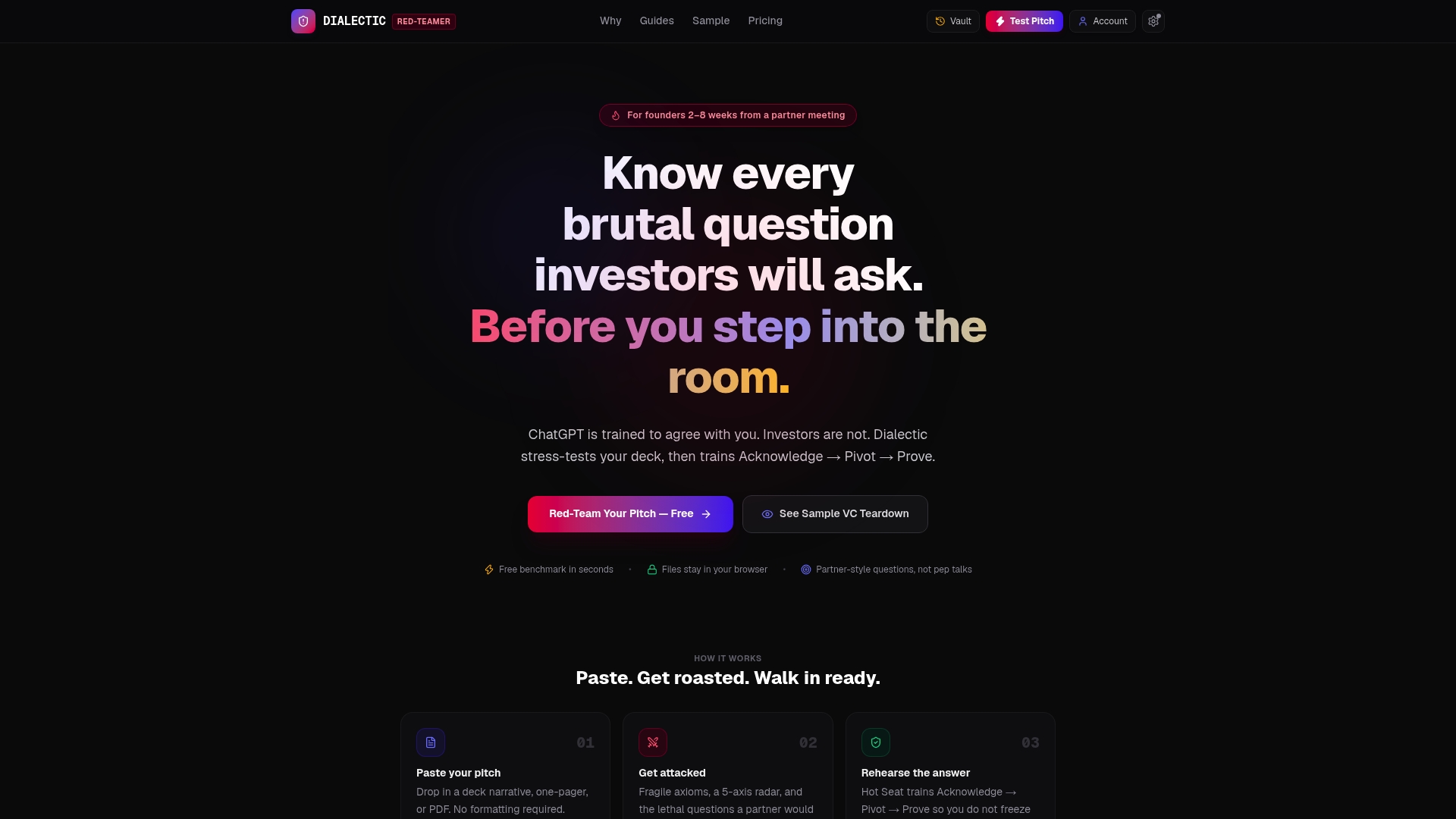
Dialectic is an adversarial pitch deck stress-testing platform. You upload a pitch deck or memo, and the platform applies expert-style scrutiny with the questions partners use to kill deals. It scores fragility and risk, detects weaknesses and blind spots, runs a real-time boardroom rehearsal with graded defense, and gives actionable feedback for improving the pitch. It is built to prepare you for the adversarial reality of VC meetings, not polite critique.
There are three ways to start:
| Option | Price | Good for |
|---|---|---|
| Tactical Audit | $25 one-off per audit | One deck or memo before one meeting |
| Founder Pro | $49 per month | A founder rehearsing and revising throughout a raise |
| Venture & Studio 5 Seats | $149 per month | Teams, venture studios, or several founders sharing one plan |
If you have a meeting coming up, upload your deck for a Tactical Audit and see which questions land hardest. For a closer look at the method, read our guide on red-teaming a pitch deck, or see how a mock VC interview plays out.
If you are pitching tier-one firms, our guide to the Sand Hill Road pitch standard explains what those rooms tend to expect.
Perspective: rehearse against the hardest room you will face
Most founders do not fail a pitch because they lacked a good idea. They fail because one question exposed an assumption they never examined, and they had never said the answer out loud.
That is why we built Dialectic around adversarial, partner-style questioning and fragility detection. Supportive feedback feels good and teaches little. A founder who has already been pushed on their take rate, their retention, and their use of funds walks into the real meeting having heard the worst version of each question.
We think rehearsal should be a loop: audit the deck, find the fragile claims, defend them in a real-time boardroom session, fix what the grade shows, and go again. Each pass turns a weak point into something you can answer with evidence. The goal is not a perfect script. It is a founder who can think clearly when the room turns skeptical.
D
FAQ
What is an investor pitch rehearsal service?
It is a service that helps you practice delivering and defending your pitch before you meet investors. The most useful versions go beyond slide polish: they challenge your claims, ask hard questions, and give feedback on your answers. Dialectic does this through an audit of your deck or memo plus a graded, real-time boardroom rehearsal.
How many times should I rehearse before an investor meeting?
There is no fixed number, but plan on several passes rather than one. Run an adversarial session to find weak spots, fix them, then rehearse again. Founder Collective suggests two or three dress rehearsals with advisors as a baseline. Stop when your answers to the hardest questions are steady and consistent.
How long should my pitch be compared with the Q&A?
Plan for the questions to take more time than the presentation. Investor Melissa Bradley suggested roughly one-third pitch and two-thirds conversation for a 30-minute virtual meeting. Prepare a short version of your pitch so you can get to the discussion quickly.
What should I do if I get a question I can't answer?
Say so, then explain how you will get the answer. The Holloway guide recommends describing how you plan to obtain the missing signal rather than making up certainty. Promise a follow-up and deliver it after the meeting.
How much does Dialectic cost?
A Tactical Audit is $25 per audit. Founder Pro is $49 per month, and Venture & Studio 5 Seats is $149 per month. You can see all three on the Dialectic site.
Sources
- Practicing Your Presentation, The Holloway Guide to Venture Capital
- How to Pitch Your Startup, Context Ventures
- Here's What You Can Really Expect When Pitching Your Seed-Stage Startup, First Round Review
- Founder and investor Melissa Bradley outlines how to nail your virtual pitch meeting, TechCrunch
- A Ridiculously Detailed Fundraising Guide, Founder Collective
- 3 Tips for Perfecting Your Early-stage Pitch, Outlander
- 100 Funding Questions Investors Ask, Lean Case checklist
- Executing the raise: The pitch process, Founder Docs
- How to Make a Successful Startup Pitch, Tuck School of Business at Dartmouth