
A useful mock VC interview is one where the questioner is harder on you than the real investor will be, and where you leave with a short written list of fixes. Friendly practice with a supportive friend feels good and teaches little. The rehearsal that pays off puts your deck and your numbers under adversarial questioning, then makes you defend your answers out loud and fix the weakest ones before the meeting. This guide shows how to run that rehearsal, which questions to drill, and how to read the feedback.
One note on scope: people also search this phrase when they are interviewing for a job at a venture capital firm. This article is for the other side of the table, founders who are about to pitch investors.
TL;DR
- A mock VC interview only works if the questioner attacks your assumptions. Supportive feedback hides the gaps that investors will find.
- Drill five areas: market, traction, business model, the ask and valuation, and risk. Know your numbers cold.
- Expect more of the meeting to be questions than pitch. Practice answering, not just presenting.
- Time every session, record it, and leave with two or three written fixes, then re-run the weakest answers.
- Dialectic stress-tests your deck with partner-style questions and runs a graded boardroom rehearsal, starting at $25 per audit.
Table of Contents
- Why the mock interview matters more than the deck polish
- What a good mock VC interview looks like
- Who should run your mock interview
- The five question areas to drill
- How to run the rehearsal, step by step
- What to do with the feedback
- Why a standard AI chat is not enough
- Where Dialectic fits in your preparation
- Start with an audit or a plan
- Our perspective
- FAQ
- Sources
Why the mock interview matters more than the deck polish
Most founders spend their final week on slides. Investors spend the meeting on questions. Founder and investor Melissa Bradley told TechCrunch that a pitch meeting should be about one-third pitch and two-thirds questions. She also said financials are a set of projections, so investors want to see the strategy behind them, including how you would pivot or recover if the numbers fall short.
That split changes what you should rehearse. A smooth ten-minute presentation is the easy part. The hard part is the next twenty minutes, when someone asks why your customer acquisition cost will fall, what happens if the round only half closes, or why a larger company will not simply copy you.
AWS's seed fundraising guide is blunt about sequence. It tells founders not to pitch until they have completed a mock pitch with at least one VC or angel and one founder. It also tells founders to mark every business risk, write down the questions an investor could ask about each, and prepare the answers.
That is the core idea of a mock interview: you find the holes while it is still cheap to fix them.

What a good mock VC interview looks like
A realistic rehearsal has five features.
- A skeptical questioner. Someone whose job in the room is to find the weak point, not to encourage you.
- Your real material. Your actual deck or memo, your actual model, your actual ask. Generic questions produce generic answers.
- Time pressure. Real investor attention is short. Set a hard stop for the pitch and for the questions.
- Spoken answers. Writing a good answer and saying it under pressure are different skills. Say it out loud, every time.
- A written debrief. Feedback that stays in the room is gone by morning. Write down the few fixes that matter most.
If a session lacks any of these, it is closer to a chat than a rehearsal.
Who should run your mock interview
The best questioner is someone who has written checks or raised venture money, because they know what a real objection sounds like. Experienced founders who have fundraised are the next best choice. If neither is available, a smart, skeptical person with no knowledge of your company is still useful, because they ask the naive questions that expose jargon and unstated assumptions.
Avoid the people who like you most. Co-founders can sit in the room and take turns defending, but they rarely play the hostile investor well, because they already believe the story.
There is a practical limit to this approach. Experienced investors are busy, a favor can be used only a few times, and every person you recruit sees only the version of the deck you showed them. That is the gap an adversarial platform fills: it can question your deck as many times as you need, on your schedule, the night before a meeting if necessary. More on that below.
The five question areas to drill
Investor question lists differ in wording but cover the same ground. Use these five areas as your rehearsal map.
Market
Expect questions about size, timing and your wedge. Forbes' list of 100 investor questions includes "How big is the market opportunity?" and "Why is this the right time?" For pre-seed rounds, Hustle Fund's founder playbook says investors diligence five pillars: team, problem, solution, market and traction. It adds that a strong market answer pairs clear TAM and SAM figures with a wedge into the market, favorable trends and parallels to successful adjacent companies.
The common failure here is a top-down number with no entry point. If your answer is a large percentage of a very large market, expect the follow-up: who buys first, and why?
Traction
Investors want what has actually happened, not what you expect. The same Forbes list asks "How many actual users do you have?" and "What has held back your growth?" Be ready with revenue to date, retention or churn, engagement and the trend behind each. Say plainly what is flat or falling and what you are doing about it.
Business model and unit economics
This is where many decks fall apart under questioning. Forbes' list asks about profit margins and "What pivots have you already made?" Know your customer acquisition cost by channel, the cost of serving a customer, payback period and the scale at which the model turns profitable. If you quote a metric such as MRR (monthly recurring revenue), churn or CAC payback, you should be able to explain how you calculated it without looking at your notes.
The ask and valuation
Stripe's guide for US founders says to know your ask precisely: state the amount, break down the use of funds across product, marketing, hiring and operations, tie the raise to specific milestones, and explain how you reached your valuation. Be ready to discuss burn rate and runway.
It also helps to check your numbers against dilution. A guide to the ask slide gives the formula: ask amount divided by post-money valuation equals the percentage of the company you sell. A $2 million raise at an $8 million pre-money valuation makes a $10 million post-money valuation, so you sell 20%. The same guide says founders typically sell 15% to 25% of the company in an early-stage round and suggests adding a 15% to 20% contingency buffer to the budget when you calculate the ask. If your numbers land far outside that range, an investor will ask why.
Do the arithmetic before the rehearsal. Then practice the questions that follow: what milestone does this money reach, and what happens if you raise less?

Risk
Investors test self-awareness. They want to see that you know what could kill the company before they tell you. A strong risk answer names the risk specifically, says how likely you think it is, and describes what you would do about it. A weak one calls the risk "execution" and moves on.
A useful exercise is to list your five biggest risks the way a skeptical partner would write them, then answer each in thirty seconds. Rho's list of ten pitch question themes is a good check that you have not missed one: market size, product-market fit, business model and pricing, traction, competitive moat, go-to-market, team, runway and burn, use of funds, and exit vision.
How to run the rehearsal, step by step
1. Prepare the material
Have your deck or memo, your financial model and a one-page list of key metrics. Write your likely questions by section, and mark your own weakest slides first. Those are where the investor will go.
2. Set the format
Give the pitch a fixed slot, then run a fixed block of questions, and stop when the clock stops. Short, hard limits train you to prioritize, the same way a real investor's attention forces you to.
3. Make the questioner hostile
Brief them to interrupt, to press on the first vague answer and to ask the follow-up, not just the first question. A real investor rarely accepts a first answer. If your mock questioner does, the rehearsal is too easy.
4. Answer out loud and record it
Record audio or video. You will hear filler words, hedging and answers that run past a minute. Aim for a headline answer you can give in about thirty seconds, with detail available if asked. Do not memorize wording. Memorize the points.
5. Debrief in writing
Immediately afterward, write down the two or three fixes that matter most. Not twenty. Fix them, then run the weakest answers again.
6. Repeat until the last session is clean
The number of sessions matters less than the quality of the final one. If your latest run still has a shaky answer on valuation or unit economics, run another before the real meeting.
What to do with the feedback
Not all feedback deserves action. Sort it into three piles.
- Fatal gaps. An assumption that, if wrong, breaks the business case, such as a retention figure you cannot support or a market size that depends on a single guess. Fix these first.
- Clarity problems. Answers that are right but unclear. Shorten them, lead with the conclusion, and cut jargon.
- Style notes. Pace, filler, body language. Worth fixing, but only after the first two.
If the same question trips you up in two sessions, it will trip you up in the meeting. Treat repeated questions as the real agenda.
One structure helps answers land: pair one macro fact with one micro proof point. Rho's analysis of early-stage questions found winning answers often pair one market statistic with one piece of customer evidence, such as a retention curve. Your market answer might state the size of the problem, then give a specific customer result.
Why a standard AI chat is not enough
Founders often paste a deck into a general chatbot and ask for feedback. It is a fine first read for typos and flow. It tends to be encouraging, though, and encouragement is the opposite of what a mock investor should deliver. We cover that gap in more detail in why a chatbot will not roast your pitch. For the questions that most often sink early rounds, see our guide to VC diligence questions that kill seed rounds.
Where Dialectic fits in your preparation
We built Dialectic for the part of preparation that is hardest to arrange: a questioner who will not go easy on you. You upload your pitch deck or memo, and the platform scrutinizes it the way a seasoned VC partner would. It scores fragility and risk, lists structured weaknesses and blind spots, and gives actionable feedback on what to change.
Then comes the spoken part. In the boardroom rehearsal, you defend your answers in real time and get a graded result, so you practice the exact skill the meeting tests. You can read more about the approach in our AI mock VC interview guide and our overview of how to red-team a pitch deck. To see what a forensic review of a real board memo looks like, read the Nexus take-rate teardown.
If the meeting is tomorrow, the last-minute pitch checklist covers the final 24 hours.
Start with an audit or a plan
The Tactical Audit is $25 one-off per audit, which suits a founder with one deck and one meeting coming up. Founder Pro is $49 per month for founders who iterate across several investor conversations. Venture & Studio 5 Seats is $149 per month for teams and studios that pitch together. You can upload your deck and start on the Dialectic site.
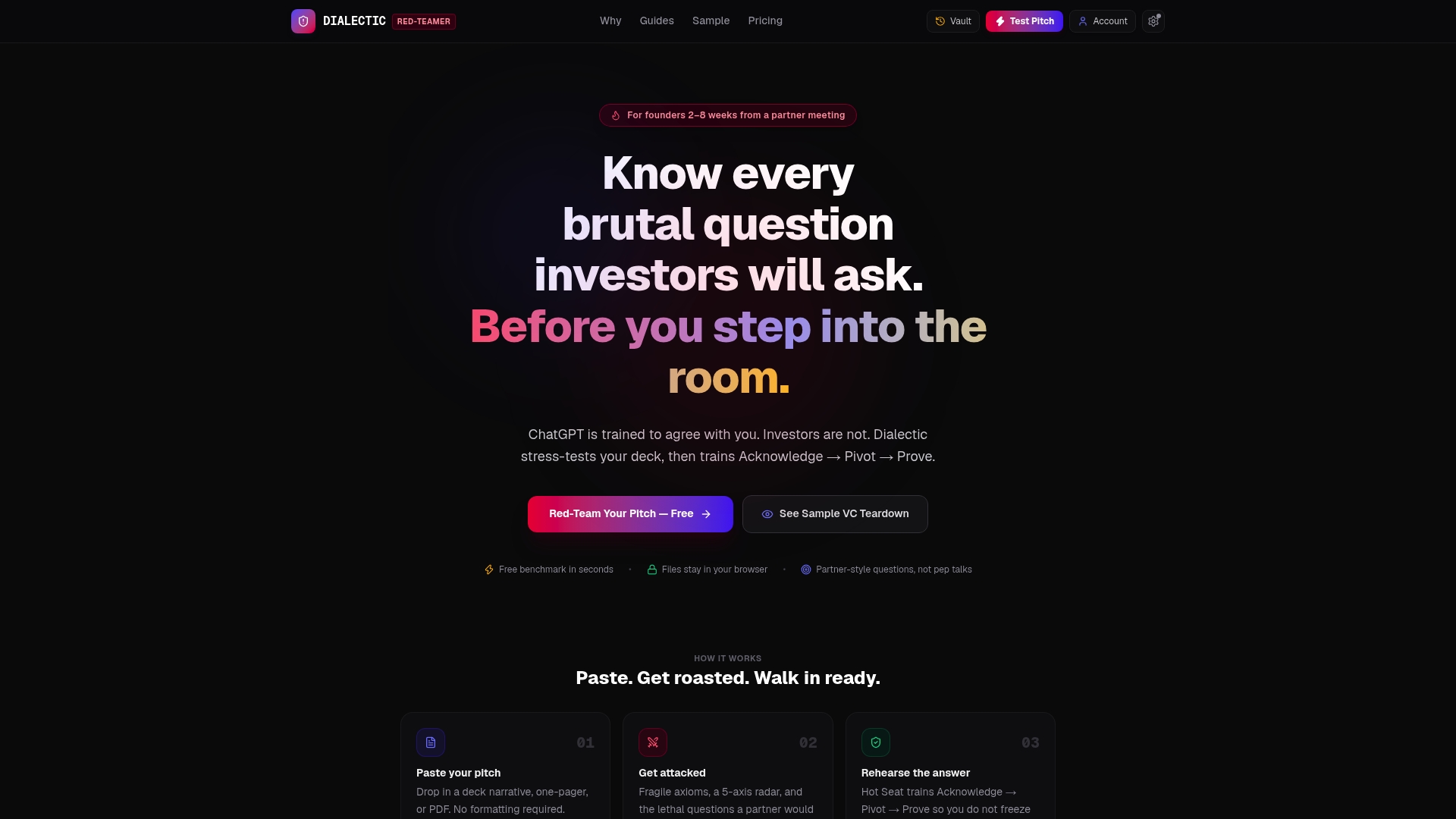
Run the audit first, fix the fatal gaps it finds, and then rehearse your defense in the boardroom before you walk into the meeting.
Our perspective
Most pitch prep fails for the same reason: the people giving feedback want you to feel good. Investors do not. They are paid to find the reason a deal will not work, and they usually find it in the first few minutes.
We think of a mock VC interview as a stress test, not a confidence exercise. The goal is to find the fragile assumption in your deck while you can still change it, and to practice defending the answer until it holds under pressure. That is why Dialectic questions your deck the way a partner would, scores where it is fragile, and makes you answer out loud in a graded rehearsal.
A founder who has already faced the hardest version of the questions walks into the real meeting with fewer surprises. That is the outcome we design for.
D
FAQ
How many mock VC interviews should I do before pitching?
There is no fixed number. What matters is that your most recent session is clean, with no shaky answers on market, unit economics, the ask or risk. If the last run still exposes a weak answer, fix it and run another. Many founders find several sessions, spread over a week or two, enough to settle their answers.
What questions will a VC ask in a pitch meeting?
Expect questions on market size and timing, traction and retention, unit economics, your ask and valuation, competition and risk. Published lists such as Forbes' 100 investor questions show the range. Rehearse the ones your own deck makes obvious, then the ones your numbers make uncomfortable.
Can ChatGPT run a mock investor interview?
It can generate questions and give a first read of your slides. The weakness is tone: general chatbots tend to be supportive rather than adversarial, so they rarely press on the assumption that would end the conversation. For hostile, partner-style questioning of your own deck, use a tool built for it, such as Dialectic.
Should my co-founder be in the mock interview?
Yes, as a participant, not as the questioner. Investors watch how a team splits topics and whether one founder dominates, so rehearse together and agree who owns which subject. Get the skeptical questions from someone outside the company.
How long should a mock VC interview last?
Keep it short and timed. A pitch of a few minutes followed by a block of questions and a hard stop is enough, then spend time on the written debrief. A short, intense session that ends in two or three fixes beats a long, comfortable one.
Sources
- TechCrunch: Melissa Bradley on how to nail your virtual pitch meeting
- AWS: An Insider's Guide to Seed Fundraising, Crafting Your Fundraising Narrative
- Forbes: 100 Questions Investors Will Ask Entrepreneurs Seeking Funding
- Hustle Fund Founder Playbook: Prepping for your first call with a VC
- Stripe: How to Pitch Angel Investors
- Glencoyne: The Ask Slide
- Rho: Master VC Pitch Questions, the CLEAR Framework