
A good pitch deck rehearsal has four parts: a clear structure, a time budget per slide, delivery practice in small chunks, and a mock Q&A where someone attacks your weakest assumptions. Most founders only do the first two. They run the deck top to bottom a few times, feel fine, and then get blindsided at minute 14 by a question about churn. This guide gives you a rehearsal routine you can start tonight, with the research behind each step.
TL;DR
- Open strong and rehearse the first 40 seconds more than anything else. Harvard Innovation Labs says the core message should land early.
- Budget your time: aim to finish in about 80% of the slot, so questions and hiccups don't push you over.
- Practice in chunks (opening, middle, ask), not only full run-throughs, and record yourself to catch filler words and pacing.
- Rehearse the Q&A as seriously as the talk: financial assumptions, traction, and the weak spots you hope nobody notices.
- Have a plan for the question you can't answer. Honesty plus a path to the answer beats a bluff.
Table of Contents
- Start with the structure, then rehearse it
- Build a time budget for every slide
- Practice delivery without reading your slides
- Rehearse in chunks, not only full run-throughs
- Record yourself and review it honestly
- Rehearse the questions that actually decide the meeting
- When you can't answer the question
- Run a realistic mock investor meeting
- Try the rehearsal loop on your own deck
- A one-week rehearsal plan
- FAQ
- Sources
Start with the structure, then rehearse it
Rehearsing a messy story only makes it messy faster. Before you time anything, check that the deck has an arc you can say out loud.
Harvard Innovation Labs recommends opening with your why or relevant experience, introducing the journey and the problem within roughly 40 to 45 seconds, and showing key business-impact metrics early. It also advises practicing the core message within the first 40 seconds. That is a useful rehearsal target: if a stranger can't say what you do and why it matters after your first minute, fix the opening before you polish anything else.
For the overall shape, Stripe Atlas suggests three acts:
- Act I makes the case. What you are building, what it can become, why now, and why you.
- Act II de-risks your approach. Evidence that the plan works and the main risks are handled.
- Act III broadens the case. What success means to you, your investors, and the world.
Stripe also says it spends over half its time on the opening slides, which should convey a unique understanding of the market, an insight, the product or service, and a signal that the approach is working. Take the hint. Your first two or three slides deserve far more rehearsal than slide nine.
A simple structure check before you practice
Say the deck aloud in three sentences, one per act. If you can't, a slide is probably doing two jobs, or none. Cut or merge it now. Rehearsal is the cheapest time to discover that a slide has no point.
Build a time budget for every slide
Running over is the most common avoidable rehearsal failure. Fix it with arithmetic, not hope.
- Know your real slot. One example from the US: the TC Angel Venture Group's presentation guide (May 2017) specifies a 12-minute in-person presentation followed by 12 minutes of investor Q&A, and suggests about 12 slides, or roughly one minute per slide. Your meeting may differ, so ask the investor or the organizer how long you have and whether the time includes questions.
- Plan for 80%. A timed-presentation guide from Stopwatch.now suggests assigning a time budget to each slide by type and planning to use 80% of your allotted time. The remaining 20% absorbs questions, technical delays, and natural variation. In a 30-minute slot, that means a 24-minute talk.
- Expect uneven slides. Title and team slides take seconds. Market, traction, and business model slides take minutes. A flat one-minute-per-slide rule is a starting point, not a law.
- Finish early rather than late. SlidesMate notes that audiences forgive a presentation that ends three minutes early but not one that runs ten minutes long.
A worked example
Say you have a 20-minute slot and 12 slides. Plan for 16 minutes of talking. A budget might look like this:
| Section | Slides | Target time |
|---|---|---|
| Opening: problem and why you | 1 to 3 | 3:30 |
| Product and market | 4 to 6 | 4:00 |
| Traction and business model | 7 to 9 | 5:00 |
| Team, ask, and use of funds | 10 to 12 | 3:30 |
| Buffer | n/a | 4:00 |
Write the target time in your speaker notes next to each slide. During a rehearsal, glance at a clock at the end of each section. If you hit the market slides at minute nine instead of minute seven, you know exactly where to cut.
Practice delivery without reading your slides
Investors can read. If you recite the slide, you have given them a reason to stop listening.
The MIT Communication Lab suggests a simple pattern for each slide: state the key message, point out what the audience should notice, explain why it matters, then transition to the next slide. It also recommends scripting the first and last slides, which helps with nerves and gives you a strong open and close.
Two habits make this work:
- Don't memorize every word. Word-for-word recall tends to sound robotic and falls apart the moment you get interrupted. Write one sentence for each slide transition, a bridge such as "That's the problem; here is who feels it most," and practice those bridges aloud.
- Practice without the slides. The MIT Biological Engineering Communication Lab recommends rehearsing without slides to reduce your dependence on them, and replacing filler words with pauses.
That same MIT page recommends fixing one delivery problem at a time before you combine improvements. If your pace is too fast and you say "um" constantly, work on pace first. Trying to fix everything on one run-through usually fixes nothing.
Why interruptions are a feature
The Holloway Guide makes the point that rehearsal gives you flexibility. Investors will interrupt, and when you know the material cold, you can move around it based on the room's reactions and questions. A founder who has only memorized a linear script has to restart the sentence. A founder who knows the argument can jump to slide 8, answer, and come back.
Rehearse in chunks, not only full run-throughs
A full run-through feels productive, but it spends most of your practice time on parts you already do well. Split the deck into three chunks instead:
- Opening: the first two or three slides.
- Middle: the heavy argument, meaning market, product, traction, and model.
- Closing: the ask, the use of funds, and the summary.
Run the weakest chunk five times, then the next weakest three times, then do one full run to stitch it together. You will notice that the transitions between chunks are where you stumble. Practice those bridges separately.
Chunking also helps if you pitch as a team. Assign each chunk to one speaker, rehearse each handoff, and agree who fields which category of question: product, finance, or go-to-market.

Record yourself and review it honestly
Nothing replaces watching yourself. The MIT Biological Engineering Communication Lab suggests recording five to ten minutes of audio and video and then reviewing pace, clarity, filler words, voice, movement, and whether you look at the screen instead of the audience. Note where your own attention wanders when you watch. If you get bored at slide 6, so will the investor.
Y Combinator gives the same advice for demo day: if you don't have people to practice with, record yourself and watch the recordings, checking whether you speak too loudly, too softly, or too quickly.
A useful review checklist:
- Where did I speed up? (Usually where I'm least sure of the number.)
- Which slide did I read word for word?
- Which sentence made me wince?
- Did I say the ask clearly, with an amount and what it buys?
- Where would a smart stranger get lost?
Write down one fix per recording. Then record again.
Rehearse the questions that actually decide the meeting
The talk gets you into the conversation. The Q&A is where the decision tends to form, and it is the part founders rehearse least. Don't practice the questions you hope to get. Practice the ones that expose the fragile part of the story.
Financial assumptions
Expect investors to pull on any number that drives your forecast. Rehearse answers to:
- How did you get from today's revenue to next year's number? Which assumption matters most?
- What is your customer acquisition cost, and how is it calculated? What does it include?
- What is the payback period, and what happens to it if your main channel gets more expensive?
- How much runway does this raise buy, and what milestone will you hit at the end of it?
- If your growth rate is half the plan, what do you cut first?
The goal is not a perfect answer. It is showing that you know which assumptions are load-bearing and have tested them. If your market size comes from a top-down percentage of a huge industry, rebuild it bottom-up (number of customers times average contract value) before the meeting, and rehearse explaining it in 30 seconds.
Traction
- Is this growth repeatable, or driven by one big customer, one launch, or one channel?
- How many customers churned, and why?
- Who is your best customer, and what do they have in common?
- What changed in the last 90 days?
Have the specific numbers in your head. Hesitating on your own retention figure costs more credibility than a mediocre retention figure.
Business model and defensibility
- Why can't a larger competitor copy this in six months?
- What does gross margin look like at 10 times the scale?
- Who pays, who decides, and who could block the sale?
- What is the take rate or pricing logic, and what stops it from compressing?
If you sell into regulated or security-conscious buyers, add diligence questions about data handling and compliance. Founders who can show a documented compliance audit platform workflow and a clear security posture answer these calmly instead of improvising.
When you can't answer the question
Every founder eventually gets a question they can't answer. How you handle it is itself a data point for the investor. A workable pattern, which we recommend practicing aloud until it feels natural:
- Say what you know. Give the closest fact you do have, even if it is partial.
- Say what you don't. "We haven't measured that yet" is better than a made-up figure that an investor can check later.
- Say how you'll find out. Name the experiment, the data source, or the person, and a timeframe.
- Offer a follow-up. "I'll send you the cohort data tomorrow" turns a gap into a reason to talk again. Then actually send it.
Also practice the harder case: a question that is really an objection. When an investor says "I don't think this market is big enough," don't defend immediately. Restate their concern in your own words, answer the underlying worry with evidence, and check whether you answered it. Rehearsing this with a partner who pushes back twice is far more useful than rehearsing with someone who nods.
Run a realistic mock investor meeting
A friendly audience gives friendly feedback, and friendly feedback is the wrong preparation for a skeptical one. To run a mock meeting that actually helps:
- Pick someone who has seen real pitches. An advisor, an operator who has raised money, or a founder one round ahead of you.
- Set the real clock. Same slot, same split between talk and questions, same screen setup if you can.
- Ask them to interrupt. Tell them to cut in at least three times and to ask the question they would be embarrassed to ask in a real meeting.
- Take notes, don't defend. Rehearsal is for collecting objections, not winning arguments.
- Sort the feedback into three piles: slide changes, answer changes, and delivery changes. Fix the first two before the next rehearsal.
Then repeat. The second mock should show fewer repeat objections. If the same one keeps surfacing, it is not a delivery problem. It is a flaw in the business case, and the deck needs to address it directly.
Our perspective on rehearsal
Most rehearsal advice assumes the audience wants you to succeed. Investors don't owe you that. A partner's job is to find the reason not to invest, and the polite feedback you get from friends, teammates, or a generic AI assistant rarely sounds like that.
That is why we built Dialectic around adversarial, partner-style questioning. We believe the most valuable rehearsal is the one that shows you your fragile assumptions, your blind spots, and the tactical pivots that turn a weakness into a strength, before the meeting and not during it.
In our view, a rehearsal has three jobs: surface the weakest claim in the deck, force a clear answer under pressure, and show you whether the answer improved the next time. Our platform is designed to do exactly that, with scrutiny of an uploaded deck or memo, scoring for fragility and risk, and a real-time boardroom rehearsal where your defense is graded. You can see the style of analysis in our Nexus take-rate teardown, where a forensic CFO red-teams a board memo.
D
Try the rehearsal loop on your own deck
If you want the hard-question part of rehearsal handled for you, Dialectic puts your deck or memo through partner-style scrutiny and tells you where it is fragile. Three ways to start, with prices as published on our site:
- Tactical Audit: $25 per audit, a one-off review of a single deck or memo.
- Founder Pro: $49 per month, for founders who iterate and rehearse repeatedly.
- Venture & Studio 5 Seats: $149 per month, for teams and studios that pitch together.
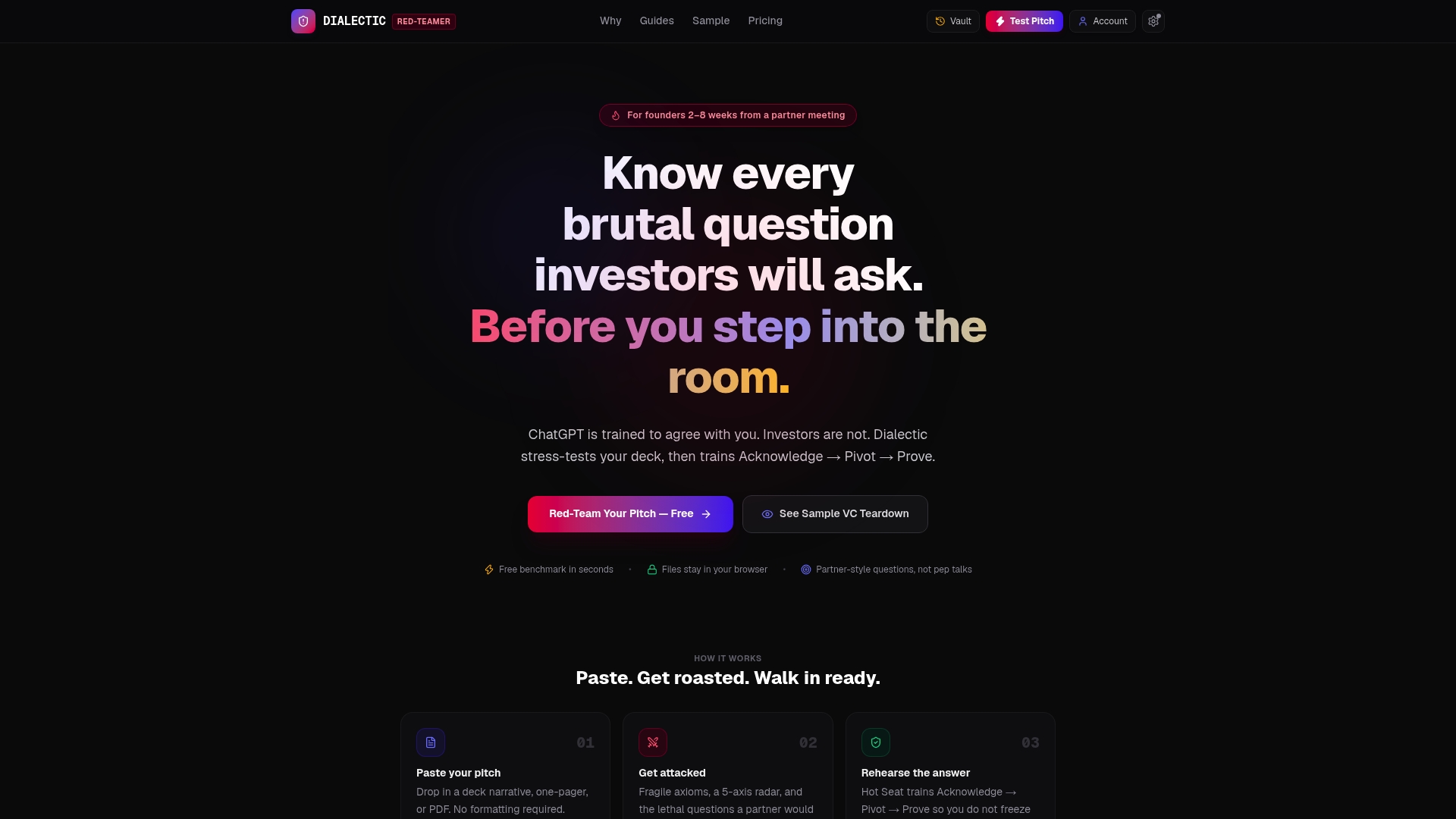
Upload your deck, read the questions it raises, and rehearse your answers against them before a real investor asks.
A one-week rehearsal plan
If your meeting is a week out, here is a schedule that uses everything above.
- Day 1: Fix the structure. Say the three acts in three sentences. Cut slides that do no work. Script the first and last slides.
- Day 2: Set the time budget per slide and write bridge sentences for each transition.
- Day 3: Chunked practice. Drill the weakest section, then the next. Record one full run.
- Day 4: Review the recording. Pick one delivery fix. Draft written answers to your ten hardest questions.
- Day 5: First mock investor meeting with someone who will interrupt. Collect objections.
- Day 6: Revise the deck and answers based on Day 5. Run the full talk without slides once.
- Day 7: Second mock, timed to the real slot. Light run-through of the opening and close only, then stop. Rest matters.
FAQ
How many times should I rehearse a pitch deck?
There is no magic number, but aim for enough repetitions that the opening and the ask feel automatic and you can handle an interruption without losing your place. Most of those reps should be on your weakest chunk and your hardest questions, not on full run-throughs of the parts you already do well.
How long should a pitch deck presentation take?
It depends on the slot you are given. As one US example, a TC Angel Venture Group guide specifies 12 minutes of presentation plus 12 minutes of Q&A. Plan to use about 80% of whatever time you have so questions and delays don't push you over.
Should I memorize my pitch?
No, not word for word. Script the first and last slides, as the MIT Communication Lab suggests, and for the rest memorize the key message and a one-sentence bridge into the next slide. That keeps you flexible when investors interrupt.
What should I do if I don't know the answer to an investor's question?
Say what you do know, state plainly what you haven't measured, explain how you will find out, and offer to follow up. Then send the follow-up promptly. Investors tend to trust a founder who is precise about the edges of their knowledge more than one who bluffs.
Sources
- Incorporate Storytelling Into Your Pitch, Harvard Innovation Labs
- Starting your fundraising pitch deck, Stripe Atlas
- How to Run a Timed Presentation, Stopwatch.now
- TC Angel Venture Group presentation guide (2017)
- How Long Should a Presentation Be?, SlidesMate
- Delivery and Q&A, MIT Communication Lab
- Public Speaking: How to Practice Effectively, MIT Biological Engineering Communication Lab
- Practicing Your Presentation, The Holloway Guide
- A Guide to Demo Day Presentations, Y Combinator
- Guardiso compliance and audit platform