
A pitch deck teardown is a paid, adversarial audit and rehearsal that finds fragile assumptions, scores risk, and trains founders to survive VC-style questioning. It exists for one reason: standard feedback from friends, advisors, or polite AI tools rarely exposes the gaps that kill a deal. If you have investor meetings coming up, a board update to prepare, or unit economics you can't yet defend under pressure, this is the moment to get one.
TL;DR:
- A pitch deck teardown identifies the weakest assumptions and provides a tactical pivot for each, focusing on rapid risk reduction.
- The process includes a fragility map, risk scoring, and a mock investor Q&A to simulate pressure and improve responses.
- Timely booking at least one to two weeks before an investor meeting ensures enough time for revisions and rehearsal.
- The most common flaw revealed is building slides before establishing a clear, logical narrative for claims and counterarguments.
- Adversarial testing is essential for surviving hard investor questions, unlike supportive feedback that often misses critical vulnerabilities.
Table of Contents
- What a teardown delivers: forensic audit, scoring, and rehearsal
- Who benefits and the outcomes a teardown can produce
- Step-by-step teardown process and typical timeline
- Pre-teardown checklist: how to prepare your deck, data room, and team
- From feedback to readiness: rehearsal plan and readiness metrics
- Cost and timing: how teardown pricing is typically structured
- Common mistakes a teardown tends to expose
- Comparing pitch deck teardown services
- Turning teardown feedback into deck revisions
- Why adversarial red-teaming matters more than encouragement
- How to hire Dialectic for a teardown
- FAQ
- Sources
What a teardown delivers: forensic audit, scoring, and rehearsal
A real teardown is not a list of design notes. It is a structured, adversarial process that treats your deck the way a skeptical VC partner would: looking for the claim that collapses under one follow-up question.
The deliverable set typically includes:
- A fragility map that ranks your weakest assumptions and attaches a tactical pivot to each one.
- A risk and assumption score that checks whether every claim has evidence behind it, not just a confident slide.
- A mock investor Q&A, live or recorded, with graded defense and annotated feedback on where your answers held up and where they didn't.
- A breakdown of how your narrative survives interruption, not just how it reads in a quiet room.
This is where adversarial red-teaming diverges from standard feedback. A friendly reviewer tells you the deck "looks strong." An AI writing assistant smooths your language. Neither one asks the question a partner at a term sheet meeting will ask: why won't this work? Dialectic's AI-assisted investor-question simulation is built specifically to surface that question before a real investor does.
Pro Tip: Treat the fragility map as your prep agenda, not a grading report. The weaknesses ranked highest are the ones to rehearse first.
Who benefits and the outcomes a teardown can produce
Not every founder needs this right now. A teardown produces the highest return when the stakes are close and specific.
- You have investor meetings scheduled in the next few weeks and no one has stress-tested your numbers.
- You're prepping for a board meeting where the story has shifted since the last update.
- Your team has pivoted the narrative recently and hasn't pressure-tested the new version.
- Your unit economics or retention assumptions feel soft, and you know it.
The outcomes founders report chasing: fewer moments where a founder freezes on a question, consistent answers across co-founders instead of contradicting each other in the room, a prioritized fix list instead of a vague sense that "something's off," and sharper responses to the exact kind of probing Sequoia says early investors use to test a founder's thinking and self-awareness.
Give yourself at least a week or two of lead time before a real meeting, more if your deck needs structural rework rather than polish.
Step-by-step teardown process and typical timeline
The process runs in three stages, and most services, including Dialectic's, follow a version of this sequence:
- Intake. You upload your deck or memo and complete a short pre-call questionnaire covering your stage, raise size, and known soft spots.
- Analysis. The reviewer gathers evidence against your claims, builds the fragility map, and assigns risk scores to the assumptions that matter most: market size, retention, margins, and competitive defensibility.
- Rehearsal. You run a staged mock Q&A that includes interruptions and follow-up pressure, not just a straight read-through, and your answers get graded.
Turnaround varies by depth:
- A quick audit focused on the deck alone can return a fragility report within a short window, often a day or two.
- A full rehearsal package, including live or recorded Q&A and graded defense, takes longer to schedule because it requires a live session or structured recording review.
Scheduling guidance is simple: book the audit first, leave time to fix the highest-risk items, then book the rehearsal close to your actual investor meeting so the practice is fresh. Teams that compress this into a single rushed session tend to get feedback they don't have time to act on.
Pre-teardown checklist: how to prepare your deck, data room, and team
A teardown is only as useful as what you bring to it. Walking in with a messy deck and an empty data room wastes the session on basic gaps instead of real stress-testing.
Deck hygiene:
- Cut spare slides that don't support a claim you're prepared to defend.
- Write a short, tight script for the live version, not a word-for-word read of the slides.
- Push deep data, cohort tables, and detailed model assumptions into an appendix rather than the core narrative.
Data room must-haves:
- A working financial model with clear assumptions, not just outputs.
- Core KPIs: retention, margins, CAC, payback period.
- Customer proof: logos, testimonials, signed contracts, or usage data.
- Any retention or cohort metrics an investor would ask to see firsthand.
Team prep:
- Decide who attends the real meeting and make sure they rehearse together, not solo.
- Align on consistent answers to the hardest questions so co-founders don't contradict each other.
- Record your dry runs. Watching yourself stumble on a question is more useful than being told you stumbled.
Pro Tip: The most common prep mistake isn't a weak slide. It's a founder who shows up with a strong deck and no rehearsed answer for the one question that actually matters to that investor.
From feedback to readiness: rehearsal plan and readiness metrics
Feedback only helps if it turns into a repeatable rehearsal routine. Here's a practical sequence:
- Cluster the weaknesses. Group fragilities into a handful of Q&A buckets: market size, competition, retention, team risk. Script a one-sentence claim and one-sentence evidence pair for each.
- Run high-fidelity simulations. Practice with real interruptions, hostile follow-ups, and specific traction probes, not a polite walkthrough.
- Track readiness with simple metrics. Grade each run on consistency across speakers, evidence backing each answer, and visible confidence under pressure.
- Iterate. Fix the highest-risk items first, then re-run a focused teardown on just those assumptions rather than redoing the whole deck.
Timing matters as much as content. Techstars recommends having roughly 80% of your fundraising prep, deck and narrative included, done before your first investor meeting, since only 1 to 4% of investor calls typically convert into a check. That low conversion rate is exactly why the rehearsal stage deserves real repetition, not a single pass the night before.
Cost and timing: how teardown pricing is typically structured
Pricing for this category tends to follow one of two models: a flat one-off fee for a single audit, or a recurring plan for founders and teams who expect to revise and rehearse repeatedly across a raise.
A single audit makes sense if you have one meeting coming up and need a focused fragility report plus a rehearsal pass. A subscription makes more sense if you're mid-raise, meeting multiple investors over several weeks, and expect your narrative to keep shifting as you learn what lands and what doesn't.
Timing-wise, a one-off audit can usually be scheduled and returned faster than a full rehearsal package, since the rehearsal stage often requires a live session or a structured recorded review with graded follow-up. If you're on a subscription, you get the flexibility to run a quick re-check after every real investor meeting, which matters because your deck's weak points tend to shift as you get further into a raise.
The practical guidance: book based on how many more investor conversations you expect, not just the one meeting directly ahead. A single audit covers a single event well. A recurring plan covers the actual shape of a raise, which rarely ends after one pitch.

Common mistakes a teardown tends to expose
The same handful of failure patterns show up across most decks, and they're rarely about design.
The most frequent one: founders build slides before they've nailed the story. Techstars advises writing the long-form narrative first and treating the deck as a vessel for that story, not the other way around. Decks built slide-first tend to have claims that don't connect logically from one page to the next, which is exactly where a sharp investor interrupts.
Other patterns a teardown regularly surfaces: a market-size slide with no bottom-up logic behind it, retention numbers presented without the cohort data to back them, a competitive slide that ignores the hardest competitor instead of addressing it directly, and a team slide that states credentials without connecting them to the specific risk the business faces.

A subtler mistake: founders prepare answers for questions they expect, not questions designed to find a reason to say no. Carta's reflection on raising a Series A notes that investors who ultimately invest often ask pointed questions specifically to find reasons not to, and the useful ones are the questions that genuinely reshape strategy. A teardown that only rehearses comfortable questions misses the point entirely.
Comparing pitch deck teardown services
Founders evaluating this category generally run into two kinds of options: broad-feedback platforms that give encouraging, generalized notes, and adversarial services built specifically to find what breaks under pressure.
The first category includes general-purpose AI writing and design tools that can tighten slide copy or suggest layout fixes. They're useful for polish, but they're built to be supportive, not skeptical, so they rarely catch a fragile unit-economics claim or a market-size number with no real basis.
The second category is built around adversarial stress-testing. This service focuses specifically on partner-style questioning and fragility detection rather than generic encouragement. Where other tools smooth your language, this process is built to find the claim that collapses under one follow-up question, score the risk attached to it, and run you through a real-time rehearsal with graded defense. The Nexus Take-Rate Teardown shows this forensic approach applied to a board memo by a CFO, which gives a concrete sense of how granular the scrutiny gets.
If your goal is polish, a general feedback tool is fine. If your goal is surviving a room full of partners who are actively looking for a reason to pass, you want the adversarial version.
Turning teardown feedback into deck revisions
Feedback is only valuable once it changes the actual deck and the actual script. A few practical rules keep that process from stalling.
Fix the highest-risk fragilities first. A teardown usually ranks weaknesses by how likely they are to sink a meeting, and it's tempting to start with the easiest fix instead of the most dangerous one. Resist that.
Rewrite, don't patch. If a slide's underlying claim is weak, a new chart won't save it. Go back to the narrative-first approach Techstars recommends: get the sentence right before you touch the slide.
Keep one evidence source per claim. Every revised claim should have a single, specific piece of backup, whether that's a cohort table, a signed contract, or a model assumption you can defend out loud, not a vague reference to "the data."
Re-test narrow, not wide. Once you've revised the riskiest two or three slides, run a focused follow-up pass on just those sections rather than redoing the entire rehearsal. It's faster, and it tells you quickly whether the fix actually holds up under a real follow-up question.
Why adversarial red-teaming matters more than encouragement
Most founders don't fail investor meetings because their deck looks bad. They fail because no one before that moment asked the question designed to find the weak point, the way a partner evaluating a term sheet will.
That's the gap adversarial red-teaming closes. An approach built around partner-style scrutiny rather than supportive notes exposes assumptions a friendly reviewer would wave through. The Nexus Take-Rate Teardown is worth reading as an applied example: a forensic CFO red-teaming a board memo line by line, which is close to what a real diligence process looks like once you're past the first meeting.
The founders who handle hard questions well aren't naturally unflappable. They've simply been asked the hard question before, in a lower-stakes room.
— D
How to hire Dialectic for a teardown
If you've read this far, you likely know which gap you're trying to close: a single meeting to prepare for, or a longer raise with a team that needs to stay consistent across many conversations.
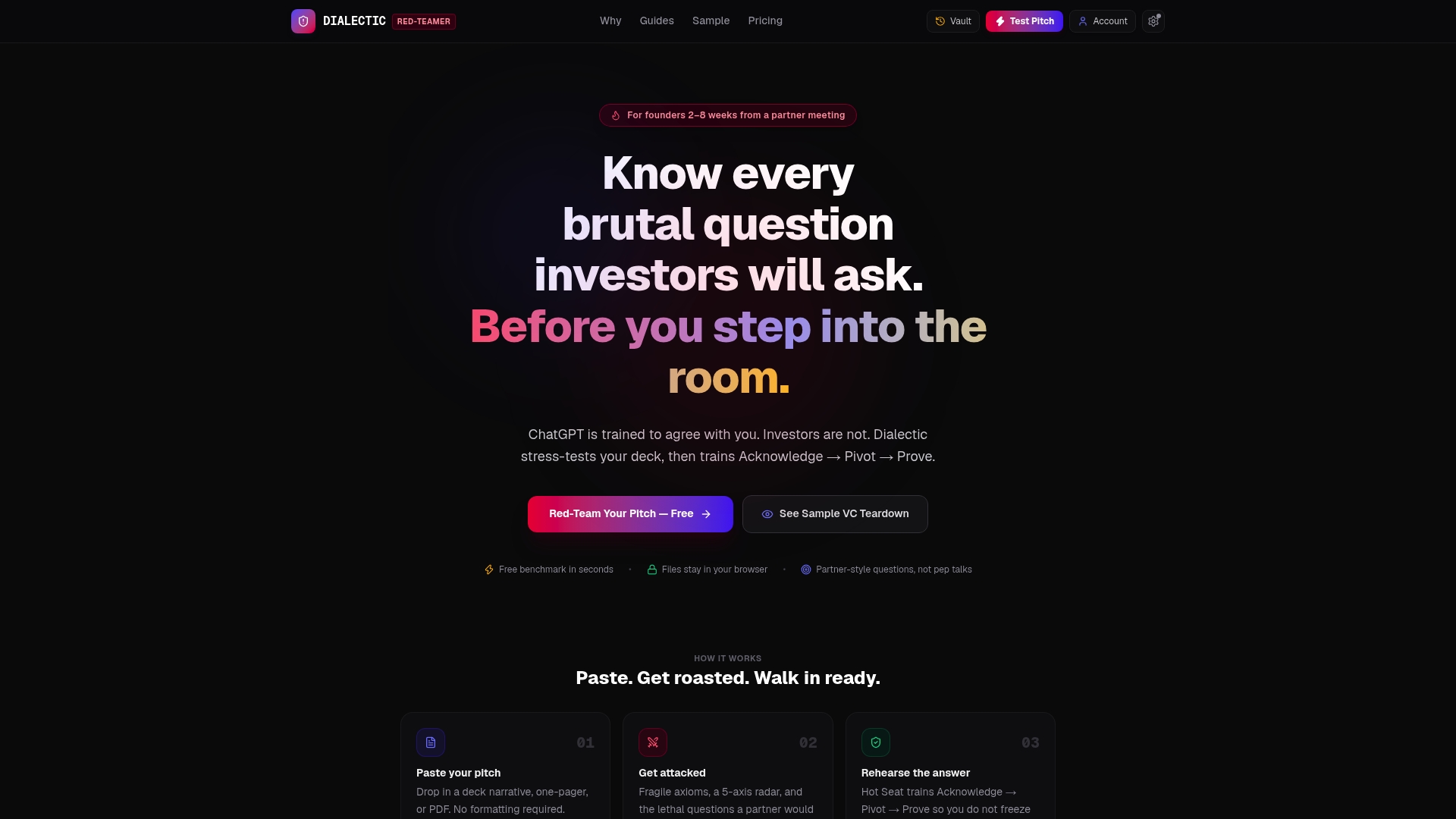
We offer three ways in, depending on where you are:
- Tactical Audit (one-off fee per audit): a single, focused fragility and risk report for founders with one upcoming meeting to prepare for.
- Founder Pro (monthly plan): ongoing access for founders mid-raise who expect their deck and answers to keep evolving.
- Team plans available for ventures or studios running multiple founders or portfolio companies through rehearsal at once.
Start with the Tactical Audit, Founder Pro, or team plan that matches your timeline, and look at the Nexus Take-Rate Teardown first if you want to see the depth of scrutiny before you commit.
FAQ
What exactly happens during a pitch deck teardown?
You upload your deck or memo, complete a short questionnaire, and then go through an analysis stage where a reviewer maps fragile assumptions and scores risk. That's followed by a rehearsal stage with mock investor questions and graded feedback on your answers.
How is this different from asking a mentor or advisor for feedback?
A mentor tends to give supportive, general notes aimed at making you feel more confident. An adversarial teardown is built to find the specific claim that would collapse under a skeptical investor's follow-up question, which is a different and more uncomfortable kind of feedback.
How much does a pitch deck teardown cost?
Pricing in this category is commonly structured as either a one-off audit fee or a recurring plan. Dialectic's Tactical Audit runs $25 per audit, while ongoing plans like Founder Pro start at $49 per month for individual founders or $149 per month for teams.
How soon before an investor meeting should I book one?
Give yourself at least a week or two, since you'll need time to revise and rehearse after the audit, not just read the report. Techstars recommends having roughly 80% of your fundraising prep done before the first meeting, and a teardown fits squarely in that preparation window.
Can a teardown actually improve my odds with investors?
It can't guarantee an outcome, but it directly targets the mechanics behind rejection: unanswerable questions, inconsistent answers across co-founders, and unaddressed weak assumptions. Given that only 1 to 4% of investor calls typically convert into a check, closing even a few of those gaps is a meaningful edge.
Sources
- Inside a Techstars Accelerator: Fundraising and the Investor Process | Techstars
- Talking seed with Sequoia | Sequoia
- How we raised our Series A | Carta