
A pitch narrative arc is the path your pitch takes from the world as it is, through a problem that matters and a solution that works, to a specific ask. Each part has to be finished before the next begins, and the sequence should leave an investor with one conclusion: this is worth funding now. This guide shows how the classic story stages map onto a startup deck, what each beat has to prove, where arcs break, and how to pressure-test yours before the meeting.
TL;DR
- A narrative arc is not decoration. It is the order in which you earn belief: problem, solution, evidence, ask.
- The five classic story stages (exposition, rising action, climax, falling action, resolution) map cleanly onto a deck if you treat the climax as your proof.
- Finish each section before moving on. Stanford's pitch lecture is explicit about this.
- Most arcs fail at the same spots: a problem nobody feels, a solution that arrives too early, and an ask that is not tied to a milestone.
- Test the arc against hostile questions before you present it. A story that survives skeptical questioning is a story you can trust.
Table of Contents
- What a pitch narrative arc actually is
- The five classic stages, mapped to a pitch
- A startup arc, beat by beat
- A worked example: rewriting a feature-first opening
- Where pitch arcs break
- Test the arc before the room does
- Our perspective: a story is only as strong as its weakest assumption
- Stress-test your own pitch narrative
- FAQ
- Sources
What a pitch narrative arc actually is
In writing training, a narrative arc is described as the path a story takes from beginning through middle to end, usually with circumstances changing people's perspectives or people taking action to change a situation. That definition translates directly to fundraising. Your investor starts with one view of the market. By the end of the pitch, you want that view to have shifted, and you want them to see a specific action (funding your company) as the logical next step.
That is why a pitch arc differs from a list of facts. A deck with a market-size slide, a product slide and a team slide contains information. An arc gives the information an order and a purpose: the problem creates tension, the solution relieves it, the evidence shows the relief is real, and the ask offers the investor a role in what happens next.
There is also a practical reason to think in arcs. Investors see many decks in a week. A deck that follows a recognizable progression is easier to follow, easier to repeat to a partner who was not in the room, and easier to compare against what they already believe. The arc does the work of making your argument portable.
One distinction matters early. An investor deck is, in First Round's words, a high-level narrative arc meant to build belief in the market, team and timing. Marketing copy for customers has a narrower job: speak to an immediate need. Do not reuse one for the other. The deck sells a trajectory; the website sells a fix.

The five classic stages, mapped to a pitch
Literature courses describe five traditional stages of a story arc: exposition, rising action, climax, falling action and denouement (resolution). Exposition establishes the world, rising action intensifies conflict, the climax turns the story, falling action releases tension, and the resolution loosens the central conflict. Oregon State's literary-terms guide offers a related five-act version in which a protagonist enters events, commits to a new environment, makes a consequential discovery, faces a crisis and confronts opposition before resolution.
These were built for fiction, so use them as a scaffold, not a script. Here is one way to map them onto a startup pitch:
| Story stage | Job in the story | Pitch equivalent | What the investor should think |
|---|---|---|---|
| Exposition | Establish the world and who lives in it | Who the customer is and how they cope today | "I understand this market." |
| Rising action | Intensify the conflict | The problem, its cost, why existing options fail, why now | "This hurts, and it is getting worse." |
| Climax | The turning point | Your solution, plus the proof that it works (demo, traction, pilots) | "This is real." |
| Falling action | Tension releases | Business model, go-to-market, why you win against alternatives | "This can become a business." |
| Resolution | The central conflict is settled | The ask, the milestone it funds, and the future state | "I know what my money does." |
The table shows one non-obvious point. In fiction, the climax is where the story turns. In a pitch, the turn should be evidence, not assertion. If your solution slide is the most dramatic moment but the proof comes three slides later, the investor spends those slides doubting you.
A startup arc, beat by beat
Stanford's startup course lecture gives a full pitch structure that follows the same progression: introduction, problem, solution, market, business model, go-to-market, competition, traction, team, and funding ask. For a short pitch, the same lecture compresses it to Problem, Solution and Evidence, and says not to move to the next part until the previous one is complete. That single rule is the most useful sentence in this guide. Here is how to apply it to each beat.
Beat 1: The opening, who and what
Open with the customer, not with yourself. One or two sentences should name who has the problem and what they are trying to do. If you cannot describe the customer in plain words, the investor will not be able to either.
Keep the introduction short. Its only job is to give the problem somewhere to land. Founders who spend a minute on company history before the problem appears are spending the investor's attention on exposition that does not yet matter.
Beat 2: The problem, made felt
Stanford's guidance for the problem slide is to describe the target customer's problem and make the audience feel it, using statistics or examples to show how significant it is. Both halves count. A statistic without a person is abstract. A person without a statistic is an anecdote.
A reliable pattern is one concrete example followed by one number that shows how common it is. The example creates the tension; the number tells the investor the tension is not a one-off. Then say what the problem costs: time, money, risk or lost revenue. A problem with a visible cost raises the stakes, and stakes are what turn a description into rising action.
If you need to explain why this problem is unsolved, do it here, in one beat. Why do current options fall short? Why is now different? Keep that answer specific. "Legacy tools are clunky" does not move anyone.
Beat 3: The solution, as a direct answer
The solution should read as the answer to the exact problem you just described. Use the same words. If the problem was "finance teams reconcile three systems by hand every month," the solution begins with what happens to that reconciliation. Do not jump to features. Describe the change in the customer's world.
A demo or a screenshot helps, but only if it shows the change. A tour of settings pages is not part of the story.
Beat 4: The evidence, where the arc turns
This is your climax. The Stanford lecture asks for evidence for why the solution and the team are right, including defensibility and traction. What counts as evidence depends on your stage:
- Pre-product: customer interviews, waitlists, letters of intent, a prototype and what it taught you.
- Early product: pilot results, retention, usage that grows without pushing, a few named customers.
- Revenue: growth, margins, payback period, expansion within accounts.
First Round's Verkada case study shows how far early evidence can go without revenue. The founders validated their camera hypothesis by building about 100 Raspberry Pi prototypes, handing them to friends and businesses, and learning about streaming, connectivity and product requirements. The lesson for your arc: evidence is anything that shows you tested the idea against reality and learned something specific.
Beat 5: Market, business model and go-to-market
Once the investor believes the product works, the story moves into falling action: tension releases, and the question changes from "is it real?" to "how big, and how does it make money?" Stanford's outline puts market, business model and go-to-market here, and its guidance includes explaining pricing and revenue streams.
Tie these slides back to the beginning. Start the market sizing from the customer you introduced in Beat 1 and count up from there. Show how the first customers turn into the next hundred. Explain the pricing in the same units the customer uses to think about the cost of the problem. A reader who sees the arc of the business, not just a number, will trust the number more.
This is also the part of the pitch where the assumptions are most exposed. We come back to that below.
Beat 6: Competition and team
Handle competition as part of the story, not as a defensive appendix. Name the real alternatives, including doing nothing, and say why customers would switch. Then use the team slide to answer one question: why are these people the ones to do it? Link each credential to something in the arc. A founder who lived the problem, an engineer who built the hard part, an operator who has sold into this buyer.
Beat 7: The ask, the resolution
The Stanford lecture closes with the funding amount and the milestone it will reach. This is your resolution, and it should feel inevitable. State how much you are raising, what it buys over what period, and what will be true at the end that is not true today. A milestone gives the investor something to evaluate. "Eighteen months of runway" gives them only a duration.
End on the future state, not on a thank-you slide. The last thing the investor hears should be what the world looks like if this works.
A worked example: rewriting a feature-first opening
The following is an illustrative example, not a real company. Imagine a startup that sells scheduling software to home-care agencies.
Feature-first opening: "Our platform uses machine learning to optimize caregiver schedules, with real-time shift swaps and compliance tracking."
Story-first opening: "A home-care agency with 80 caregivers builds next week's schedule by hand, on Thursday night, from phone calls and text messages. Every no-show means the coordinator starts over, and a missed visit can mean a client goes without care. Agencies tell us they lose their best caregivers to the chaos. We replaced the Thursday-night scramble with a schedule that rebuilds itself when someone cancels."
The second version has a customer, a conflict, stakes and a turn, all in about 70 words. The features still appear later, when the investor already knows why they matter. Notice that the claim "agencies tell us" would have to be backed by real interviews in a real deck. A story-first opening makes stronger promises, so it needs stronger evidence behind it.
Where pitch arcs break
Most weak arcs fail in a few predictable places.
The investor never feels the problem. If the problem slide is a market statistic with no customer in it, nothing has been put at risk. Stanford's advice to make the audience feel the problem is the fix.
The solution arrives before the problem is finished. Founders who love their product reveal it on slide two. The investor then evaluates a solution to a problem they have not yet accepted. Finish the section before you move on.
Slides without a purpose. Every slide should move the argument forward. A slide that exists because "decks usually have one" interrupts the arc. Cut it or fold it into a neighbor.
Evidence that comes late or thin. If the proof of your climax is a single logo or a vague "strong interest," the story turns on nothing.
An ask with no milestone. A raise without a defined result leaves the resolution open. Investors then supply their own milestone, and it is rarely the generous one.
Using the investor narrative everywhere. As First Round notes, early marketing should hook people with customer pain, assume zero context, and focus on beachhead users rather than the total market, proving claims with real quotes, traction and team credibility. The investor deck's wide-angle arc is a different document.
If you want a second view on the logical flow of the whole presentation, this overview of the logical flow of a presentation is a helpful companion when you are deciding what order your sections should follow.

Test the arc before the room does
A clean arc reads well on paper. The real test is what happens when someone interrupts it. A partner will ask about the weakest link in the chain, and the arc only holds if each beat survives a hostile question.
Try this before any investor meeting:
- Write the one-sentence claim for each beat. Problem: who loses what. Solution: what changes. Evidence: what you tested and learned. Ask: how much, for what milestone.
- For each sentence, write the hardest question a skeptical investor would ask. "Why hasn't a larger company solved this?" "What happens to your margins at ten times the volume?" "Is that retention number from paying customers?"
- Answer aloud, in under 45 seconds. If you need a paragraph of qualifications, the beat is not finished.
- Find the assumption each answer depends on. Those assumptions are where the story is fragile. Mark them.
- Fix the fragile beat or reorder the arc. Sometimes the fix is more evidence. Sometimes it is moving a claim later, until you have earned it.
- Rehearse the full pitch with interruptions. Ask a colleague to cut in at random and make you return to your place in the arc.
Our perspective: a story is only as strong as its weakest assumption
We built Dialectic around one observation: founders rarely lose a round because the story was dull. They lose it because one assumption under the story gave way when a partner pushed on it.
Supportive feedback is pleasant, and it is the wrong preparation. A friendly reader tells you the narrative flows. A partner asks whether the take rate holds, whether the market is reachable by your first channel, and what happens if your one big customer leaves. If the arc cannot answer those, the arc is a draft.
That is why our approach is adversarial by design. You upload a deck or memo, and we scrutinize it the way a seasoned VC partner would: fragility and risk scoring, a structured list of weaknesses and blind spots, and the tactical pivots that can turn a weak point into a strong one. Then you can rehearse in a real-time boardroom session where your defense is graded.
We think the narrative arc and the stress test belong together. The arc tells you in what order to make your case. The stress test tells you which parts of that case will not bear weight. Founders who run both walk into the meeting having already heard the hard questions once.
D
Stress-test your own pitch narrative
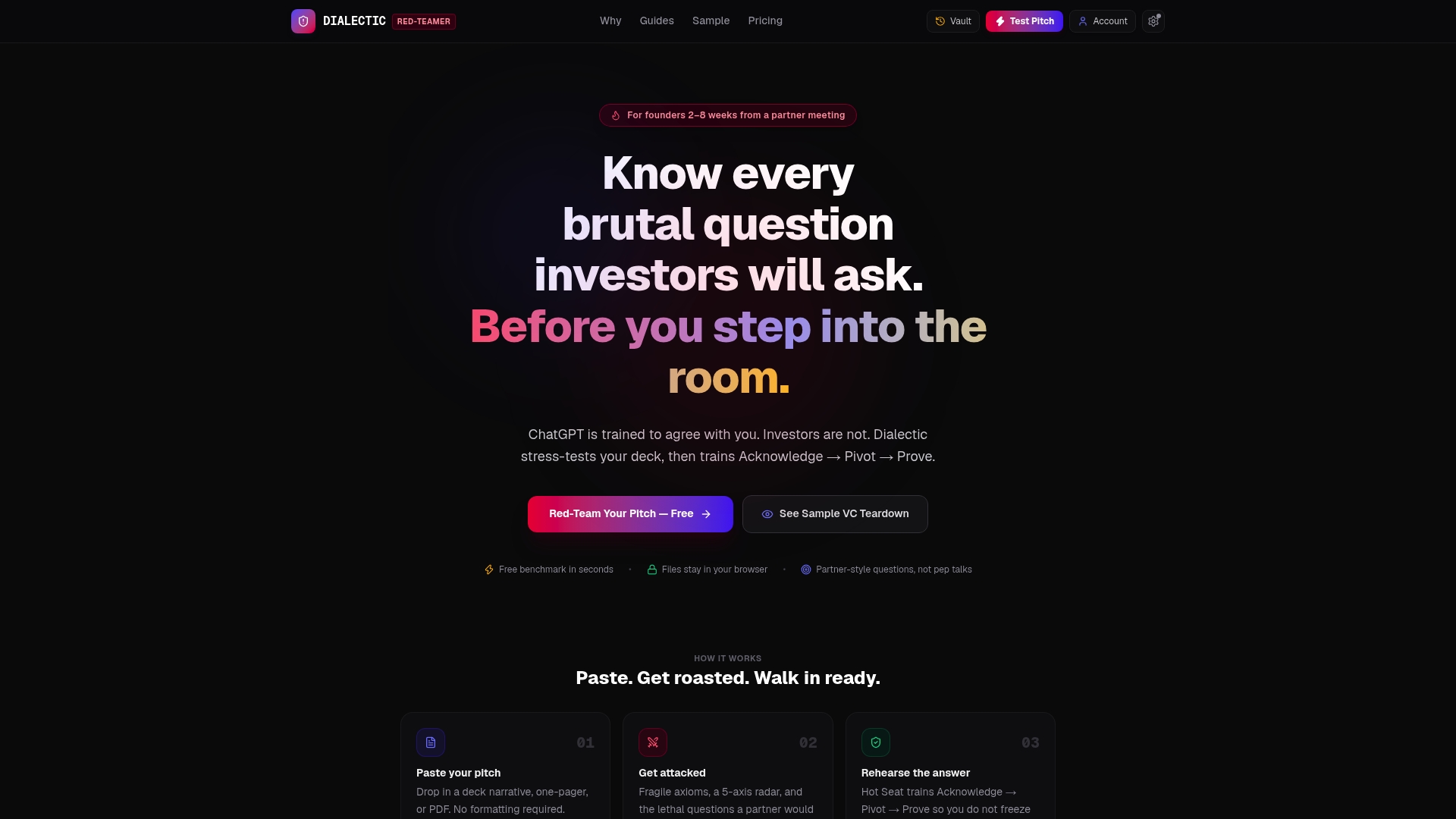
If your arc is drafted and you want to see where it cracks, upload the deck or memo to Dialectic and let it question the story the way a VC partner would. You get a fragility and risk score, a structured list of weaknesses and blind spots, and the chance to rehearse your defense against tough questions.
The Tactical Audit is $25 per audit, a one-off purchase for a single deck. Founder Pro is $49 per month for founders who iterate on their pitch repeatedly, and Venture & Studio with 5 seats is $149 per month for teams. See the plans on Dialectic or look at how a forensic CFO red-teams a board memo in the Nexus take-rate teardown to see what the scrutiny looks like in practice.
FAQ
What is a narrative pitch?
A narrative pitch presents your idea as a story with a beginning, middle and end rather than a list of facts. It moves the audience from a problem, through a solution and its proof, to a specific action. The path from beginning through middle to end, with something changing along the way, is what makes it a narrative.
What are the 5 stages of a story arc?
The five stages are exposition, rising action, climax, falling action and resolution (denouement). In a startup pitch, exposition is the customer and context, rising action is the problem, the climax is your solution and its evidence, falling action is the business model and market, and the resolution is the ask and milestone.
How many slides should a pitch arc have?
There is no single correct count, and the research behind this guide does not set one. Stanford's full outline has ten parts: introduction, problem, solution, market, business model, go-to-market, competition, traction, team and ask. Use that as the skeleton and give each part as many slides as it needs to be finished, and no more.
Should I tell the same story to every investor?
Keep the arc the same and adjust the emphasis. The order of problem, solution, evidence and ask should not change, but you can spend more time on the beats a particular investor cares about, such as go-to-market for a growth-focused fund or technical proof for a deep-tech one. Rehearse the variations so the arc still holds when you shift weight.
Sources
- Public Writing Training: How to Write a Pitch, SAPIENS
- Elements of Fiction, Lumen Learning (Literature for the Humanities)
- What is a Narrative Arc? Oregon State Guide to Literary Terms
- Giving a Great Pitch, Stanford CS224G lecture, 2025
- Verkada, First Round
- Don't Ship Your Pitch Deck to Your Website, First Round Review