
A good pivot story answers three questions in under two minutes: what you learned, what you changed because of it, and what proof shows the new direction is working. Investors do not punish a pivot. They punish a founder who cannot explain one with evidence, who hides what happened to earlier traction, or who gets defensive when asked about runway. This guide shows how to build the story, what to put behind it, and how to rehearse it until the hardest questions feel routine.
TL;DR
- Tell the pivot as a sequence: the signal you saw, the decision you made, the evidence since, and the path from here.
- Name the market signal that triggered the change. Investors will ask for it, and a vague answer reads as drift.
- Say what you kept (technology, customers, team, data) and what you dropped, with numbers where you have them.
- Be direct about previous investors, runway and old metrics. Do not make the new story depend on hiding the old one.
- Rehearse against hostile questions before the meeting, not during it.
Table of Contents
- What counts as a pivot, and when you owe investors an explanation
- The structure of a credible pivot story
- The evidence that should sit behind the new direction
- Talking about traction, revenue, runway and earlier investors
- The tough questions investors ask about a pivot
- Our perspective
- How to rehearse the story and prove the new strategy works
- Stress-test your pivot story before the meeting
- FAQ
- Sources
What counts as a pivot, and when you owe investors an explanation
A pivot is rarely one dramatic night. Academic research describes it as a strategic reorientation that builds up through a series of smaller decisions to exit or add strategy elements, reallocating resources and attention to deal with ongoing problems and opportunities. That definition is useful because it tells you what investors will test: not whether you changed, but whether the changes were deliberate and connected.
You owe an explanation whenever the change touches something an investor priced in. That usually means one of these:
- Your customer changed (for example, from consumers to small businesses).
- Your core problem changed, so the product's job changed.
- Your business model changed (from services to software, from one-off to subscription).
- Your market changed, and the old one no longer supports the company you want to build.
A feature rework or a new pricing page is not a pivot story. If a new investor would not notice it in your deck, it does not need a section in your pitch.
The structure of a credible pivot story
The strongest pivot stories are short and ordered. One communication framework describes a "From-To" message: acknowledge reality, explain the strategic reason, show evidence from pilots or data, and lay out the way forward. Adapted for an investor meeting, it becomes five beats.
1. State what was true before
One or two sentences on the original thesis and what you built. Do not apologize and do not spend a slide on it. Another founder-facing guide on explaining a SaaS pivot advises connecting the new direction to dated records of the old one, which is good practice in a pitch too: the old thesis was real, and here is what the records show.
2. Name the signal
This is the part that separates a pivot from a panic. Investors want to know what specific signal triggered the change, whether customer feedback, usage data or competitive shifts. "We felt the market was moving" is not a signal. "Eleven of our fourteen pilot customers used only the reporting feature, and none renewed for the rest" is.
External events count too. Climate-tech startup Noya, for instance, decided in 2022 to pivot to modular direct air capture because the U.S. Inflation Reduction Act changed the economics of carbon capture. A policy shift is a legitimate trigger, as long as you can show how it changed your numbers.
3. Say what you preserved
Investors will want you to quantify what carried over: technology, customer relationships, team capabilities or data. This is where a pivot stops sounding like starting over. If 40 percent of your codebase, your three best engineers and your first twelve customers came with you, say so, with the real figures.
4. Show evidence from the new direction
See the next section. A pivot story with no post-pivot evidence is a plan, and plans are priced differently from traction.
5. Close with the path forward
End on what the next round of money buys and which assumption it tests. Keep it to one milestone investors can check.
Frame it as evolution, not failure
Founder guidance commonly says to frame a pivot as a strategic evolution based on data rather than a failure. Take that as a tone guide, not a spin guide. Research from Harvard Business School on how firms recover support after a major innovation failure points the same way: stakeholders respond when external framing matches the company's actual capabilities and when accountability is paired with a focused plan for fixing the problem. Own what did not work, then move to what you did about it.
The evidence that should sit behind the new direction
Investors discount narrative and weigh data. Reporting on how founders can win investor backing for a pivot says to use user data to show whether customers need the product, whether usage is rising, and whether target customers have a burning need. The same piece notes that investors look for strong growth and customers who are eager to use and share the product.
Translate that into a one-page evidence list:
| Evidence type | What to show | Weak version to avoid |
|---|---|---|
| Customer | Interviews or pilots with the new customer, with counts and outcomes | "Customers love the new direction" |
| Usage | Activation, weekly active use and retention for the new product only | Blended numbers that mix old and new |
| Revenue | Revenue from the new model, by cohort, separate from legacy revenue | A single combined ARR figure |
| Market | Size of the new segment and why it is reachable | A top-down TAM slide reused from the old deck |
| Product | What is live today versus on the roadmap | Roadmap shown as if it were shipped |
One practical tip: treat the pivot as a bounded test. A useful pivot changes an important assumption and produces evidence about a different path, which is why one founder-oriented write-up suggests running a bounded test of the new assumption. Even six to eight weeks of clean data on the new assumption beats a year of optimism.
Also separate old and new numbers on purpose. Investors who see blended metrics assume you are hiding something, and they usually find the split in diligence anyway.
Talking about traction, revenue, runway and earlier investors
This is where most pivot pitches go wrong, because founders want to talk about the future and investors want to know about the past.
Traction. Show the old traction briefly and honestly, then show the new. If the old business had real revenue that is now declining by design, say that it is declining by design.
Runway. Be exact. After the SEC investigation, Bolt's CEO said the company had to demonstrate it was enterprise-ready, with a longer runway and a path to profitability. Whatever your situation, the principle holds: a pivot story gets more believable when it comes with a runway number and a profitability path rather than a hope.
Time to rebuild. Sometimes the pause is the plan. Aggregate Knowledge used the extra time the 2008 downturn gave it to develop a new CEO and product before raising new financing, according to a former founder's account. Investors accept a slow stretch when you can show what you did with it.
Earlier investors. Talk to them first. Venture investor Micah Rosenbloom wrote that when a pivot is dramatic, some consider it best practice to offer investors their money back, which shows you understand the size of the shift and lets them recommit with open eyes. You do not have to make that offer, but new investors will ask how your existing ones reacted, so have an answer that is true.

Pivots that went on to raise
Public examples show the pattern of change plus proof:
- DataRails pivoted in early 2020 from a compliance platform to a financial planning tool for small and midsize businesses, then closed an $18.5 million Series A in 2021 after annual recurring revenue grew fivefold.
- Glimpse moved in 2024 from Airbnb product placements to a fintech platform and later raised a $35 million Series A led by Andreessen Horowitz, with its earlier $10 million Series A rebranded as a seed round.
- MagicSchool is not a pivot, but its founder's approach to skepticism applies. Facing doubt about his educator background, Adeel Khan leaned on growth metrics and traction, including 3x year-over-year revenue growth.
The common thread is not charisma. It is a measurable result that arrived after the change.
The tough questions investors ask about a pivot
Expect a partner to probe the seams. These come up most often, and each has a shape a good answer takes.
- "What exactly told you to change?" Give the signal, the date range and the number. Not a feeling.
- "What do you keep from the old business?" List assets with figures: code, customers, data, team.
- "Why won't you pivot again in six months?" Explain the test you ran, what would have disproved it, and why it did not. Investors want to see a decision process, not a streak of good luck.
- "What happened to the money already raised?" Say how it was spent, what was learned, and how earlier investors responded.
- "How much runway do you have, and what does it buy?" One number, one milestone, one date range.
- "Why are you the team to win in this new market?" Tie founder background to the new customer. If you have no edge there yet, name how you are getting one.
Allied Venture Partners describes a technique it calls the "Pivot Play" for tough questions: acknowledge the concern, bridge with a transition phrase, then reframe toward a related strength or bigger vision. Use it carefully. Acknowledge the concern fully and answer it with a fact before you bridge. A reframe that skips the answer is exactly what a sharp investor notices.
Our perspective
Most pivot advice teaches founders how to sound confident. That is the wrong target. A pivot story fails in the room when the founder meets a question they never practiced, not when the slides are unpolished.
At Dialectic, we think the story should be built backwards from the hardest questions. Which assumption in your new direction is most fragile? Where does the old data contradict the new narrative? What would a skeptical partner say in the first five minutes? If you only discover those answers live, you are paying for the lesson with your fundraise.
That is why we built Dialectic around adversarial, partner-style questioning rather than supportive feedback. Polite critique tells you the story flows. Adversarial scrutiny tells you where it breaks, scores how fragile it is, and lets you defend it out loud before it counts. A pivot narrative deserves that kind of pressure more than any other, because it already carries a built-in objection: "why should I believe this time is different?"
D
How to rehearse the story and prove the new strategy works
Rehearsal is where a pivot story becomes believable. A workable routine:
- Write the 90-second version. Five beats, one number per beat. If you need a slide to say it, it is too long.
- List your ten worst questions. Start with the six above, then add the ones your cofounder dreads. Be your own harshest critic: Allied's Matt Wilson recommends a "murder board" approach, practicing with trusted advisors to find logical leaps and red flags before the meeting.
- Answer out loud, with a timer. Aim for 30 to 45 seconds per answer. Record yourself and listen for hedging words.
- Hunt the contradictions. Put the old deck and the new deck side by side. Any number that appears in both and differs needs a one-line explanation.
- Show the loop. Investors trust a pivot more when they see you test, learn and adjust on a schedule. Bring a simple log: assumption, test, result, decision.
- Rehearse the money question last. Runway, use of funds and milestones should come without a pause.
The weakest rehearsals use friends who say "sounds great." The best ones involve someone who is rewarded for finding the hole.
Stress-test your pivot story before the meeting
If you want that adversarial pass without recruiting a panel, upload your pitch deck or memo to Dialectic. It scrutinizes the narrative with the kind of hard questions a VC partner asks, scores fragility and risk, and flags weak assumptions and blind spots. You can then rehearse your defense in a real-time boardroom session with graded answers.
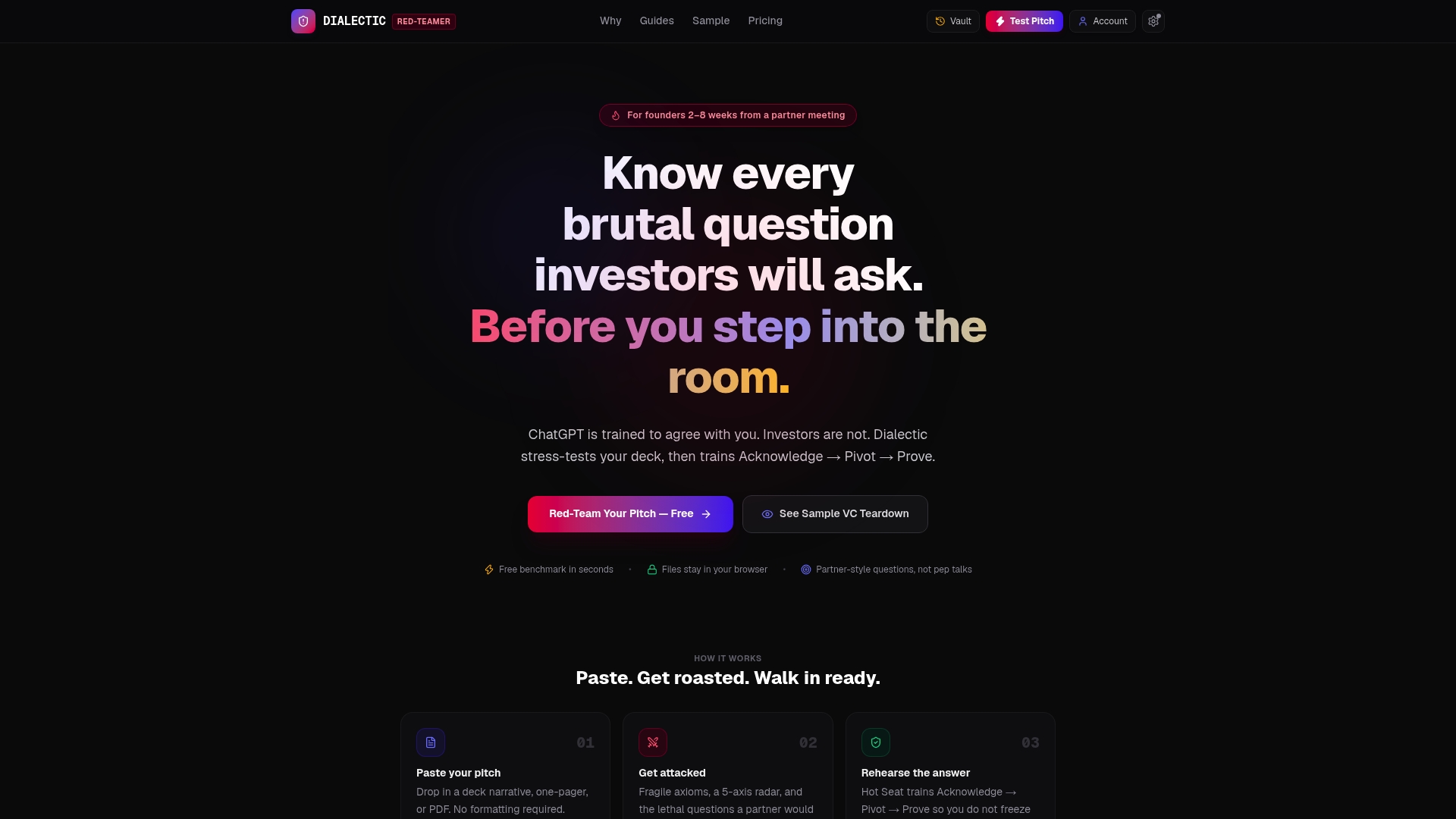
The Tactical Audit is $25 per audit, Founder Pro is $49 per month, and Venture & Studio (5 seats) is $149 per month. You can see all plans on the Dialectic site, or look at how a forensic review of a board memo plays out before you upload your own.
FAQ
Should I open my pitch with the pivot?
Usually no. Lead with the problem and the company you are building now, then bring in the pivot where it explains your evidence. If the pivot is the reason you have a unique insight or customer access, it can move earlier. Either way, do not make investors discover it on their own.
Do I have to tell new investors about earlier investors' reactions?
Yes, be ready for the question, and answer truthfully. Say what you told them, what they said and whether they are participating again. A clean, specific answer helps. A vague one raises doubts about the relationship.
How much post-pivot traction do I need before I raise?
There is no universal threshold. What matters is that your evidence supports the specific assumption you changed: new-customer usage, retention or revenue that separates cleanly from the old business. Even a short, well-structured data set can be persuasive if the test was bounded and honest.
What if my pivot came after a failure?
Say so plainly, then spend most of your time on what you learned and what changed. Research on recovering stakeholder support after a major setback points to pairing accountability with a focused plan for fixing the problem, which is also the best structure for a pitch answer.
Sources
- What is a pivot? Explaining when and how entrepreneurial firms change strategy (Strategic Management Journal)
- The Promise-Risk Balance (Harvard Business School)
- Noya pivots to embrace modular direct air capture (TechCrunch)
- How to Explain a SaaS Pivot While Building in Public (Buildside)
- Narrative shifts during product pivots (Inspire Now)
- Turning setbacks into strategy: how to lead a company pivot (Startup Fundraising)
- How to get your investors to back a pivot (TechCrunch)
- A Founder's Guide to Recognizing a Useful Pivot (DEV)
- 10 Lessons From The Great Recession (Crunchbase News)
- Bolt CEO discusses company moving on after SEC probe (TechCrunch)
- Before You Make That Pivot (TechCrunch)
- After pivoting, Glimpse raises $35M (TechCrunch)
- After Pivot, DataRails Gets On Track With Series A (Crunchbase News)
- How An Educator-Built Edtech Startup Raised Nearly $63M (Crunchbase News)
- Startup Pivots: Support or Worry? Investor's Guide (Angel Investors Network)
- How to Respond to Investor Questions (Allied Venture Partners)