
Your first job after an investor meeting is to capture exact quotes and log feedback within 24 hours, not to rewrite your deck. One vague pass from one partner is noise. The same objection from three unrelated investors is signal, and that distinction should drive every edit you make between now and your next pitch.
TL;DR:
- Only objections raised by three or more independent investors should prompt major changes to your pitch, while single feedback remains merely log data.
- Capture verbatim quotes and engagement signals within 24 hours, assigning ownership and maintaining a strict timeline to prevent memory decay.
- Categorize feedback into objections, curiosity, fit mismatch, or soft passes to prioritize concrete fixes over narrative rewrites.
- Use fragility scoring based on severity, frequency, and independence to identify which investor concerns truly warrant structural adjustments.
- Conduct structured debriefs within 24 hours, with clear roles, quick sessions, and consistent formats to turn individual feedback into actionable pattern recognition.
Table of Contents
- Why Structured Post-Meeting Debriefs Beat Ad Hoc Reactions
- The 24 to 48 Hour Checklist: What to Capture and Who Owns It
- Categorize Feedback: A Repeatable Taxonomy and Log Schema
- Fragility Scoring and Detecting Independent Patterns Across Investors
- Prioritize Fixes Without Rewriting Your Core Narrative
- Rehearsal, Follow-Up Questions, and Building Memo-First Materials
- Best Practices for Scheduling and Structuring the Debrief Session
- Roles and Responsibilities During a Debrief Meeting
- Managing Emotional Bias and Confirmation Bias in Debrief Discussions
- Sharing Debrief Insights With the Broader Team
- Tools and Templates for Debrief Documentation and Tracking
- Turning Debrief Learnings Into Better Future Pitches
- Publisher Perspective: Operationalizing Adversarial Debriefs Across a Fundraise
- How Dialectic Helps: Adversarial Stress-Testing, Fragility Scoring, and Tactical Rehearsals
- Primary Sources on Debriefing and Investor Feedback
- Sources
- FAQ
Why Structured Post-Meeting Debriefs Beat Ad Hoc Reactions
Founders who rework their deck after every rough meeting fall into what amounts to narrative drift: each edit chases the last objection, and after five meetings the pitch has no spine left. A structured post meeting debrief stops that by separating fund-specific quirks from real structural problems in your pitch.
Some investors pass because your traction doesn't fit their thesis. Others pass because your unit economics genuinely don't hold up. Those look identical in the moment but demand opposite responses.
There's a second reason this matters beyond your own sanity: the meeting you just had feeds directly into an investment memo that a partner or associate will write, often within days. What that memo writer remembers about your pitch depends heavily on what you said and how clearly you said it.
A quick gut check before you touch the deck:
- Did this objection come from the fund's specific mandate, or from the substance of your pitch?
- Would a different investor with a different thesis have raised the same concern?
- Is this the first time you've heard it, or the third?
The 24 to 48 Hour Checklist: What to Capture and Who Owns It
Memory decays fast, and pitch memory decays faster because you're running on adrenaline. Founders who wait more than a day to write things down tend to remember their own performance, not the investor's actual words.
Here's the minimum viable capture process:
- Log the basics immediately: investor name, firm, role (associate, principal, partner), date, and meeting format (Zoom, in-person, group partner meeting).
- Write down verbatim quotes, not summaries. "Your CAC payback looks slow for this stage" is different from your memory of "they seemed worried about spend."
- Note engagement signals separately from content: did they lean in during the cohort slide? Did they check their phone during the market-size slide?
- Record the stated next step, even if it's a soft one like "let me talk to my partners."
- Assign one owner for the log, whether that's the CEO, a co-founder, or someone on the fundraising team, and hold a 24-hour service level agreement on entry.
Pro Tip: Keep a strict line between what the investor said and what you think they meant. "Partner said growth rate concerned them" is data. "Partner probably thinks we're too early" is your interpretation, and interpretations are exactly what get diluted or exaggerated after three more meetings.
Categorize Feedback: A Repeatable Taxonomy and Log Schema
Raw notes are worthless until they're sorted. Practitioner guidance on fundraising rejection consistently points to categorizing feedback before deciding what to do with it, and four buckets cover almost everything you'll hear.
- Objections (traction, market size, team gaps) call for a follow-up ask or new evidence, not a story rewrite.
- Curiosity signals ("tell me more about your enterprise pipeline") tell you where to add depth, not where you're weak.
- Thesis or fit mismatches ("we don't do pre-seed check sizes this small") mean you target-audit your investor list, not your pitch.
- Soft passes with no specific reason attached usually deserve a polite follow-up question and then get deprioritized.
A workable log needs only five columns, and you can build this in a spreadsheet in ten minutes:
| Field | Example entry |
|---|---|
| Investor / firm | J. Alvarez, Meridian Ventures |
| Date | March 3 |
| Exact quote | "Your logo retention is strong, but I don't see the expansion path" |
| Bucket | Objection (traction/growth) |
| Recommended action | Add net revenue retention slide, bring cohort data forward |
Run every meeting through this schema. Categorization is what turns twelve chaotic meetings into a decision, instead of twelve separate emotional reactions.
Fragility Scoring and Detecting Independent Patterns Across Investors
Not every objection deserves the same weight. A simple fragility score, severity times frequency times independence, gives you a way to rank what actually needs fixing instead of chasing whichever comment stung most recently.
Severity asks how fatal the objection is to your investment case. A partner questioning your total addressable market is more severe than one asking about your logo color. Frequency counts how many separate meetings raised it. Independence checks whether those investors actually think differently, or whether they're all reading from the same market narrative because they talk to each other.
That third factor matters more than founders assume. Three investors from firms with overlapping portfolios and shared deal flow aren't three independent data points. They may have compared notes before your meeting even happened.
The rule of thumb worth adopting: wait for the same concern from three or more genuinely independent investors before making a major structural change. One meeting is an opinion. Three unrelated ones are a pattern.
Weight the source, too:
- An associate's concern often reflects what they think will pass the partner screen, worth noting but not decisive on its own.
- A partner's concern usually reflects the actual investment committee discussion that follows.
- Feedback from a firm whose thesis genuinely overlaps your stage and sector carries more weight than feedback from an obvious mismatch.
Prioritize Fixes Without Rewriting Your Core Narrative
The founding story, why you're building this and why now, should almost never change based on investor feedback. What changes is emphasis, ordering, and evidence. Confusing these two categories is how founders end up with a fourth deck version that says nothing clearly.
- Keep: your core narrative, the problem you're solving, and why your team specifically can solve it.
- Reframe: slide order, headline framing, and which proof points lead versus support.
- Add: cohort data pulled forward if traction objections repeat, a one-slide risk mitigation section if the same risk keeps surfacing unaddressed.
Concrete example: if three investors ask about churn before you've explained it, don't wait for slide 14 to answer. Move retention data to slide 4. If two investors from different funds independently ask "what happens if your biggest channel dies," that's your cue to build an explicit risk slide rather than hoping the next investor won't ask.
Pro Tip: Before editing anything, write down which bucket the feedback falls into. If you can't tell whether it's a story problem or an emphasis problem, it's probably emphasis. True story-level flaws are rare and usually show up as the same blunt objection from investors who have never met each other.
Decision rule: update your target investor list when the mismatch is about thesis or check size. Refactor slides when the mismatch is about clarity or missing evidence.
Rehearsal, Follow-Up Questions, and Building Memo-First Materials
Polite rehearsal, where a friendly advisor nods through your pitch, rarely surfaces the fragile spots a real investment committee will hit. Adversarial rehearsal, structured to mimic actual partner-level scrutiny, tends to expose weak assumptions before a real investor does. Run it before your first meeting and again after every third meeting once new patterns emerge.
When an investor gives a vague pass, don't accept it. Specific follow-up questions get you real information investors are otherwise inclined to soften:
- "Was there a specific number or metric that gave you pause?"
- "Is this a stage-fit issue, or would this concern you at any stage?"
- "What would need to be true in twelve months for this to become a yes?"
Build your materials so a memo writer can lift them directly: cohort retention curves, CAC payback timelines, an explicit written risk list, and two or three representative customer references ready on request.
Best Practices for Scheduling and Structuring the Debrief Session
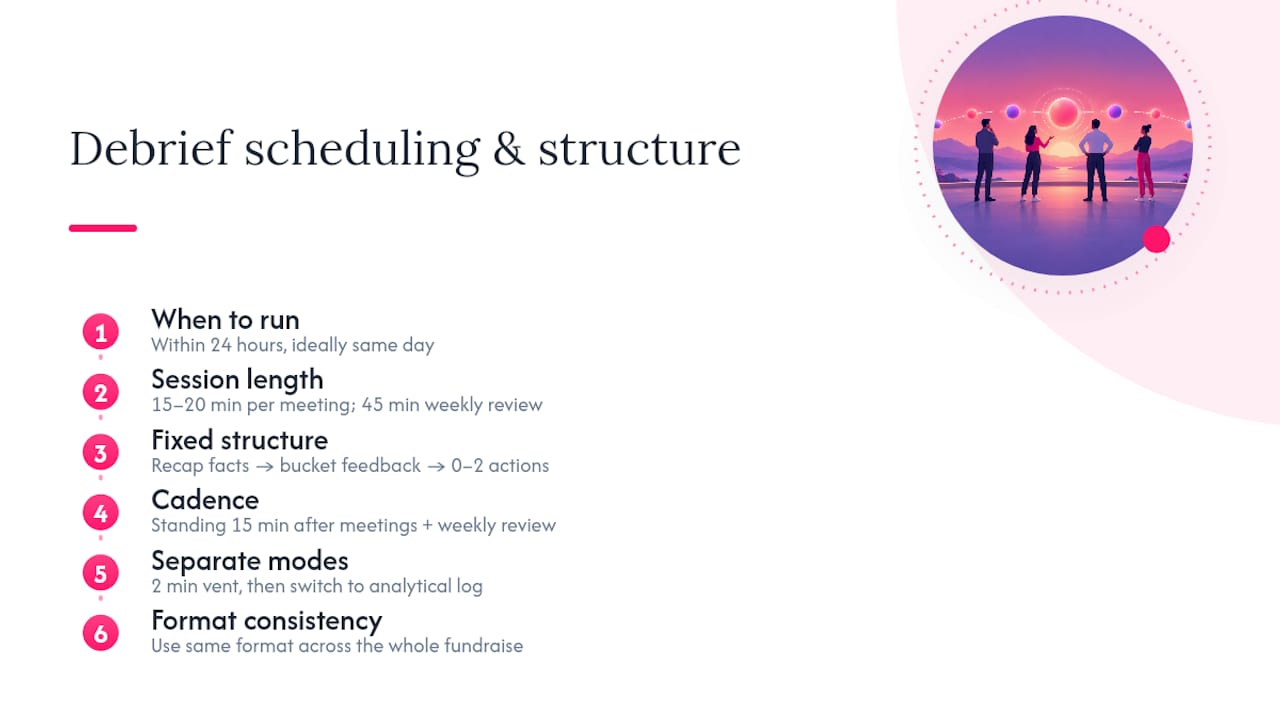
Run the debrief within 24 hours of the meeting, ideally the same day while the exact phrasing is still fresh. Waiting until the end of the week to "batch" debriefs sounds efficient, but it guarantees you'll lose the specific words that matter most.
Keep the session short. Fifteen to twenty minutes is enough for a single-meeting debrief; anything longer usually means the team is relitigating the meeting instead of extracting data from it. Structure it in three fixed parts: recap the facts (who, what was asked, what was said), sort the feedback into buckets, and decide on zero to two concrete actions. If a debrief produces five action items, you're probably overreacting to one meeting.
Schedule debriefs as a standing calendar block during any active fundraise, not as an afterthought squeezed between other calls. A useful cadence is a 15 minute sync after every individual meeting, plus a longer 45 minute weekly review where the team looks across all logged meetings for the three-plus pattern.
One structural choice matters more than people expect: separate the emotional recap from the analytical one. Let whoever was in the room vent for two minutes about how it felt, then explicitly switch modes to "now we're just looking at the log." Skipping that separation is how a single harsh comment ends up driving a deck rewrite that a calmer look at the pattern would have avoided.
Keep debrief sessions consistent in format across the whole fundraise. If session one is a free-form chat and session six is a rigid checklist, you lose the ability to compare meetings against each other, which is the entire point of running debriefs in the first place.
Roles and Responsibilities During a Debrief Meeting
Someone has to lead, someone has to document, and someone has to own the follow-up. When all three roles fall on the same overworked founder, debriefs get skipped the moment the calendar gets busy, which is exactly when you need them most.
The lead is usually whichever founder was actually in the meeting; they walk the team through what happened before opinions start flying. The documenter should ideally be someone who was not in the meeting. An outside note taker catches contradictions and vague language that participants gloss over because they were emotionally inside the conversation. If your team is just two co-founders, rotate this role rather than always assigning it to the same person.
The follow-up owner sends the "thanks, one quick question" email, tracks whether the investor responds, and updates the log when they do. This should be a named person with a deadline, not a vague "someone will handle it."
For solo founders or very early teams, these roles collapse into one person, but the sequence still matters. Recap first. Document second. Decide on follow-up third. Skipping straight to "what should we change" without writing anything down is the single most common failure mode in early-stage debriefs, and it's the reason the same objection resurfaces three meetings later as if it were new.
If you're bringing on an advisor or a fractional team member for the fundraise, give them the documenter or follow-up role rather than the lead. They lack the pitch-specific context to run the recap well, but they're often better positioned to catch bias in how the founders are interpreting what was said.
Managing Emotional Bias and Confirmation Bias in Debrief Discussions
Founders hear what they expect to hear. If you walked into a meeting anxious about your market size slide, you'll remember the investor's neutral question about market size as a devastating critique. Confirmation bias in a debrief doesn't feel like bias. It feels like certainty.
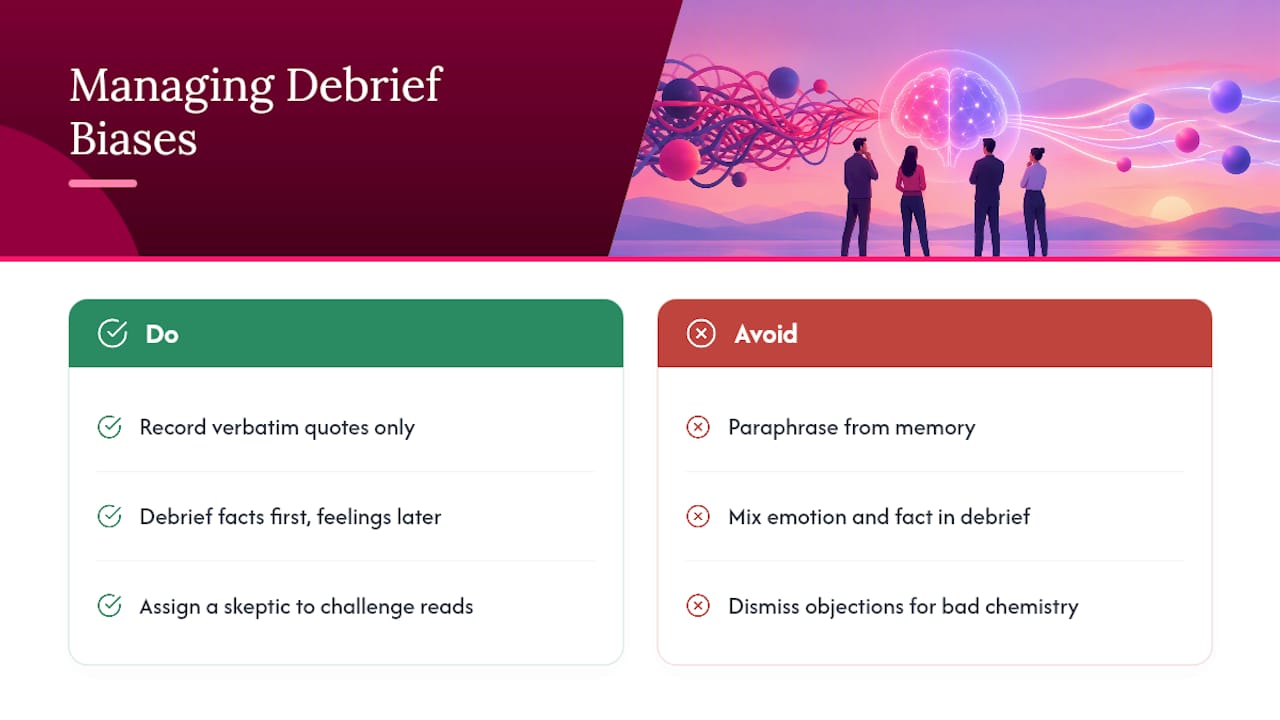
A few concrete guards help. First, require verbatim quotes in the log, not paraphrases, precisely because paraphrasing is where bias sneaks in. "They hated our market slide" and "they asked how we sized the market" are wildly different statements, but they can both get written down after a rough meeting if you're working from memory instead of notes.
Second, separate the "how did it feel" conversation from the "what actually happened" conversation, and do the factual one first. Teams that debrief emotion and fact simultaneously tend to let the emotional read color which quotes get remembered as important.
Third, assign someone in the room the explicit job of playing skeptic during the debrief itself, questioning whether the team's read on the meeting matches what was actually said. This is uncomfortable, and it's supposed to be. A forensic teardown of a board memo works precisely because an outside adversarial reviewer has no emotional stake in defending the pitch as originally written.
Finally, watch for the inverse bias: dismissing a real objection because the investor who raised it was someone the founders didn't like personally, or because the meeting ended on an awkward note unrelated to pitch substance. Bad chemistry and bad feedback are not the same thing, and conflating them is how genuinely useful objections get thrown out.
Sharing Debrief Insights With the Broader Team
A debrief that lives in one founder's head, or worse, in a single Slack message that scrolls away, produces nothing. The value comes from synthesis across meetings, which means insights need a home the whole team can actually see and search.
After each debrief, add a short synthesis note to the shared log: not just the raw quotes, but a one-line read on what bucket the meeting's core feedback fell into and whether it echoes anything from a prior meeting. This is the step that turns twelve individual debriefs into a visible pattern rather than twelve disconnected stories.
Share a rolling summary weekly with anyone involved in fundraising strategy, including advisors and board members who aren't in every meeting. A simple format works: "This week: 4 meetings, 2 independent objections on go-to-market clarity, 1 strong curiosity signal on the enterprise pipeline, 1 clean pass unrelated to pitch quality." That's enough for someone outside the room to spot a pattern the people inside the room might be too close to see.
Avoid sharing raw, unfiltered notes with the whole team by default. Verbatim quotes taken out of context can spook a co-founder or board member who wasn't there to hear the tone. Share the synthesized pattern, and keep the raw log available for anyone who wants to dig into the source quotes themselves.
Tools and Templates for Debrief Documentation and Tracking
You don't need anything elaborate to start. A shared spreadsheet with the five-column schema covered earlier, investor, date, exact quote, bucket, recommended action, handles the first ten to fifteen meetings of most seed rounds without friction.
Once you're running a larger round with dozens of investor conversations, a lightweight CRM built for fundraising, or even a general-purpose one repurposed for this, becomes worth the setup time. The key requirement isn't the tool's sophistication. It's whether it makes filtering by bucket and by investor easy, so you can pull up "every objection tagged traction" in a few clicks when you're deciding what to fix next.
For turning scattered comments into structured categories, frameworks built specifically for that translation step can help teams that are still arguing over how granular their buckets should be. And if the real challenge is deciding which repeated signal is worth acting on versus noise, tools designed around tracking bets and outcomes over time offer a useful mental model, even outside their original use case: log the claim, log the outcome, and let the pattern accumulate before you act on it.
Whatever tool you pick, resist the urge to build something too complex before you've run three or four real debriefs. Overengineering the template is a common way founders procrastinate on the harder work of actually categorizing and weighing what investors said.
Turning Debrief Learnings Into Better Future Pitches
The point of all this logging and scoring is useless if it doesn't change the next meeting. After every third or fourth debrief, pull the log and look specifically for repeated buckets, not individual comments.
If "go-to-market clarity" shows up as an objection across three unrelated firms, that's your next deck revision, and it should happen before your next scheduled meeting, not after your entire pipeline has heard the same weak slide. Treat this as a standing checkpoint: every five to seven meetings, stop and ask whether the log is telling you something the last edit missed.
This is also where adversarial rehearsal earns its place in the cadence. Once you've identified a pattern from real investor meetings, running it back through a tough mock session before your next pitch confirms whether your fix actually closes the gap or just moves the objection to a different slide. Founders who skip this step often discover, three meetings later, that they solved the wording problem but not the underlying evidence gap.
Keep a short "lessons applied" column in your log itself, noting which fix addressed which pattern and whether it worked in the next round of meetings. Six months into a fundraise, that column becomes the clearest record of what your pitch actually needed versus what felt urgent in the moment.
Publisher Perspective: Operationalizing Adversarial Debriefs Across a Fundraise
Most fundraising advice treats debriefs as an afterthought. Run the meeting, jot some notes, move on. That backwards priority is why so many founders over-rotate on the last meeting instead of the pattern.
A weekly cadence with one clear log owner beats sporadic Slack venting every time. Bring in an external adversarial reviewer once you've logged three or four meetings and can't tell if a repeated objection is a real fragility or founder fatigue talking.
— D
How Dialectic Helps: Adversarial Stress-Testing, Fragility Scoring, and Tactical Rehearsals
Once your debrief log flags a repeated fragility, the fastest way to test whether a fix actually works is to put it in front of adversarial scrutiny before your next real investor meeting does.
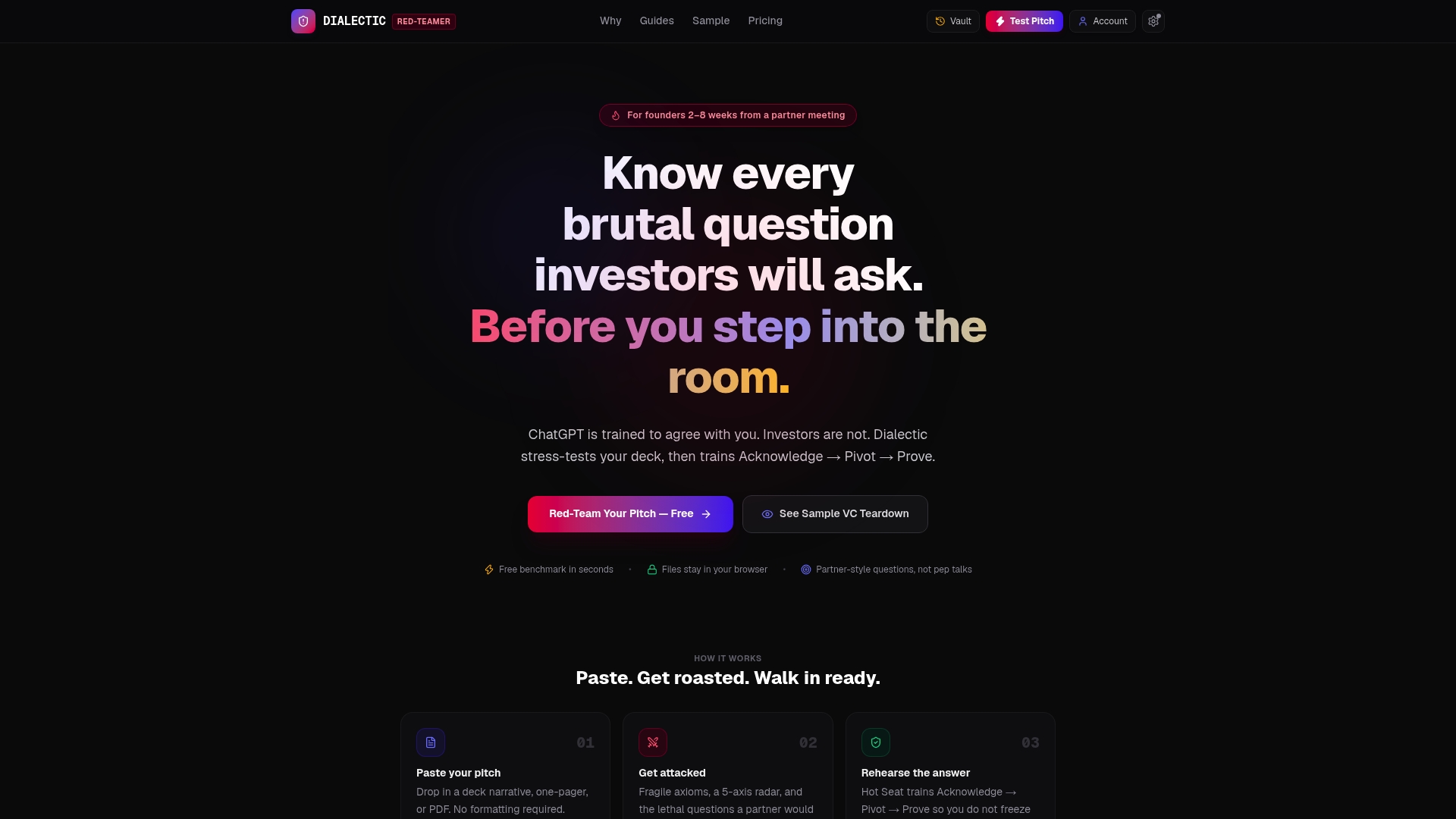
That's the gap Trydialectic fills. Instead of the encouraging feedback most AI tools offer, it stress-tests your deck the way a skeptical partner would, surfacing fragile assumptions and blind spots you'd otherwise only discover in a live meeting. The Tactical Audit gives you a single adversarial pass on a deck or memo. Founder Pro supports ongoing rehearsal as your pitch evolves across a fundraise. Venture & Studio 5 Seats fits teams running multiple portfolio pitches at once.
Internal practice sessions work fine for rehearsing delivery. A paid adversarial rehearsal is worth it once your debrief log shows a specific, repeated fragility you need to pressure-test before your next partner meeting. Start with a Tactical Audit on Trydialectic before your next pitch.
Primary Sources on Debriefing and Investor Feedback
The guidance above draws on a small set of sources worth reading directly if you want the underlying reasoning. Harvard Business Review's research on how VCs assess pitches backs the follow-up question templates. Vestd's guide to learning from rejection supports the three-plus independent investor rule. Ilya Strebulaev's writing on VC due diligence and Spectup's investment memo guide both inform the memo-first materials framework, and empirical research on VC evaluation criteria supports weighting feedback by what investors actually screen for.
Sources
- How venture capitalists really assess a pitch — HBR
- Learning from fundraising rejection to sharpen your pitch — Vestd
- Empirical findings on VC evaluation — Springer
- VC investment memo guide — Spectup
FAQ
What Is a Post Meeting Debrief in Fundraising?
A post meeting debrief is a structured review of an investor meeting done within 24 to 48 hours, capturing exact quotes, categorizing feedback, and deciding whether it reflects a real pitch problem or just one fund's preference. It's distinct from casually reflecting on how a meeting "felt."
How Long Should I Wait Before Changing My Pitch Deck?
Don't change your core narrative after a single meeting. Wait until the same objection surfaces from three or more independent investors before making a structural change, and treat single-meeting feedback as evidence to log, not act on immediately.
What Should I Capture Right After an Investor Meeting?
Log the investor's name, firm, role, exact quotes, engagement signals, and any stated next step within 24 hours of the meeting. Capturing notes quickly preserves accuracy that fades fast once you've had three more meetings that week.
How Does Fragility Scoring Work for Pitch Feedback?
Fragility scoring ranks feedback by severity, frequency, and independence, so you prioritize fixing objections that are both serious and repeated by unrelated investors. It stops you from rewriting your deck over a single harsh but isolated comment.
What Does Trydialectic Cost for Pitch Rehearsal?
Trydialectic offers a one-off Tactical Audit for $25, a Founder Pro monthly plan at $49, and a Venture & Studio 5 Seats plan at $149 per month for teams. Current details and plan features are listed on Trydialectic.