
A pre-revenue pitch narrative has one job: make an investor believe that you understand a real problem better than anyone, that the timing is right, and that a specific amount of money buys a specific, testable result. Without sales to point to, the story carries the weight that revenue would carry later. That means every claim in it has to survive a skeptical question.
This guide gives you the structure, the kinds of evidence that stand in for revenue, a way to present projections without losing credibility, and a method for pressure-testing the whole story before a partner does it for you.
TL;DR
- Without revenue, investors judge the founders, the insight, the market, the timing and whatever early signal exists. Build the story around those five things.
- Use a clear arc: problem, insight, solution, evidence, market, business model, team, and an ask tied to milestones. Ten to twelve slides is typical.
- Replace revenue with demand evidence: waitlists, signed pilot commitments, deposits, and hand-delivered (concierge) versions of your service. Never call a letter of intent revenue.
- Present projections as a set of explained assumptions, not a growth chart to defend.
- Rehearse against hostile questions, not friendly ones. Name your biggest risk before the investor does.
Table of Contents
- What investors are really underwriting when there is no revenue
- The structure of a pre-revenue narrative
- Replace revenue with evidence of demand
- Present projections without overselling them
- Make the ask the end of the story
- Prepare for the hard questions
- Our perspective: the story that survives is the one that was attacked first
- Stress-test your narrative before the meeting
- A pre-meeting checklist for your narrative
- FAQ
- Sources
What investors are really underwriting when there is no revenue
At pre-seed, nobody expects a revenue line. What they expect is that you show intimate knowledge of your customer and market, the right team, the ability to execute, and an awareness of the risks along with a plan to handle them. That is the standard Carnegie Mellon's entrepreneurship center sets out in its 2025 pitch workshop materials.
The same materials add a point worth reading twice: storytelling matters at this stage, and the narrative should make the company feel inevitable while still being honest about risk. Those two goals can look opposed. They are not. An investor who sees you name the weakest part of your plan, and show how you will test it, trusts the rest of the story more.
Think of the narrative as answering four silent questions:
- Why you? What is your specific relationship to this problem?
- Why this insight? What do you see that a smart outsider would miss?
- Why now? What changed recently that makes this possible or urgent?
- Why this money? What exactly will the round accomplish, and by when?
If a slide does not help answer one of these, it is probably decoration.
The structure of a pre-revenue narrative
There is no single correct order, but the ingredients are consistent across sources. The Carnegie Mellon workshop lists company purpose, customer pain and the status quo, the solution and value proposition, why now, customer and market size, value to the customer, business model, go-to-market, validation, team, competition, future vision, and financials. J.P. Morgan's guidance on investor decks covers much the same ground: the problem and urgency, product and differentiation, market opportunity, team fit, traction, competition, revenue model and route to market, milestones and timeline, and the ask.
For a pre-revenue company, a compact version works well. A pre-seed deck is typically 10 to 12 slides covering the problem, insight, solution, evidence, market, business model, team and funding ask, according to RobbVC's pre-seed guide.
Here is how that maps to a story an investor can follow.
| Beat | What it must do | Common failure |
|---|---|---|
| The problem | Show a specific customer in a specific painful situation, and what they do today | A market-size statistic standing in for a person |
| The insight | State what you believe that others do not | Describing the product instead of the belief |
| Why now | Name two or three real changes in technology, regulation or behavior | "The market is growing" |
| The solution | Show what you are building and what it does for the customer | Feature lists |
| Evidence | Show the strongest early signal you have | Vanity numbers with no definition |
| Market and model | Explain how you make money and acquire customers | Top-down "1% of a huge market" math |
| Team | Show why these people can execute this | A list of past employers with no link to the problem |
| The ask | Tie the amount to milestones and a timeline | "We need money to build and grow" |
Open with your relationship to the problem
With no revenue, the first thing an investor evaluates is you. Opening with a market chart wastes the moment. Open with the reason you are the person who noticed this: the years you spent inside the problem, the process you ran, the customers you served. One sentence of this does more than three slides of context.
Make the insight a claim, not a category
"We are building an AI platform for logistics" is a category. "Most freight brokers lose money on rework because carriers and shippers describe the same load differently, and we believe a shared structured format fixes that" is an insight: it can be right or wrong, and an investor can argue with it. Arguable is good. It shows there is something there to test.
Give timing real substance
Timing is one of the few things a pre-revenue story can prove with outside facts. Pick two or three concrete shifts: a cost curve that fell, a rule that took effect, a customer behavior that changed. Cite each. If your timing argument would work equally well for a company started five years ago, it is not a timing argument.
Replace revenue with evidence of demand
Revenue is one kind of proof. It is not the only kind. The Carnegie Mellon materials point to validation and traction signals such as engagement, customer love, pipeline, unit economics and retention, and to early signs that your first go-to-market hypothesis can work, or at least a strong understanding of your go-to-market options.
For a company with no sales, the credible forms are practical ones. RobbVC lists waitlists or email signups, letters of intent or written commitments to pilot, pre-orders or deposits, and concierge versions of the service delivered by hand. They differ in strength:
- Waitlist: cheap to get, so weak on its own. It becomes meaningful if you can say who signed up and why they match your target customer.
- Letter of intent or pilot commitment: stronger, because someone put their name to it. Describe it as what it is. Do not count it as revenue, and do not let a slide imply that it is.
- Deposit or pre-order: the strongest of the three, because money moved.
- Concierge version: you do the job manually for a handful of customers. This shows you understand the work, and it produces real quotes, real usage and real retention data.
Define the risk, then the test
A stronger move than listing signals is to name your single biggest risk and the event that would test it. For example: "Our riskiest assumption is that small clinics will come back weekly. We will know in 90 days if 15 of 20 pilot clinics complete the core task three weeks in a row." That sentence turns an unproven company into a company with a learning plan, and investors tend to value how fast you move through cycles of assumption, test and insight.

It also fits how a venture investor sees the job. They are underwriting risk, so the founders who do best are those who can say where the risk lives and what reduces it, rather than pretending it is absent.
Be exact about numbers
Define every metric the way a diligence analyst would. Stripe's guide to pitching an early-stage startup cautions founders to cite metrics correctly, for instance not confusing gross merchandise volume with revenue. The same discipline applies to "users" (signed up or active?), "pipeline" (conversations or qualified opportunities?) and "customers" (paying or piloting?). One loose definition discovered in diligence taints everything around it.
Present projections without overselling them
Founders often dread the financial slide most, because the numbers are guesses. The way out is to stop presenting them as predictions.
Carnegie Mellon's pitching materials recommend a bottom-up forecast that accounts for long sales cycles and seasonality, explains the assumptions underneath, and identifies when cash-flow break-even arrives. Bottom-up means you build from units: how many conversations you can have, what share become pilots, what share of pilots convert, at what price. Every multiplier is something an investor can challenge, and that is the point.
A workable projection slide has these elements:
- Three to five named assumptions that drive the model, such as sales cycle length, conversion rate, price, and monthly churn.
- A source or a test for each. If it comes from your pilots, say so. If it is a guess, say what experiment will replace it.
- The milestone the round reaches. A realistic number of months of runway tied to a specific outcome.
- A break-even point, even if it is far out.
Stripe's advice for founders is to sell growth potential rather than current profitability, since investors know they are backing early-stage promise. Experienced investors generally read your model to see whether you understand the dynamics of your business, not to hold you to a five-year chart. So spend your time on how the parts connect: how pricing relates to the customer's return, how acquisition cost relates to contract size.
Business-model assumptions to explain
Three questions come up in almost every pre-seed pitch, and the Carnegie Mellon workshop frames them well: how will you make money, does your pricing fit the return your customer gets, and how will you acquire customers at scale? Prepare a short, specific answer to each. For pricing, anchor to the customer's cost of the problem: "A clinic loses about X hours a week to this task; we charge Y." For acquisition, name the first channel and why you believe it works, even if you have only tested it with ten conversations.
Make the ask the end of the story
Vague asks sink otherwise strong narratives. A clear plan for what the money achieves, such as building a specific version in a set time and signing a defined number of pilots, is easier to back than a general plan to build and grow, as RobbVC puts it. J.P. Morgan's guidance likewise recommends keeping the ask clear.
A good ask slide answers in one glance:
- How much you are raising
- How many months it funds
- The two or three milestones it reaches
- What those milestones unlock (the next round, a first paid contract, a regulatory step)
End the spoken pitch with a specific call to action too: a follow-up meeting, a data room, an introduction to a pilot customer.
Prepare for the hard questions
The narrative is only half of the pitch. The other half is the conversation that follows, and for a pre-revenue company it is more adversarial, because there is less data to settle disagreements.
The questions to expect cluster around a few themes:
- Insight: "Why hasn't someone already done this?"
- Demand: "Who has actually said they would pay, and how do you know?"
- Go-to-market: "How do you get your first 50 customers without a large sales team?"
- Model: "What happens to your margin if your key assumption is wrong by half?"
- Team: "What is the biggest gap on this team, and who fills it?"
- Risk: "What is the single thing most likely to kill this?"
The Techstars pitch toolkit suggests a simple routine: record the questions you receive, pick the five most important, develop answers, and practice them until the whole team knows them solidly. It also advises that if you do not know an answer, you say so honestly and offer to follow up right away. That beats a confident bluff every time.
Rehearse in conditions that resemble the real thing
A few practical rules from published guidance:
- Rehearse a five-minute version. TechCrunch's account of effective pitch meetings recommends practicing the full pitch in five minutes with no more than 12 slides, and leaving substantial time for Q&A.
- Test your opening hook on outsiders. Harvard Business School's startup guide suggests trying a one-minute hook on two or three unbiased colleagues and using their specific feedback to judge whether the pitch conveys a passionate, repeatable purpose. Friends who love you do not count.
- Answer directly and briefly. Give the answer in the first sentence, then the reasoning.
- Follow up the same day with whatever materials or answers you promised.
Our perspective: the story that survives is the one that was attacked first
We built Dialectic around one observation: most pitch feedback is too kind to be useful. Friendly readers, supportive AI tools and polite advisors tend to tell founders what is working. Investors do the opposite. They look for the assumption that breaks.
For a pre-revenue company this matters more, because the narrative is the whole case. If the insight is thin, the timing argument is generic or the demand evidence is a waitlist presented as traction, a partner will find it in the first ten minutes. Far better to find it yourself a week earlier.
That is why our approach is adversarial by design. We examine your deck or memo the way a seasoned VC partner would, surface fragile assumptions and blind spots, score the fragility and risk, and show you where a story needs a tactical pivot. Then you rehearse the defense out loud against tough, realistic questions, and get graded on how you hold up.
We would rather you hear the lethal question from us than from the investor you most want to impress.
D
Stress-test your narrative before the meeting
If you have a draft deck or memo, the quickest way to find its weak points is to have it attacked. With Dialectic you upload your pitch deck or memo and get partner-style scrutiny, fragility and risk scoring, and a structured list of weaknesses and blind spots. You can then run a real-time boardroom rehearsal and get a graded defense.
Three ways to start, at the prices published on our site:
- Tactical Audit: $25 per audit, one-off. Suited to a single deck you want pressure-tested before a specific meeting.
- Founder Pro: $49 per month. Suited to founders iterating on a deck and rehearsing repeatedly through a raise.
- Venture & Studio 5 Seats: $149 per month. Suited to teams, studios and small funds working across several pitches.
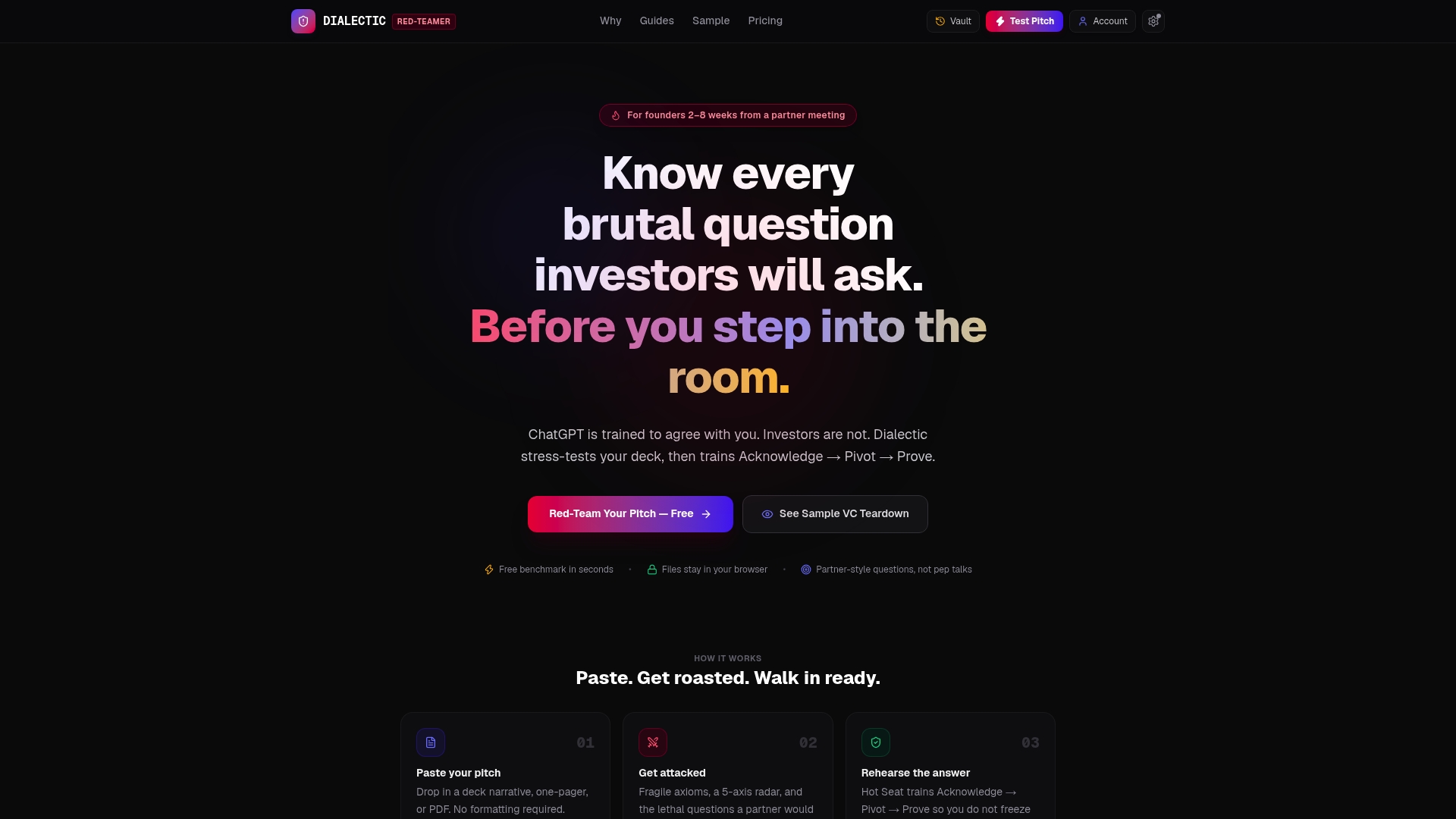
Upload your deck at Dialectic and see which assumptions an investor would go after first.
A pre-meeting checklist for your narrative
Run through this the week before a first investor meeting:
- Can you state your relationship to the problem in one sentence?
- Is your insight a claim someone could disagree with?
- Do you have two or three cited, concrete timing shifts?
- Is every traction figure defined precisely, and is anything pilot-related kept clearly separate from revenue?
- Does each projection rest on named assumptions you can defend?
- Is your biggest risk named on a slide, with the test and the date it resolves?
- Does the ask tie a dollar amount to months of runway and specific milestones?
- Have you answered your five hardest questions out loud, with someone who is trying to beat you?
If any answer is no, that is where to spend the remaining hours.
FAQ
How long should a pre-revenue pitch deck be?
Ten to twelve slides is typical for a pre-revenue pitch, covering the problem, insight, solution, evidence, market, business model, team and ask. You should be able to present it in about five minutes, which leaves most of the meeting for questions.
What do I show investors if I have no revenue and no product?
Show your reason for being the right founder, a clear insight, timing evidence, and the strongest demand signal you have. That can be a waitlist, signed pilot commitments, deposits or a manually delivered version of the service. Be precise about what each one is, and never label it revenue.
Should I include financial projections at pre-revenue?
Yes, but as a bottom-up model built on a few named assumptions, with a milestone the round reaches and a break-even point. Investors mainly use the model to judge whether you understand how your business works, so explain the assumptions rather than defending a growth curve.
How do I handle a question I cannot answer?
Say you do not know yet, explain how you would find out, and offer to follow up quickly, ideally the same day. Honest gaps with a plan are far less damaging than an answer that falls apart under the next follow-up question.
How can I practice for tough investor questions?
Write down the questions you get, choose the five that matter most, and rehearse answers until the team knows them cold. Practice with people who will push back, and consider an adversarial tool that questions your deck the way a VC partner would.
Sources
- Carnegie Mellon Swartz Center, pitch workshop (2025)
- Carnegie Mellon Swartz Center, Pitching to Investors
- J.P. Morgan, Creating an Investor Pitch Deck for Your Startup
- RobbVC, How to Raise a Pre-Seed Round Without a Product
- Stripe Atlas, Pitching your early-stage startup
- Techstars, Master Your Pitch
- Harvard Business School, How to Build a Great Pitch that Hooks Investors
- TechCrunch, A 7-step method for running effective pitch meetings