
To prepare for an investor meeting, do five things: research the people across the table, build your materials in layers, know your numbers cold, rehearse the hardest questions out loud, and plan the last five minutes and the follow-up before you walk in. Most founders spend their prep time polishing slides. The meeting is decided by how you think under questioning, so most of your prep should go there.
This guide walks through each step in the order you would do it, with the specifics that matter in a US seed or Series A meeting.
TL;DR
- Treat the first meeting as a mutual assessment. The investor is deciding whether to give you a second meeting or an introduction inside the firm.
- Research every person in the room and check stage, sector and portfolio conflicts before you book time.
- Prepare a short deck, a spoken version and a deeper drill-down, and keep your financial model explainable.
- Practice the questions that expose your weakest assumptions, not the ones you already answer well.
- Finish by agreeing next steps and timing, then follow up the same day.
Table of Contents
- What investors are trying to decide in the first meeting
- Research the investor before you build the pitch
- Build your materials in layers
- Know your numbers and the questions behind them
- Stress-test the deck before a partner does
- Run the meeting as a conversation
- Close the meeting and follow up the same day
- Perspective
- Prepare against the questions that matter
- FAQ
- Sources
What investors are trying to decide in the first meeting
A first meeting is rarely about closing. According to the Holloway Guide to Raising Venture Capital, it is a chance for both sides to get to know each other, and the investor is deciding whether you and your work are interesting enough for another meeting or for introductions within the firm. Your goal is to earn that next step.
The same guide notes that investors often show "thoughtful skepticism" during a pitch, and that this is a sign of engagement rather than disinterest. Knowing that changes how you prepare. A partner who pushes on your market size is not rejecting you. They are testing whether your thinking holds up.
Later in the process, the evaluation gets more formal. The Angel Capital Association's due diligence playbook says investors weigh the management team's leadership, how the business model generates revenue, and the details of the deal, including valuation expectations. Every one of those shows up, in miniature, in the first conversation. Prepare as if each will be probed.
One more thing investors watch: how you handle questions you did not expect. Polaris Alpha describes first meetings as a test of exactly that. A clean, honest answer to a hard question often does more for you than a flawless slide.

Research the investor before you build the pitch
Generic pitches get generic responses. Spend the first few hours of your prep on the audience, not the deck.
Research everyone in the room
Stanford Graduate School of Business advises founders to research everyone in the meeting, including their backgrounds, points of common interest and the areas where your company is not relevant to them. Its example is blunt: pitching a consumer startup to a partner focused on semiconductors is a poor fit for both sides. If you find that kind of mismatch, say so, or better, skip the meeting and spend the slot on a better-matched firm.
Check stage, sector and portfolio
HBS Online recommends looking at an investor's industries, investment stage and track record before you pitch, since the relationship is a partnership and these factors help you tailor the pitch and judge whether the investor is the right one. NYU Entrepreneurship adds a practical filter: target investors actively investing in your sector and stage, check their websites and portfolios, and avoid those with competitive portfolio companies.
Stanford's venture program makes the point that this research prevents wasted conversations. Useful filters include whether the investor still invests at your round, has capacity left in the fund, and has a sensible portfolio concentration.
Track it in one place
Techstars suggests keeping a pipeline spreadsheet with each investor's past investments, stage preference and focus, plus contacts, check size, themes, last contact, next steps and the reasons for any pass. That last column is underrated. Patterns in passes tell you which part of your story is not landing.
A short checklist for each meeting:
- What has this person invested in at your stage in the last two to three years?
- Which portfolio companies overlap with yours, and how will you address that directly?
- What have they written or said publicly about your sector?
- Who from your network can give you a candid view of how they work with founders?
Build your materials in layers
One deck cannot serve every moment of a fundraise. Techstars recommends four pieces: a teaser deck of no more than 10 slides, an investor deck you can present in no more than 10 minutes, a drill-down deck for detailed questions, and a financial model you understand well enough to explain line by line.

The layered approach protects your focus. Guy Kawasaki warns, in the Stanford piece cited above, that adding a slide for every investor request makes a pitch unfocused. Put the extras in the drill-down and keep the main deck tight.
What the core deck should cover
HBS Online lays out a logical flow: introduction, problem, solution, market size, competition, go-to-market plan, business model, financial projections and the ask. It is a standard order for a reason, because each section answers the question the previous one raises.
Two cautions from investors:
- Clarity beats polish. Stanford GSB's Douglas Leone stresses crystal-clear thinking over visual design. He also warns against unsupported market claims, such as simply taking a percentage of a huge market, and says a pitch should give the market real attention instead of mostly describing the product.
- Show why you. TGN Ventures, citing Moring, points to founder-market fit: link your real-world experience, customer access and product-testing evidence to the solution.
Plan the time split
A UCSD startup toolkit suggests that in a 30-minute meeting you explain for about 8 minutes and leave about 22 for dialogue. You may never hit that ratio exactly, but it sets the right instinct: the deck is a starting point for the conversation, not the conversation.
Know your numbers and the questions behind them
Founders are repeatedly told to know their numbers. A Forbes piece on fundraising coaching singles out CAC and LTV, customer acquisition cost and lifetime value, as the ones to have ready. Knowing the figure is only half of it. Be ready to explain how you calculated it, what assumptions sit underneath, and what would change it.
A useful exercise: take every number on your deck and write down the question a skeptical partner would ask next.
| Number on your slide | The follow-up you should expect |
|---|---|
| Market size | How did you build it bottom-up, and who is the first customer segment you can actually reach? |
| CAC | Which channels does it blend, and does it hold as you scale spend? |
| LTV | How many cohorts of retention data support it? |
| Growth rate | What drove it, and is it repeatable without you personally selling? |
| Valuation or raise | What milestones does this round fund, and what does the next round need to look like? |
| Competition | Why can a well-funded incumbent not copy this in two quarters? |
If you cannot answer a row in two or three sentences, that row is where your prep time goes.
Turn questions into a living FAQ
Forum Ventures suggests treating investor questions as indicators of risk: add each one to an FAQ document and build context for it into the deck. After five or six meetings, your deck quietly answers the questions that used to derail you. Keep the document structured so each answer has a claim, the evidence behind it and where that evidence lives. If you want a model for that discipline, data room Q&A with cited answers shows how to tie each response to a specific source document, which is the habit that makes diligence go smoothly.
Hold your ground without being defensive
Jon Low of Polaris Alpha says founders should control the frame of the conversation, and that investors respect strong, defensible convictions even when they disagree. The practical version: concede what is true, give your evidence for what you still believe, and say what data would change your mind.
Stress-test the deck before a partner does
Most founders rehearse with friends, advisors or a mirror. Those audiences tend to be kind, and they rarely know which question will hurt. The questions that sink a raise are usually ones you have quietly avoided: a take rate that depends on a single assumption, a retention curve with too few cohorts, a competitor you describe as "not really a threat."
A better rehearsal is adversarial on purpose. Here is a process you can run in a day:
- List your five load-bearing assumptions. These are the claims that, if wrong, break the business case.
- Write the hardest question for each. Phrase it the way a partner who wants to pass would.
- Answer out loud, with a timer. Two minutes per answer. Notice where you reach for jargon or change the subject.
- Score yourself. Mark each answer as defended, partially defended or exposed. Fix the exposed ones with data, or change the claim.
- Repeat with someone who will interrupt. Real investors do.
We built Dialectic to do this step: you upload a pitch deck or memo, and it scrutinizes it the way a skeptical VC partner would, flagging fragile assumptions and blind spots. To see what that kind of teardown looks like on a real document, read our take-rate teardown, where a forensic CFO red-teams a board memo.
Run the meeting as a conversation
The meeting itself is where prep shows. A few moves that the sources agree on.
Open by setting the agenda
Kawasaki's advice from Stanford GSB is to confirm the meeting length, ask which three topics matter most to the investors, and agree how questions will be handled. That lets you spend your minutes on what the audience cares about. Techstars adds that you can ask whether the investor prefers to see the deck or just talk, and that you should aim for dialogue rather than a monologue.
Adapt to the investor's style
Equidam points out that investors differ: some want a data-heavy deep dive, others care most about the founder's vision. Flexibility matters. Bring the drill-down material for the first type and a crisp story for the second, and read the room in the first five minutes.
Ask real questions
The UCSD toolkit encourages founders to treat meetings as collaborative sessions for gaining industry insight and to approach investors as equals, not as petitioners. Good questions to bring: what excites you about this space right now, what would make this a clear yes for your partnership, and what concerns do you have that I can address today.
Be ready for mechanics too. TechCrunch recommends being prepared to say whether you are comfortable with SAFE notes, what your incorporation status is and what the investor's typical timeline looks like.
Close the meeting and follow up the same day
The last five minutes are the most commonly wasted. Equidam suggests asking about the investor's process, the expected timeline for feedback, and whether they need additional materials or partner meetings. Forum Ventures adds that you should set a clear decision deadline to build momentum, and leave knowing the next steps and timing.
Then move fast. TechCrunch's guidance is to follow up the same day with whatever you agreed to send, such as data room access or answers to open questions. The same piece notes that an effective follow-up can include a pre-signed SAFE with a defined deadline, which makes it easier for an interested investor to commit.
A follow-up email that works usually has four parts:
- One line of thanks that references something specific from the conversation.
- The materials you promised, attached or linked.
- Straight answers to any question you did not fully answer live.
- The next step and the date you proposed.
Log the meeting in your pipeline sheet the same day, including the questions you were asked. Those become your next round of rehearsal.
Perspective
We think most pitch prep fails for a simple reason: it is built to make you feel ready, not to find out whether you are. Feedback that is supportive by default tells you what is good about your deck. Investors are looking for what is wrong with it.
That is why we built Dialectic around adversarial, partner-style questioning. The goal is to surface fragile assumptions, blind spots and the tactical pivots that turn a weak point into a defensible one, before a real partner finds them for you. A weakness you have already found and answered is an asset in the room. A weakness you meet for the first time at the table is a lost meeting.
We also believe rehearsal should feel like the real thing. Facing tough, realistic questions in a boardroom-style session, and being graded on how well you defend your answers, builds the habit of answering directly under pressure. Do it a few times and the structured feedback loop shows you which parts of your argument keep getting exposed, so you can fix the argument and not just the wording.
The best founders we see are not the ones with no weaknesses. They are the ones who know exactly where their weaknesses are and have a clear answer ready.
D
Prepare against the questions that matter
If you are heading into a fundraise, the fastest way to find your weak spots is to have them tested. Dialectic takes your pitch deck or memo, scores its fragility and risk, lists the structured weaknesses and blind spots it finds, and lets you rehearse your defense in a real-time boardroom session with graded answers.
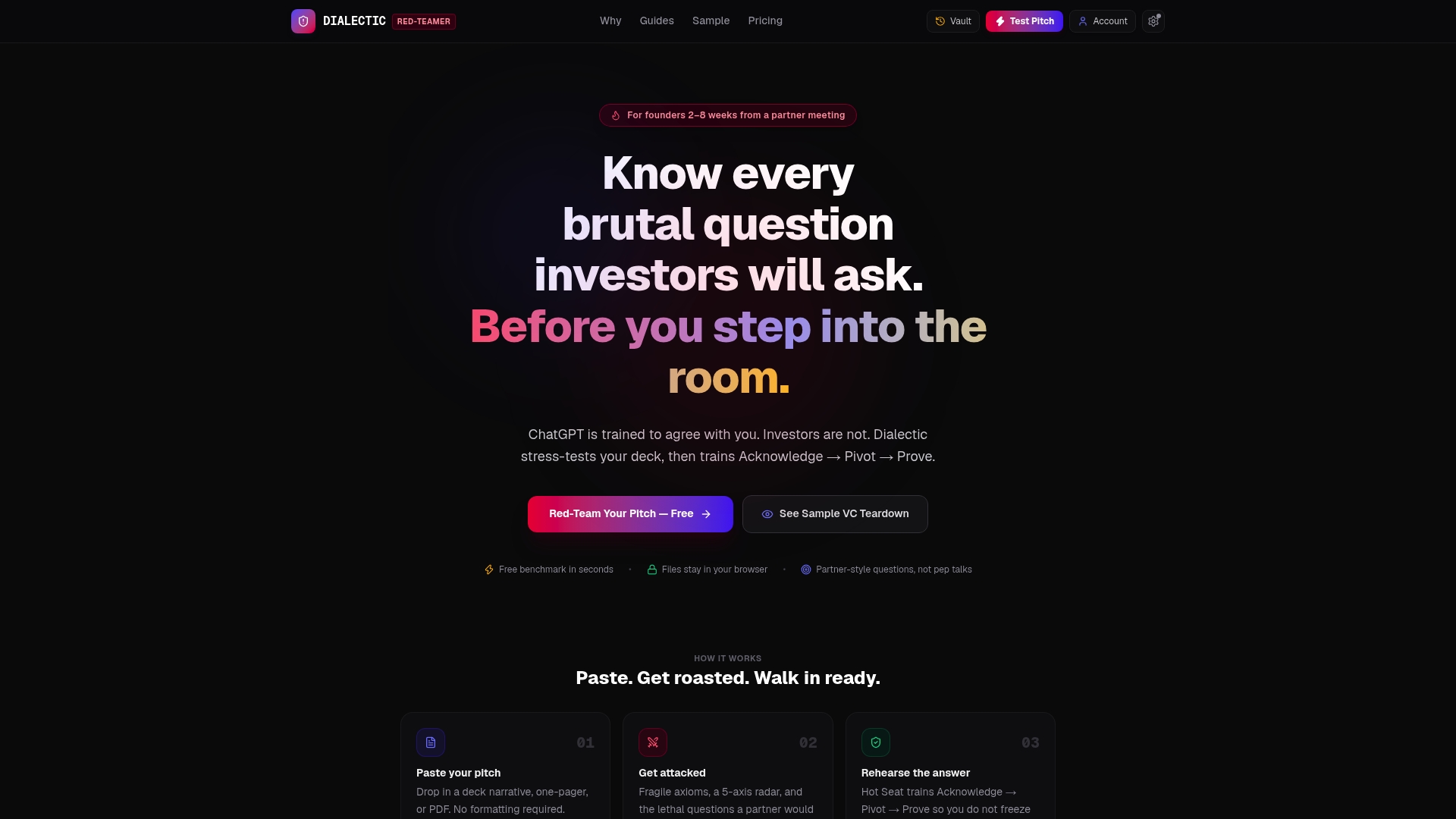
Pricing is simple. A Tactical Audit is $25 one-off per audit, Founder Pro is $49 per month, and Venture & Studio 5 Seats is $149 per month for teams. You can start on the Dialectic site by uploading your deck.
FAQ
What happens at an investor meeting?
It is a two-way assessment. The investor wants to know whether you and your business are interesting enough to justify another meeting or an introduction to colleagues, according to the Holloway Guide. Expect a short presentation followed by a lot of questions on your market, model, team and numbers.
How long should I present before taking questions?
There is no fixed rule, but a good target is to keep your presentation short and leave most of the time for conversation. One toolkit suggests about 8 minutes of explanation in a 30-minute slot. Techstars recommends an investor deck you can present in no more than 10 minutes.
Which numbers should I know before I walk in?
Know your CAC and LTV at minimum, and be able to explain how they are calculated. Beyond those, be ready for market sizing, growth drivers, retention and what the raise funds. If a number is on your slide, assume someone will ask where it came from.
What should I do right after the meeting?
Follow up the same day with the materials you agreed to send and answers to any open questions. Restate the next step and the timeline you discussed. Then record the questions you were asked so you can prepare for them in the next meeting.
Sources
- Investor Meetings, The Holloway Guide to Raising Venture Capital
- Due Diligence Playbook, Angel Capital Association
- Raising Your Institutional Round, Polaris Alpha
- 10 Steps to Perfect Your Startup Pitch, Stanford GSB
- How to Pitch a Business Idea, HBS Online
- The Fundraising Process, NYU Entrepreneurship
- Fundraising: A Candid Account, Stanford
- Techstars: Ready to Raise
- Techstars: Prepping Your Materials
- Techstars: Why Most Pitch Decks Don't Work
- Douglas Leone: Five Lessons, Stanford GSB
- Before You Pitch: A Practical Check for Investor Fit, TGN Ventures
- What Founders Should Ask VCs, UCSD Startup Toolkit
- A Fundraising Coach's Step-By-Step Guide, Forbes
- How To Prepare For Seed Round Investor Meetings, Forum Ventures
- A 7-step method for running effective pitch meetings, TechCrunch
- Making the Most of Investor Meetings, Equidam
- Data room Q&A with cited answers