
Social proof in a startup pitch is evidence that other people already believe in you: customers who use the product, advisors who vouch for it, press that covered it, and investors who have committed or shown interest. It works because investors rarely evaluate a company alone. They read signals from others. But it only helps when each signal is real, relevant and labeled exactly for what it is. Overstated proof is worse than none.
TL;DR
- Social proof means other people's interest in a venture. In an academic field experiment, it raised investor interest most when paired with product certification.
- The main types are customers, advisors, media and other investors. Proof from a credible, relevant source counts for more than a long list of weak ones.
- Place proof where an investor is likely to doubt you: traction claims, pricing, market size and the ask.
- Label every signal precisely: conversation, verbal yes, signed agreement, active pilot, paying customer. Regulators have charged founders for blurring these lines.
- Pre-revenue teams can show proof of learning: documented interviews, tested hypotheses and the changes they drove.
Table of Contents
- What social proof means in an investor pitch
- Why investors respond to it
- The types of social proof a pitch can use
- Where social proof belongs in the deck
- How to show proof when you have no revenue
- Present traction with exact labels
- Where overstated proof becomes a legal problem
- A checklist before you send the deck
- Our view: proof is a claim an investor will test
- Pressure-test your proof before investors do
- FAQ
- Sources
What social proof means in an investor pitch
Marketers use the term for reviews and testimonials aimed at buyers. In fundraising the audience is different, and so is the definition. A study in Management Science defines social proof in early-stage equity investment as other people's interest in investing in a venture, and treats it as a signal about the venture's investment characteristics. In plain terms: when someone credible has already looked at your company and leaned in, the next investor reads that as information.
Nir Eyal describes the same pattern from the founder's side. In his account of fundraising, investors tend to invest more readily when other investors are already in or interested, especially when those investors are well regarded. Seed investors in particular often show herd behavior, more inclined to commit once other well-regarded investors have.
That gives you two layers of social proof to manage:
- Market proof: customers, users, partners and press that show people outside your team want what you built.
- Capital proof: angels, funds, accelerators and advisors who have already put their name or money behind you.
Both appear in a good pitch. Neither replaces the fundamentals: a clear problem, a credible team, unit economics that make sense and a plan for the money.
Why investors respond to it
Early-stage investing is decision-making under thin information. There is little revenue history, the product is changing and the market is unproven. Investors use shortcuts, and social proof is one of the strongest.
The best controlled evidence comes from a randomized field experiment reported in Management Science. It found that combining product certification with social proof produced a 65% higher likelihood of investor interest than receiving none of the tested signals. The useful lesson is in the word combining. Social proof paired with a second, independent signal of quality did more than either alone. A logo slide with no evidence the product works is a weaker pitch than a smaller set of customers with a documented result.

Surveys point the same way, though with softer data. In one survey of 143 startups, nearly a third said positive reviews and social proof were critical for generating investor interest. That is founders' opinion, not investor behavior, so treat it as context rather than proof.
There is also a reason to be careful. If investors lean on others' judgment, they also notice when that judgment is hollow. VCs quoted by TechCrunch say celebrity or insider buzz may create attention without showing mass adoption, and they look for qualified teams and genuine user interaction behind it. Borrowed prestige gets you a meeting. It does not survive diligence.
The types of social proof a pitch can use
Social proof typically comes from advisors, customers, the media and investors. Its value is generally proportional to the legitimacy of whoever is endorsing you: big-name customers, reputable media placements and commitments from experienced investors are the strongest. A broader list from TechCrunch adds product reviews, testimonials, earned media, influencers and community signals, with the caveat that they should be credible and relevant.
Here is how those types translate into a pitch deck.
| Type | What it looks like in a deck | What an investor will ask |
|---|---|---|
| Customers | Named customers with a measured outcome, short quote, usage or retention data | Are they paying? Do they renew? Is this one account or a pattern? |
| Advisors | Operators or domain experts who work with you, with a line on what they do | What have they actually contributed? Do they have equity or a real role? |
| Media | Coverage from outlets your buyers and investors respect | Did it drive users, or is it a vanity mention? |
| Investors | Committed capital, lead investor, or credible angels already in the round | Who is leading? How much is committed versus soft? |
| Community | Active users, open-source adoption, waitlist with engagement data | Do these people use the product, or only sign up? |
Relevance matters as much as prestige. A well-known logo in an unrelated industry says less than three small customers who match your target segment and renew. Pick proof that answers the specific doubt a reader of your deck would have.
Where social proof belongs in the deck
Do not collect your proof on a single slide and move on. TechCrunch's guidance for customer-facing social proof applies to pitch decks too: it is most useful near friction or objection points, such as pricing, extraordinary claims and critical calls to action. Credible, relevant evidence beats generic praise.
Map that onto a standard deck:
- Problem slide: one customer quote or interview finding that shows the pain is real and costly. Not a statistic from a report. Someone who lives with the problem.
- Solution and product: a short case with a named or described customer and the specific outcome they got. Phil Green of the Harvard Innovation Labs advises founders to sell the specific outcome and show that a similar customer already achieved it with your offering, rather than selling the product itself.
- Traction: your strongest evidence, with metric definitions and time periods.
- Business model and pricing: proof that people pay at this price. A signed contract at your list price is better than a survey saying people would pay.
- Team: advisors and prior employers that make your claim to the problem credible, kept to the ones who matter.
- The ask: who is already in the round, who is leading, and what is committed versus in conversation.
A useful test for each slide: what is the most skeptical question an investor could ask here, and does the proof on the slide answer it before they ask?
How to show proof when you have no revenue
Pre-revenue does not mean pre-proof. It means the proof changes shape. The Lean LaunchPad method, studied in a National Science Foundation-supported paper, uses iterative hypothesis testing and data collection, including interviews and observations, to guide product development. The artifacts of that process are social proof of a kind.
The Harvard Innovation Labs makes the investor-side point directly: for early-stage startups, documented customer interviews, tested hypotheses and adjustments made from feedback are often more valuable than early revenue numbers. What this looks like in practice:
- Interview evidence: how many people you spoke to, how you chose them, and what share described the problem unprompted.
- Hypothesis log: what you believed, what you tested, what you found, and what you changed.
- Commitments with cost: a signed letter of intent, a paid pilot or a deposit says more than a compliment.
- Advisors with a real role: someone who introduced you to three buyers is proof. Someone who lent a name is not.
- Early investor interest: a respected angel who has committed, described exactly as committed.
The point is not to look bigger than you are. It is to show you learn faster and more honestly than the next team.
Present traction with exact labels
This is where most pitches either earn trust or lose it. Hustle Fund recommends separating conversations, verbal yeses, signed agreements, active pilots and paying customers, and giving growth figures a period, a starting value and a metric definition. Its guidance also notes that a letter of intent is evidence of interest, not booked revenue, and a waitlist is evidence of sign-ups, not product use.
A simple way to apply it is the claim-proof-limit-next format the same source suggests: for each important claim, show the proof, state what the evidence does not prove, and name the next milestone. For example:
Claim: Mid-size logistics firms will pay for automated customs paperwork. Proof: Four signed 90-day pilots at a fixed monthly fee. Limit: Pilots are paid but not yet converted to annual contracts. Next: Convert at least three to annual terms with this round's first six months.
That structure is credible because it shows what the evidence proves and what it leaves for the financing to test. Keep the backup ready too: interview notes, product logs, contracts and the calculations behind each figure, since investors will ask for them in follow-up.
Where overstated proof becomes a legal problem
In the United States, this is not only about reputation. Securities regulators treat statements to investors seriously, and several recent actions involve exactly the kind of proof founders are tempted to inflate.
- The SEC alleged that a founder overstated a startup's revenue and subscriber numbers to investors.
- In a 2023 matter, the SEC alleged that a company prematurely claimed a contract had been executed and left out material information about the economic terms of another.
- In a 2024 complaint, the SEC alleged that a pitch-deck logo slide was misleading because it included companies that were not subscribers. Some had only paid for a proof of concept, and others had never been customers.
These are allegations in filed complaints, not a verdict on every founder who uses a logo slide. But the pattern is clear and practical. Only show a logo if that company is a customer in the sense your slide implies. Never describe a pilot as a contract or a waitlist as users. If you are unsure how to word something in an offering document, ask your securities counsel before the deck goes out.
Vanity metrics are the quieter version of the same problem. Followers, press mentions and total sign-ups feel like proof but rarely answer the question an investor actually has: will people pay, stay and tell others? Put those numbers behind retention, revenue and usage, or leave them out.
A checklist before you send the deck
Run every piece of proof through these questions:
- Is it true as stated? Could a reference call or a document confirm the exact wording?
- Is it relevant? Does it come from the segment, size and use case you are selling to?
- Is it credible? Would the person or organization be recognized by the investor reading it?
- Is it recent? Old logos and last year's quote age quickly.
- Is it labeled? Pilot, LOI, verbal, signed, paid: is the word on the slide?
- Is it placed well? Does it sit next to the claim it supports?
- Can you back it up in the room? Do you have the log, contract or calculation behind it?
If an item fails any of these, either fix it or cut it. A shorter proof section that survives every follow-up question is stronger than a long one that cracks on the second.
Our view: proof is a claim an investor will test
Most founders treat social proof as decoration: a logo strip, a quote, a press badge. We see it differently. In a real investor meeting, every piece of proof is a claim, and the partner across the table is paid to find where it breaks.
That is why supportive feedback does not prepare you. A friendly reader will tell you the logo slide looks strong. A skeptical partner will ask which of those logos pay you, since when, and what happens if the biggest one leaves. If you are hearing that question for the first time in the meeting, you are improvising on the most expensive hour of your fundraise.
We built Dialectic around that gap. You upload your deck or memo, and it is scrutinized the way a seasoned VC partner would scrutinize it: fragile assumptions, blind spots, and the questions that tend to end conversations. Your traction and proof claims get the same treatment. The result is a fragility and risk score and structured feedback on what to tighten, so a vague claim becomes a precise, defensible one.
Then you rehearse. Real-time boardroom practice puts the hard questions to you and grades your defense, so the way you explain your proof is as solid as the proof itself.
D
Pressure-test your proof before investors do
If you have a deck with traction claims, customer logos or investor interest on it, the cheapest time to find the weak spots is before the meeting. We built Dialectic for that. Upload your pitch deck or memo and see how it holds up against partner-style questioning.
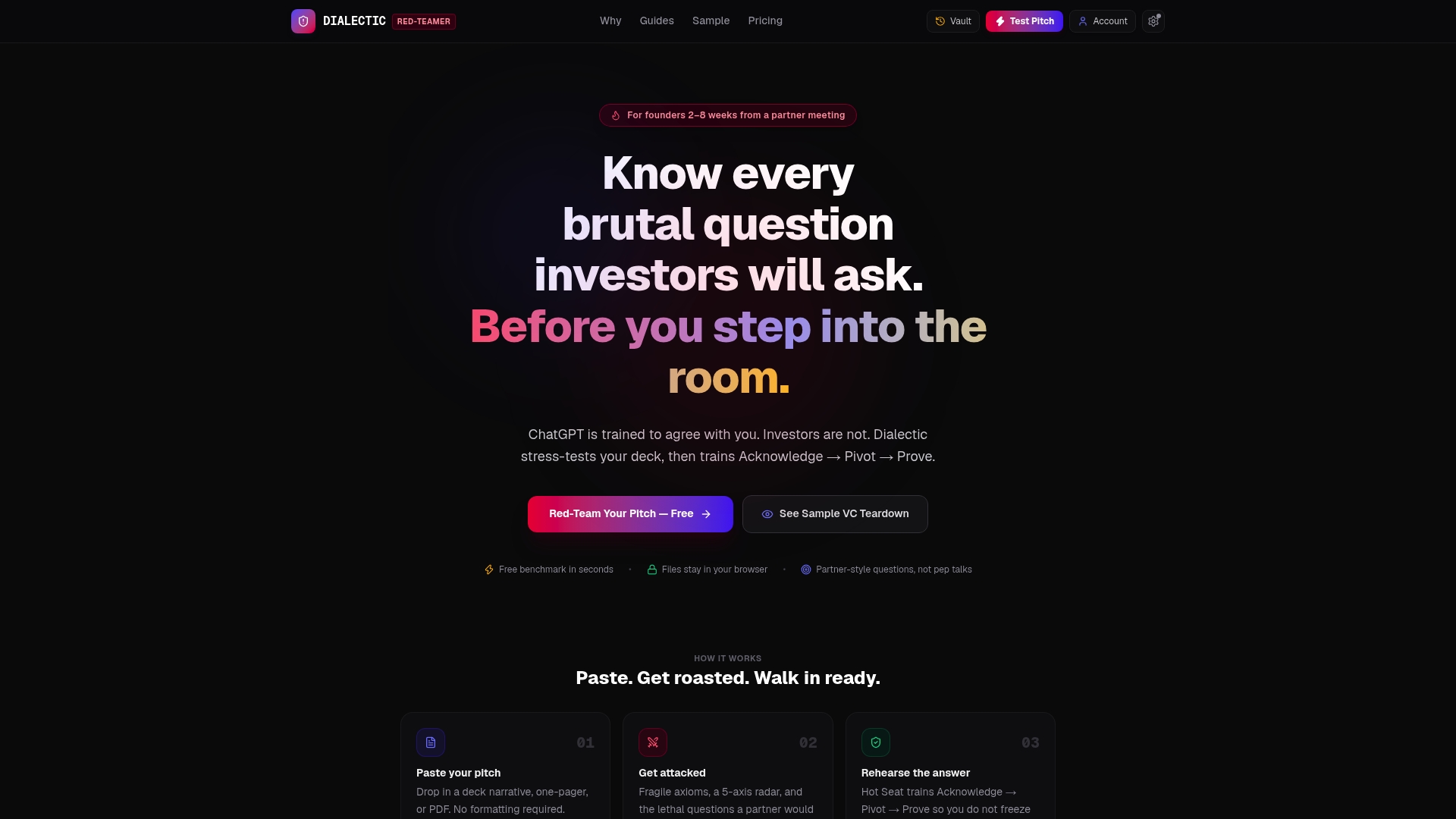
There are three ways to start. The Tactical Audit is $25 one-off per audit, a fit if you want one deck checked. Founder Pro is $49 per month for founders who iterate and rehearse repeatedly. Venture & Studio 5 Seats is $149 per month for teams and studios who need several people working on pitches. You can see the options and start on the Dialectic site.
FAQ
Is social proof the same as traction?
Not quite. Traction is measured progress, such as revenue, active users or retention. Social proof is what other people's behavior or endorsement signals about you, such as customers, advisors, press and investors. The strongest pitches use social proof to support traction and traction to back up social proof.
Can I use social proof if I have no customers yet?
Yes. Use evidence of learning: documented customer interviews, tested hypotheses and the changes you made in response. Add advisors with a real role and any credible early investor interest. Label each one for exactly what it is, since an interview is not a commitment and an LOI is not revenue.
Should I put customer logos in my pitch deck?
Only for companies that are customers in the way your slide suggests. The SEC has alleged that a deck's logo slide was misleading when it listed companies that were not subscribers. If a logo represents a pilot or a proof of concept, say so on the slide.
How many pieces of social proof are enough?
There is no magic number. A few relevant, verifiable signals from credible sources beat a long list of weak ones. Choose the proof that answers the main doubt on each slide, and be ready to back every item with a document, log or reference.
Does naming other investors in the round help?
It can, especially when they are well regarded, because investors often follow others who have already committed. Be precise about whether they have committed capital, are leading, or are only interested. Investors will check.
Sources
- Complementarity of Signals in Early-Stage Equity Investment, Management Science
- Using Mind Control to Raise Startup Cash, Nir Eyal
- What Investors Look For in Seed Startups, Sterling Road
- The importance of social proof in FinTech, Trustpilot
- Demand Curve: How to get social proof that grows your startup, TechCrunch
- How to Get Startup Traction and Social Proof, Fundable
- Lean LaunchPad and Customer Discovery, NSF Public Access Repository
- Startup Myths to Leave Behind in 2025, Harvard Innovation Labs
- How First-Time Founders Build Investor Credibility, Hustle Fund
- SEC complaint, Central District of California (2025)
- SEC litigation release on Intrusion Inc. (2023)
- SEC complaint, Northern District of California (2024)
- 3 VCs weigh in on when to follow the hype cycle, TechCrunch (2023)