
Prepare your startup three to six months before fundraising by assembling a data room covering legal, financial, commercial, IP, and team documents. Then run adversarial rehearsals and a full document audit to expose the gaps investors will find anyway, before they find them.
TL;DR:
- After a term sheet is signed, active diligence typically lasts 60 to 90 days, so late document cleanup can weaken your negotiating leverage.
- If you have only weeks, reconcile the cap table first, verify every contributor’s signed IP assignment second, and gather top customer contracts third.
- Investors compare bank statements with the books and deck, and they expect KPI definitions, calculation methods, and forecast assumptions to stay consistent.
- Investor checklists can cover eight to ten categories and more than 100 requests, so assign folder owners and log major document changes.
Table of Contents
- How does investor due diligence unfold stage by stage?
- What exactly do investors look for in each category?
- What goes in your data room, folder by folder?
- When should you start, and what if you don't have six months?
- What legal and IP risks tend to stall a deal?
- What financial hygiene do investors actually test?
- How do investors evaluate your team and operations?
- What habits keep a startup always ready for diligence?
- What does real adversarial rehearsal reveal that a friendly review misses?
- Diligence readiness is a signal, not a chore
- How Dialectic helps you pressure-test your pitch before investors do
- FAQ
- Sources
How does investor due diligence unfold stage by stage?
Due diligence rarely arrives as one event. It builds in layers, and each layer brings sharper questions and a narrower set of investors still at the table.
- Sourcing and screening: an investor reviews your deck, asks clarifying questions about market size and traction, and decides whether to take a meeting.
- Initial diligence: after a first meeting, associates or principals request basic financials, your cap table, and customer references to confirm the pitch holds up.
- Deep diligence: once there is real interest, a team digs into contracts, IP assignments, tax filings, and detailed unit economics, often with outside counsel involved.
- Partner review: the deal moves to investment committee, where partners stress-test assumptions and look for anything that was glossed over earlier.
- Closing: final confirmations, updated cap table reconciliation, and signature on financing documents.
Screening funnels are unforgiving. Survey evidence from the venture process shows a large pool of deals considered narrows sharply at each stage, with only a small subset reaching detailed diligence and an even smaller subset closing, according to a practitioner review of startup due diligence questions. That means the founders who get funded are usually the ones whose paperwork survives repeated, increasingly skeptical passes.
Timing matters as much as content. Active diligence windows typically run 60 to 90 days once a term sheet is signed, and legal advisors recommend starting preparation three to six months before you plan to raise, according to Morgan Lewis's review of the NVCA model documents. Starting late does not just compress your timeline. It compresses your negotiating leverage, since investors sense when a founder is scrambling to produce documents on demand.
What exactly do investors look for in each category?
Every diligence category maps to a specific set of documents, and each document answers a specific question an investor is quietly asking. Knowing the question in advance lets you prepare the answer instead of improvising it.
- Legal: investors want your certificate of incorporation, bylaws, board and shareholder consents, and any prior financing documents, using templates close to the NVCA Model Legal Documents as the reference standard for what a clean structure looks like.
- Financial: historical profit and loss statements, a balance sheet, cash flow statements, bank reconciliations, and a reconciled cap table that matches your legal filings line for line.
- Commercial and product: signed customer contracts, retention and churn data, and unit economics that back up the growth story in your deck.
- IP and technology: signed assignment agreements from every founder, employee, and contractor, plus a clear account of any open-source components and basic security posture.
- HR and compliance: employment agreements, equity vesting schedules, payroll tax filings, and contractor agreements that distinguish independent contractors from employees correctly.
Investor checklists tend to span eight to ten major categories and can run past 100 individual line items once you count every document and metric requested, according to Neotas's investment due diligence checklist. That volume is exactly why founders who wait until a term sheet lands to start pulling files run out of runway fast.
Legal diligence usually starts with formation documents because a messy cap table or an unauthorized stock issuance can unravel an entire deal. Financial diligence goes deeper than your top-line revenue number: investors reconcile your bank statements against your books to confirm the numbers in your deck are the numbers in your accounts, not a cleaned-up version of them, as explained in this notes on valuing a business.
Commercial diligence tests whether your growth is durable. An investor reading your top ten customer contracts wants to know if revenue is concentrated in one account that could walk away, and whether your retention numbers hold up cohort by cohort rather than in aggregate. IP diligence is often the most technical and the most commonly mishandled, since a missing assignment agreement from an early contractor can put your core technology's ownership in question. HR diligence checks whether your team structure can survive a scale-up, looking at vesting schedules, offer letters, and whether equity grants were documented and approved correctly at the time they were made.
What goes in your data room, folder by folder?
A data room is only useful if an investor can find what they need without asking you for it twice. Organize it by category, name files consistently, and keep every document current rather than archived from a year ago.
- Corporate and formation: articles of incorporation, bylaws, board and shareholder meeting minutes, and a full record of stock issuances.
- Cap table: a single reconciled cap table, every option grant with vesting terms, and documentation for every SAFE or convertible note outstanding.
- Financials: profit and loss statements, balance sheet, cash flow statement, bank statements, and reconciliations tying the books to the bank.
- Contracts: customer agreements, vendor contracts, partnership agreements, loan documents, and any lease agreements still in force.
- IP and technology: signed IP assignment agreements for every contributor, patent filings if applicable, access to code repositories, and any security or penetration test reports.
- Customers and commercial: your top customer list, representative sample contracts, and metrics covering ARR or MRR and retention by cohort.
- HR and payroll: offer letters, equity grant schedules, and contractor agreements that confirm proper worker classification.
- Compliance and tax: federal and state tax filings, sales tax records, state registration filings, and any required licenses for your industry.
Each folder should have a named owner inside your team, someone accountable for keeping that section current rather than assuming it will get updated before the next raise. A change log noting when major documents were revised saves you from explaining discrepancies later, and it signals to investors that your records are maintained, not assembled under pressure.
Pro Tip: Reconcile your cap table against your bank records and legal filings every month during an active fundraising window, not just before you open the data room.
The IP folder deserves particular attention because it is the one category where a single missing signature can stall a deal. Pull your full list of past and current contributors, including early contractors and part-time engineers, and confirm each one signed an assignment agreement before work began. Gaps here are common and expensive to fix retroactively, according to the American Bar Association's review of IP due diligence in M&A.
When should you start, and what if you don't have six months?
The three to six month window before a raise is not arbitrary. It is roughly how long it takes to find and fix the kinds of problems that only surface once someone starts pulling at threads: an unsigned IP assignment, an unreconciled cap table entry, a customer contract with an unusual termination clause.
- Six months out: run a legal audit of your formation documents, reconcile your cap table against every issuance, and confirm every contributor has signed IP assignments.
- Four months out: clean up your financials, so your bank statements, books, and investor deck all tell the same story with no quiet adjustments.
- Two months out: assemble your top customer contracts, finalize your metrics package, and make sure HR and payroll records are current.
- One month out: run a full mock diligence pass, treating your own data room as an investor would, and fix whatever breaks.
If you are working with weeks instead of months, triage ruthlessly. Fix your cap table first, since an unreconciled cap table is the single fastest way to lose investor confidence. Confirm IP assignments second, since that gap is the hardest to remediate under time pressure. Pull your top customer contracts third, since concentration risk is the first thing a commercial reviewer will ask about.
What legal and IP risks tend to stall a deal?
A handful of issues account for most of the delays and renegotiations that happen late in diligence, and nearly all of them are fixable well before an investor ever sees your data room.
- Securities compliance gaps on SAFEs, convertible notes, or equity issuances, since every security issuance needs proper documentation or a valid exemption under the Securities Act of 1933.
- Missing IP assignment agreements from founders, employees, or contractors, which can lead an investor to treat your core technology as unsecured.
- Material contract clauses, such as change-of-control provisions or exclusivity terms, that restrict future financing rounds or limit a future exit.
Investor checklists commonly span eight to ten major due diligence categories and can include more than 100 individual document and data requests across a single round, according to Neotas. That scope is why a single missing assignment agreement or an unreconciled issuance can feel disproportionately disruptive: it is one gap in a review process built to catch exactly that kind of gap.
Fixing securities and IP issues before a raise rather than during one changes the tone of the entire negotiation. A founder producing clean issuance histories and signed assignments on request looks prepared. A founder scrambling to backfill a contractor's signature mid-diligence looks like a risk, whether or not the underlying business is sound.
What financial hygiene do investors actually test?
Financial diligence is less about whether your numbers are good and more about whether your numbers are real, consistent, and traceable back to source documents.
- Historical profit and loss statements, a balance sheet, and cash flow statements that reconcile cleanly against your bank statements month over month.
- Core KPIs investors expect to see, including ARR or MRR, customer acquisition cost, lifetime value, churn, and gross margin, presented with the calculation method shown.
- Written assumptions behind your forecasts, including growth rates, hiring plans, and any material one-time adjustments called out explicitly rather than buried in a footnote.
Investors do not expect a flawless financial history. Early-stage companies have messy books, and most investors know it. What erodes confidence is a number in your deck that does not match the number in your bank statement, or a KPI definition that shifts between your pitch and your data room. If your CAC calculation includes paid marketing spend in one slide and excludes it in another, that inconsistency gets noticed and it gets asked about.
Document your assumptions as plainly as you would explain them out loud.
How do investors evaluate your team and operations?
Investors diligence people almost as closely as they diligence numbers, because a strong product with a disorganized team is still a risky bet.
- Employment agreements, equity vesting schedules, and contractor assignment agreements that confirm clean, documented relationships with everyone on the team.
- Reference checks and background documentation on founders and key hires, which investors use to confirm the story you told in the pitch matches how others experienced working with you.
- Operational playbooks covering onboarding, basic security practices, and repeatable processes that show the business can function without the founder personally handling everything.
A team that can produce clean HR records on request signals the same discipline an investor hopes to see in the product itself. A team that cannot find a signed offer letter for a co-founder signals the opposite, regardless of how strong the metrics look.
What habits keep a startup always ready for diligence?
The founders who move through diligence fastest are not the ones who prepare hardest right before a raise. They are the ones who never let their records drift far from ready in the first place.
Run a quarterly document audit and keep one reconciled cap table as the single source of truth, rather than a master version plus several out-of-date copies circulating in email threads. Assign a named owner to each data-room folder and keep a simple change log for major updates, so nothing goes stale without someone noticing. Treating a data room as a living system rather than a one-time deliverable is standard guidance among practitioners who track how NVCA's model documents get used across financing rounds.
Add a quarterly mock-diligence pass to that routine, including an adversarial rehearsal where someone plays a skeptical investor and pushes on your weakest claims. Inconsistencies caught in a rehearsal cost you nothing. The same inconsistencies caught by a real investor cost you leverage.
Pro Tip: Schedule your quarterly cap table reconciliation and mock-diligence review on the same calendar day, so neither one quietly slips.
What does real adversarial rehearsal reveal that a friendly review misses?
A supportive review tells you your deck sounds good. An adversarial rehearsal tells you where it falls apart under pressure, which is the version of scrutiny you will actually face in a partner meeting.
The difference shows up in what gets found. A friendly reviewer flags typos and slide order. An adversarial reviewer asks why your churn number excludes a specific cohort, or why your take rate assumption does not match your signed contracts, the kind of forensic question an investor raises right before passing on a deal.

A useful real-world illustration of this approach is the Nexus Take-Rate Teardown, where a forensic-style red-team review of a board memo surfaced a mismatch between a stated take rate and the underlying contract terms, the exact category of gap that standard diligence is built to catch. Rehearsing against that level of scrutiny before a real investor does is the practical difference between a fixable gap and a lost deal.
Diligence readiness is a signal, not a chore
Treat due diligence as ongoing operational hygiene, not a sprint you run once before closing. A startup that can produce a reconciled cap table and signed IP assignments on a Tuesday afternoon with no notice is telling an investor something about how it runs, long before the financials even get read.
The founders who struggle most in diligence are rarely hiding something serious. They are usually just disorganized, and disorganization reads as risk whether or not it is.
— D
How Dialectic helps you pressure-test your pitch before investors do
We built our platform around one gap we kept seeing: standard AI feedback tools tell you your deck sounds fine, while real investors do not. Our adversarial pitch deck stress-testing scores fragility, flags blind spots, and runs real-time boardroom rehearsal with graded responses, so the first person to find your weakest assumption is not a partner halfway through your raise.
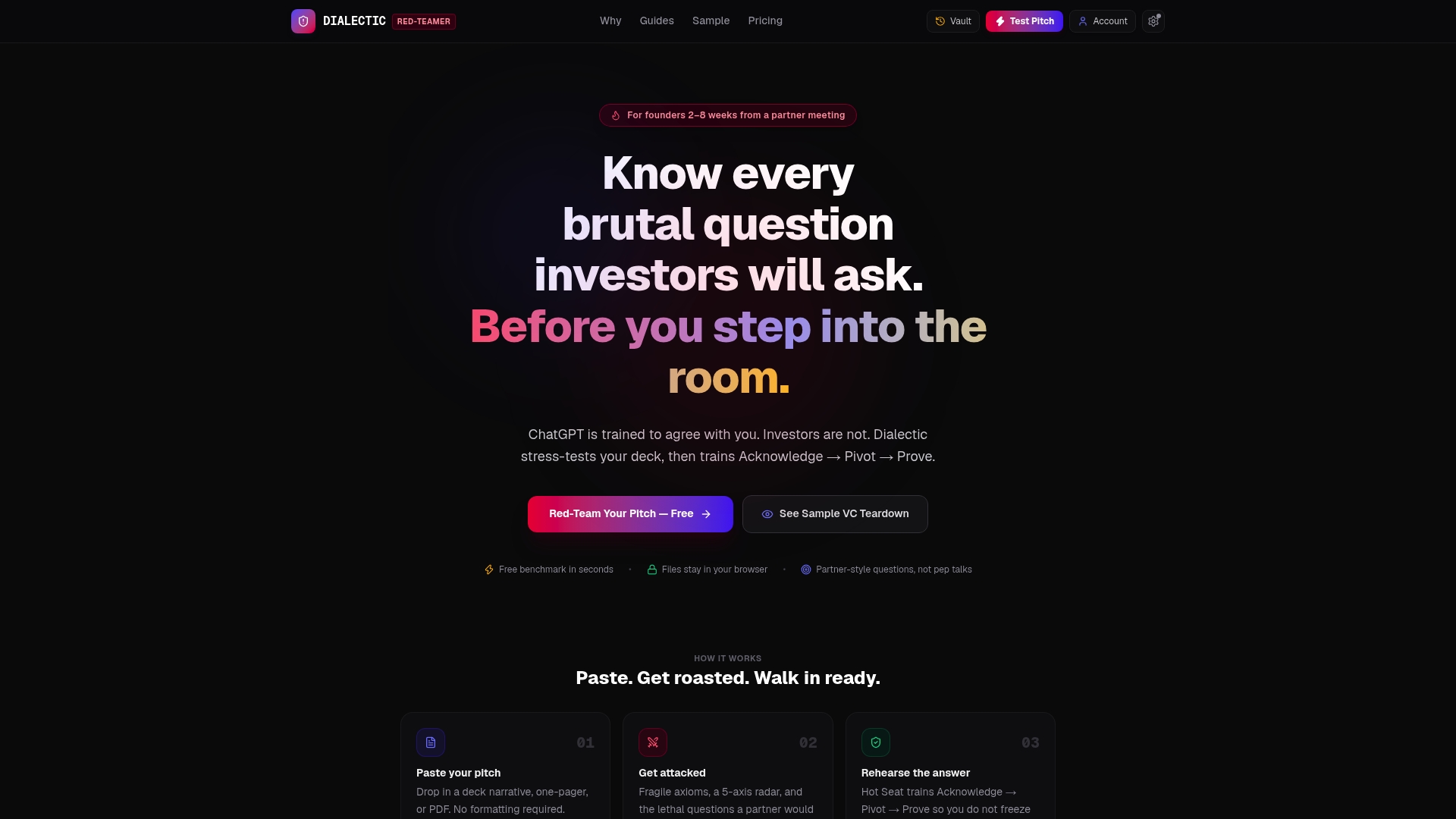
Our Tactical Audit runs a one-off review of your deck or memo for $25. Founder Pro, at $49 a month, gives you ongoing rehearsal access as you refine your pitch. Venture & Studio 5 Seats, at $149 a month, covers a team preparing multiple raises or portfolio companies at once. The Nexus Take-Rate Teardown shows what that scrutiny looks like applied to a real board memo.
| Offer | What it does | Price |
|---|---|---|
| Tactical Audit | One-off adversarial review of a deck or memo | $25 one-off per audit |
| Founder Pro | Ongoing rehearsal and feedback access | $49 per month |
| Venture & Studio 5 Seats | Team access for multiple raises or portfolios | $149 per month |
Check availability and start your Tactical Audit before your next investor meeting.
FAQ
What is the ideal timeline for startup due diligence prep?
Start three to six months before you plan to fundraise, since that is roughly how long it takes to fix cap table errors, missing IP assignments, and financial inconsistencies, according to Morgan Lewis. Once a term sheet is signed, active diligence typically runs 60 to 90 days.
What documents do investors request most often during due diligence?
Investors most commonly request formation documents, a reconciled cap table, financial statements with bank reconciliations, signed IP assignment agreements, and your top customer contracts. Checklists often span eight to ten categories and well over 100 individual items, according to Neotas.
What are the most common deal breakers found in startup due diligence?
Missing IP assignment agreements, unreconciled or improperly issued equity, and restrictive clauses in existing contracts are among the most frequent issues that stall or kill a deal. IP assignment gaps in particular are a well-documented failure point, according to the American Bar Association.
How can founders rehearse for tough investor questions before a real meeting?
Run adversarial rehearsals where someone plays a skeptical investor and pressure-tests your weakest claims and numbers, rather than relying on a supportive first read. Tools like our adversarial pitch rehearsal platform are built specifically to simulate that kind of scrutiny before you face it live.
What legal documents should every startup have ready for investors?
Every startup should have its certificate of incorporation, bylaws, board and shareholder consents, a reconciled cap table, and signed IP assignment agreements ready and current. The NVCA Model Legal Documents serve as the industry standard reference for what these documents should contain.
Sources
- What's new in the NVCA model legal documents and what's next — Morgan Lewis (2024)
- NVCA Model Legal Documents
- Intellectual property due diligence in M&A — American Bar Association (2023)
- Investment due diligence checklist — Neotas