
Your use of funds slide must show three things in one glance: the ask and round type, an allocation broken into a handful of milestone-linked categories, and a runway figure backed by a real spreadsheet. Skip any of the three and investors read the gap as a lack of preparation, not a lack of detail. Get all three right and the slide becomes the strongest evidence in the deck that you know how to run the company.
TL;DR:
- A strong use of funds slide clearly states the ask, round type, and runway, backed by a real spreadsheet with defendable calculations.
- Every allocation should link to a measurable milestone and include a specific, time-bound goal to avoid vague or guesswork signals.
- Visuals should focus on up to six categories connected directly to traction claims, with supporting detail in the appendix or spreadsheet.
- Stress-test assumptions on customer acquisition, hiring timelines, and capital needs by simulating slower growth or delays before investor questioning.
- Tailor the emphasis on the slide to the investor type, with founders clarifying aims for angels, VCs, or strategic partners.
Table of Contents
- What the use of funds slide is and why investors care
- Core elements to include: the checklist founders must show on the slide
- Visual patterns and slide examples that work
- How to compute and defend allocations
- Stress-testing your use of funds slide
- Tailoring the slide for different types of investors
- Examples of successful use of funds slides from well-known startups
- Updating the slide across later funding rounds
- Integrating risk assessment related to fund allocation
- Storytelling and narrative flow around the slide
- Investor priorities and what really moves a deal
- How Dialectic can help founders stress-test their allocation story
- Sources
- FAQ
What the use of funds slide is and why investors care
The use of funds slide answers one question for investors: will this founder spend our money like an owner or like someone hoping for the best? It sits near the end of the pitch deck, right after or combined with the ask, and it is often the last substantive thing an investor studies before deciding whether to take a second meeting.
Investors scan it in about five seconds and run three checks almost automatically. First, is the ask amount and round type stated plainly, with no digging required. Second, does the allocation logic make sense for the stage and the story told earlier in the deck. Third, are the categories tied to measurable milestones and a timeline, or are they just labels with percentages attached.
A weak slide fails at least one of these checks, and the damage is not cosmetic.
- Percentages with no milestones read as guesswork dressed up as a plan.
- Categories like "operations" or "growth" with no specifics signal the founder has not modeled the business.
- A missing or vague runway statement suggests the founder does not know when they will need to raise again.
Each of these signals tells a partner that diligence will surface more problems, and that is often the moment a deck gets quietly shelved rather than escalated.
Core elements to include: the checklist founders must show on the slide
A use of funds slide that survives scrutiny has five parts, in a fairly fixed order. Miss the order and the slide reads unfinished even if all the information is technically present.
- State the ask and round type first. Put the dollar figure and round label (seed, Series A, bridge) in the largest text on the slide, top-left or as a header, so it never requires a second look.
- Break the budget into four to six categories. Categories like product development, sales and marketing, hiring, and operating buffer work better than a dozen thin slices that dilute the story.
- Attach one milestone to each category. Say what the money buys in outcome terms: "12 enterprise customers by Q3" reads stronger than "sales and marketing, 35%."
- State runway in months and the underlying assumption. A single line such as "18 months of runway at current burn, with headcount growing from 8 to 14" gives investors the number they will otherwise calculate themselves.
- Add proof of capital efficiency only if it strengthens the story. A prior round that stretched further than typical, or a low burn multiple, belongs here only if it is genuinely notable, not as filler.
Pro Tip: Write each milestone as a SMART goal, specific, measurable, achievable, relevant, and time-bound, the same discipline behind sample decks that closed seed rounds using SMART, time-bound milestones on the ask slide.
The phrasing matters as much as the structure. Vague, timeless milestones are one of the clearest signs of an underprepared team during investor review, according to TechCrunch's analysis of sample seed decks.
Visual patterns and slide examples that work
The right chart depends on the complexity of the raise, not on what looks best in a template library.
- Pie chart with milestone callouts works well for early-stage, single-phase raises where four or five categories cover the whole ask and each slice can carry a short milestone label.
- Stacked bar by phase suits multi-year or multi-phase plans, showing how allocation shifts from, say, product-heavy spending in year one to sales-heavy spending in year two.
- Timeline with metric anchors fits founders who can tie spending directly to revenue or product milestones, showing a line from funding to feature launch to customer count to next raise.
- Appendix, not the main slide, is where the detailed hiring plan, unit economics table, and sensitivity analysis belong, ready the moment an investor asks to see the math.
Whichever visual you pick, resist cramming more than six categories onto one chart. A slide with ten thin slices forces investors to read labels instead of absorbing the story, and the extra detail belongs in the appendix anyway.
How to compute and defend allocations
Every number on the slide should trace back to a calculation you can defend on the spot, not a round figure that felt right.
Start with runway. The standard formula is cash balance divided by monthly cash burn, and it is the first thing most investors will recompute in their heads. Say a company has $1,200,000 in the bank and burns $80,000 a month: that gives 15 months of runway. If the new raise adds $2,000,000 and burn rises to $150,000 a month to support new hires, runway becomes roughly 21 months. Showing both the before and after numbers demonstrates that you understand how spending decisions move the clock.

Sequoia's guidance on extending runway recommends planning to raise your next round with enough buffer to close the deal about 12 months before the cash runs out, which means your use of funds slide should implicitly show more than bare survival to the next milestone.
From there, translate every percentage into a dollar figure and a milestone, never leave it as a bare percentage. TechCrunch argues that expressing a use of funds slide only as percentages is itself a red flag, because it lets founders avoid committing to what the money actually buys. The same source recommends pricing out the milestones needed to raise the next round and adding a safety buffer on top, rather than relying on round percentages alone.
A significant portion of the raise, typically a safety buffer, should be set aside against slower-than-planned hiring, delayed customer acquisition, or unexpected costs, a range TechCrunch cites as standard practice for founders sizing their ask. That buffer is not padding: it is the difference between a plan that survives a rough quarter and one that forces an emergency bridge round.
Build the backing spreadsheet before the meeting, not after someone asks for it.
- List every hire by month, with fully loaded cost, not just salary.
- Show customer acquisition cost and expected customer growth month over month.
- Include marketing spend by channel and the assumption behind each number.
- Run a quick sensitivity check: what happens to runway if CAC rises 25% or a key hire slips two months.
Keep this spreadsheet as an appendix slide or a leave-behind document, ready the moment diligence starts, rather than something you promise to send later.
Stress-testing your use of funds slide
The slide that survives a partner meeting is the one that survived a harder conversation first. Every allocation on the slide should have an owner, a metric, and a month-by-month cash need behind it, because investors will ask "who owns this number" long before they ask "does the math work."
Three assumptions tend to be the fragile ones a rigorous review turns up almost every time.
- Optimistic customer acquisition cost, often modeled on early results that will not hold at scale.
- Hiring timelines that assume every offer is accepted on schedule, when recruiting almost always runs slower than planned.
- Underestimated capital expenditure, especially for hardware, inventory, or compliance costs that get discovered late.
An adversarial rehearsal, where someone plays the skeptical partner and pushes on exactly these points, tends to surface the weak spots before an investor does it for real. That is the model behind Dialectic's approach to pitch deck audits and investor question rehearsal, which stress-tests the same categories a VC partner would probe: is the CAC number based on real spend or a guess, does the hiring plan match the milestones on the slide, and does the buffer actually cover the risks named earlier in the deck.
Pro Tip: Before your next investor meeting, have someone in the room ask "why this number and not double" for every single category on the slide, then be ready to answer in one sentence.
Have the detailed hiring plan, any early test-marketing results, and signed or drafted contracts ready to hand over the moment diligence starts. A forensic teardown of a board memo shows how quickly a reviewer can find the gap between a stated number and the underlying support for it, which is exactly the gap a rehearsal is meant to close before a real investor finds it.
Tailoring the slide for different types of investors
Angels, venture capital funds, and strategic investors read the same slide for different reasons, and a slide tuned for one audience can undersell you with another.
Angel investors, often writing smaller checks from personal capital, respond to founder-level detail: personal runway, how far the round gets you without another raise, and evidence that you are spending your own resources carefully. Keep the categories simple and the story close to the product.
Venture capital partners want to see how the round advances you toward the metrics that unlock the next round. Their read of the slide is really a read of your fundraising trajectory, so tie each allocation to the specific traction number (ARR, active users, retention) that will matter when you raise the next round.
Strategic investors, often corporates or industry players, care most about how the funds advance the relationship or market position that justifies their involvement. If part of the raise funds integration work, a pilot, or a joint go-to-market effort, that category should be named explicitly rather than folded into generic "operations."
The underlying numbers do not need to change across versions of the deck, but the emphasis and the language around each category should shift to match what that investor type is actually evaluating.

Examples of successful use of funds slides from well-known startups
Sample decks that have publicly closed rounds share a consistent pattern: the ask and use of funds live on one slide, milestones are dated rather than vague, and the categories map directly to what the company said earlier in the deck it needed to prove.
A seed-stage biotech deck that closed a $3.5 million round, for instance, combined the ask and use of funds slide and paired each budget line with a specific, time-bound milestone rather than a bare percentage, an approach TechCrunch highlighted as a strength in its analysis of the deck. The lesson generalizes well beyond that sector: whatever your categories are, each one should read as a promise with a date attached, not a spending category.
What separates decks that raise from decks that stall is rarely the visual polish. It is whether the categories connect back to the traction claims made three or four slides earlier in the deck. If the team slide mentioned a hiring gap in sales, the use of funds slide should show hiring dollars against that exact gap. If the traction slide showed slowing growth, the allocation should show marketing dollars aimed directly at that problem. Investors notice when the slide answers the concerns the rest of the deck raised, and they notice just as quickly when it does not.
Updating the slide across later funding rounds
The use of funds slide is not a one-time artifact. Each round changes what investors expect to see on it, and reusing last round's categories without updating them is one of the faster ways to look out of touch with your own company's stage.
At seed stage, the slide is mostly a bet on the founder and the plan: categories tend to be broad (product, first hires, early marketing tests) because there is little operating history to point to. By Series A, investors expect the categories to reflect actual unit economics, real CAC data, and a hiring plan built on lessons from the first round rather than assumptions. By Series B and beyond, the slide should show scaling logic: how the next dollar extends a proven model into new markets, channels, or products, with historical burn and efficiency numbers backing every claim.
Each round should also show, briefly, how the previous round's money was actually spent versus what was planned. Revise every dollar figure, milestone, and runway assumption from scratch each round rather than adjusting the previous deck's numbers, since stale assumptions are easy for a diligence-minded investor to spot.
Integrating risk assessment related to fund allocation
Every allocation carries a risk, and naming that risk on or near the slide is stronger than hoping no one asks about it. The three most common risks are execution risk (can you actually hire and ship on the stated timeline), market risk (will the customer acquisition assumptions hold as you scale spend), and capital risk (does the buffer cover a slower-than-planned quarter without forcing an emergency raise).
A brief, honest acknowledgment of risk, paired with the mitigation built into the plan, reads as more credible than a slide that implies everything will go exactly as modeled. If a category depends on a hire that has proven hard to recruit for, say so and show the contingency plan. If a channel's CAC is unproven at higher spend, note the smaller test planned before scaling it fully.
This is also where the safety buffer earns its keep as more than a rounding cushion. Investors are not looking for a plan with no risk. They are looking for a founder who has already identified the risks that matter and priced them into the ask.
Storytelling and narrative flow around the slide
The use of funds slide works best as the payoff to a story the rest of the deck has already told, not as a standalone financial exhibit. If the problem slide established that customer acquisition is the company's biggest unlock, the allocation should visibly put real money against that exact problem. If the team slide flagged a gap in engineering leadership, the hiring category should show that gap closing on a specific timeline.
The strongest version of this slide reads almost like a sentence: "we are raising [amount] to hit [milestones] within [timeframe], which gets us to [next round or outcome]." Everything else on the slide, the categories, the chart, the runway line, exists to support that one sentence rather than compete with it for attention.
Avoid treating the slide as a place to list every possible expense. A category that does not connect to a milestone mentioned earlier in the deck, or that exists mainly to make the pie chart look balanced, tends to dilute the narrative rather than reinforce it. The categories with the strongest story, usually two or three of the four to six on the slide, deserve slightly more visual weight and a clearer milestone than the rest.
Investor priorities and what really moves a deal
Founders spend a disproportionate amount of time on chart design and comparatively little on whether the milestones would survive a skeptical follow-up question. That ordering is backwards. Investors forgive a plain pie chart; they rarely forgive a milestone that falls apart under one "how did you get that number" question.
If you have limited time before a meeting, work in this order: get the ask and round type unmistakably clear, make every milestone defensible with real numbers behind it, then stress-test the runway assumption against a slower-than-planned quarter. Visual polish is the last five percent, not the first.
The founders who close rounds are usually the ones who rehearsed the hard questions and built the appendix before anyone asked for it, not the ones with the best-looking slide.
— D
How Dialectic can help founders stress-test their allocation story
Most founders review their use of funds slide by rereading it themselves or asking a friendly colleague, which rarely surfaces the questions a skeptical partner would actually ask. Dialectic takes the opposite approach: it puts your deck through the kind of adversarial, partner-style questioning that reveals fragile CAC assumptions, hiring timelines that will not hold, and buffers that do not actually cover the risks you named.
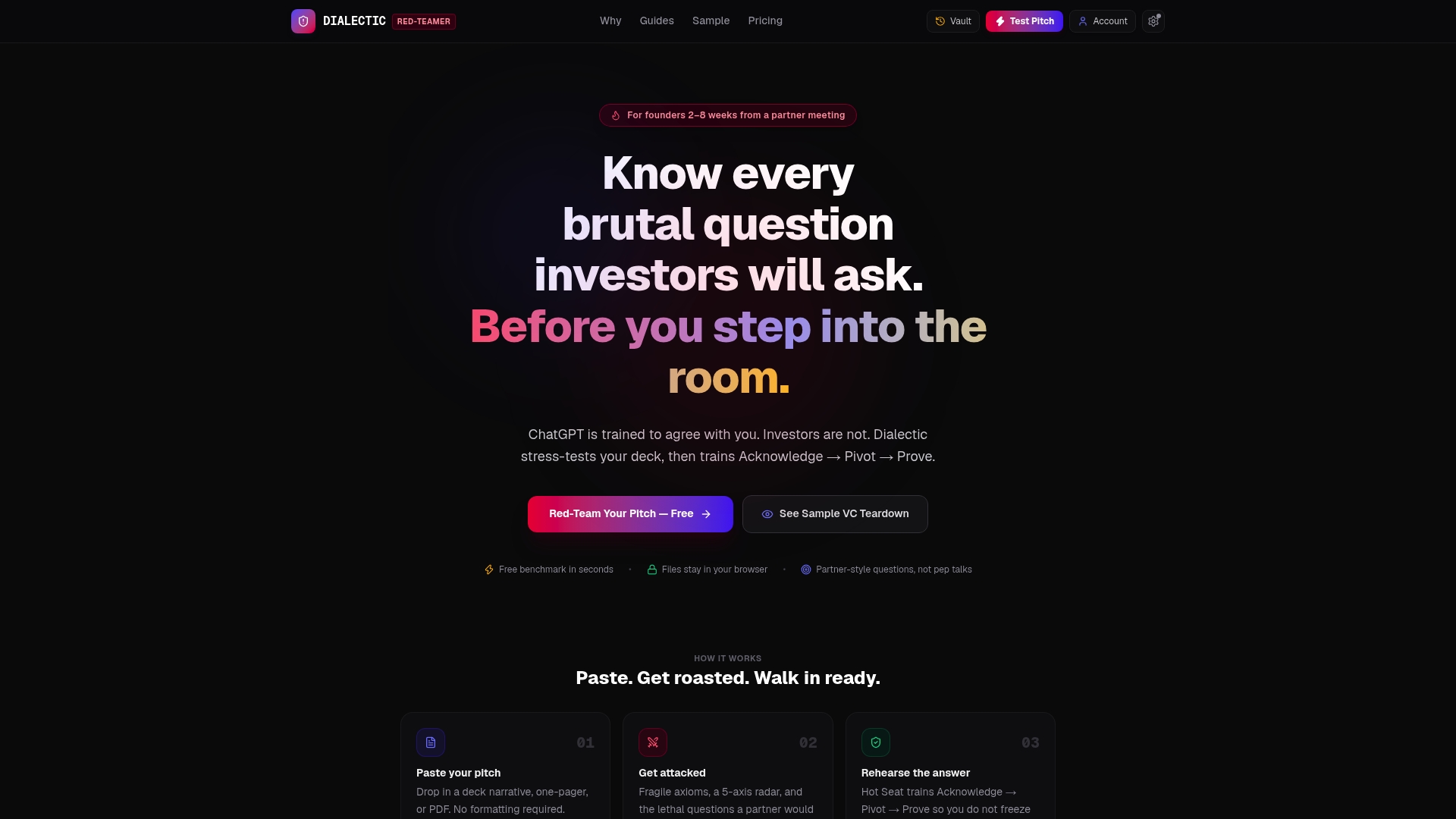
- The Tactical Audit provides a one-off audit that runs your deck through fragility scoring and structured weakness detection ahead of a single high-stakes meeting.
- Ongoing plans give access to rehearsal and audit tools as your deck evolves across multiple investor conversations.
- Team subscriptions extend stress-testing across multiple companies or founders preparing for pitch season.
Choose an external audit when you have already revised the slide internally and need someone to argue against it the way a VC partner would. After a session, most founders leave with tighter milestone language, a defensible runway number, and answers ready for the questions that used to catch them off guard. Start with the Tactical Audit or a Founder Pro plan before your next investor meeting.
Sources
For further reading, TechCrunch's analysis of use of funds red flags and sample seed deck breakdown, plus Sequoia's runway guidance, cover the calculations in this article in more depth. Pair them with a one-page operational spreadsheet and a diligence-ready appendix slide, and review Dialectic's forensic teardown example for how deep that defense should go.
FAQ
What is a money slide?
A money slide is another name for the ask or use of funds slide, the page in a pitch deck that states how much you are raising and exactly what the funds will accomplish. It typically combines the round amount, the budget breakdown, and the milestones that money is expected to hit.
What are red flags for angel investors?
Angel investors tend to flag vague spending categories, allocations shown only as percentages with no dollar figures or milestones attached, and a missing or unclear runway statement. TechCrunch identifies percentage-only allocations without milestones as a specific warning sign that a founder has not modeled the business closely enough.
Is there a free tool I can use to create pitch decks?
Several free and freemium design tools, including Canva and Google Slides, offer pitch deck templates you can adapt for a use of funds slide. The harder part is not the template but making sure the numbers and milestones behind each category can survive investor questioning.
What is the 10/20/30 rule for pitch deck?
The 10/20/30 rule suggests a pitch deck should keep slides concise and use a font size large enough for clarity. It is a general guideline for keeping a deck concise rather than a fixed requirement, and the use of funds slide fits within that same discipline of stating the essential numbers clearly rather than crowding the slide with detail better suited to an appendix.