
A good VC meeting rehearsal does one thing: it makes you answer the questions a skeptical partner will ask, out loud, under pressure, before the real meeting. Reading your deck again does not do that. Running it against adversarial questions, scoring your answers and repeating until the weak spots hold does. That is what Dialectic's boardroom rehearsal is built for: you upload your deck or memo, face partner-style questioning, and get a graded defense.
This guide covers what a VC meeting actually is, how the stages differ, which questions to rehearse, a step-by-step routine, and what to do afterward.
TL;DR
- A VC meeting is a staged process, from a first conversation to a partner meeting where the firm decides. Rehearse for the stage you are in.
- The goal of the early meetings is to earn the next meeting, so your rehearsal should make your answers short, direct and backed by numbers.
- Write the ten hardest questions a skeptical partner could ask, then answer each one out loud until you stop hedging.
- Rehearsal exposes weak assumptions. Fix the assumption in the model, not just the wording on the slide.
- After the meeting, send a short follow-up and deliver anything you promised.
Table of Contents
- What a VC meeting is, and why one rehearsal is not enough
- What changes at the partner meeting
- The questions to rehearse
- How to run a VC meeting rehearsal, step by step
- Rehearsal mistakes that cost founders the next meeting
- Where Dialectic fits
- Our perspective
- After the meeting: follow-up that keeps momentum
- FAQ
- Sources
What a VC meeting is, and why one rehearsal is not enough
Founders use "VC meeting" for a series of conversations with a venture firm, not one event. One VC's guide to the process describes it as staged meetings that start with an initial substantive conversation and end with the partner meeting where the decision is made. The same guide makes a point that shapes how you should practice: the purpose of each meeting is to get the next meeting, not to close.
An idealized process, assuming no prior relationship, runs about four meetings from first sitting down with a decision-maker to a term sheet. Each one tests something different:
| Stage | What the investor is testing | What to rehearse |
|---|---|---|
| First meeting | Is this interesting enough to take seriously? | A tight story, your one memorable number, your ask |
| Follow-up with the point partner | Do the details hold? | Unit economics, traction, competition |
| Partner meeting | Will the whole partnership back this? | Defending the case under interruption from many people |
| Diligence | Are the claims true? | Sources behind every figure |
The first meeting is often a conversation, not a performance. One investor-side view argues that the best first meetings are a two-way exchange rather than a one-way pitch. That is a reason to rehearse your answers rather than a script: you need to be fluent enough to follow the conversation wherever it goes.
What changes at the partner meeting

The partner meeting, often called the Monday meeting, is where the full partnership reviews a startup and votes on issuing a term sheet. According to Startups.com's lexicon, founders typically present a tighter pitch of 15 to 30 minutes, followed by 30 to 60 minutes of questions from the partnership.
First Round's guide to seed-stage partner meetings adds practical detail:
- A partner meeting usually lasts 60 minutes, against 30 to 45 minutes for a one-on-one.
- Anywhere from 5 to 15 investors can be in the room, depending on the firm's size.
- The firm often skips introductions to save time, so ask your point partner who will attend, or check the firm's website.
- Coming with slides is almost always recommended, because they help you guide the conversation and answer questions in more detail.
- Most firms get a decision back within 24 hours, and some within hours of the same day.
Two consequences for rehearsal. First, most of the meeting is questions, so most of your practice time belongs there, not on the opening monologue. Second, different partners ask different kinds of questions: one probes the market, another the model, another you. You need answers that survive each angle.
The questions to rehearse
The most useful rehearsal exercise is also the least comfortable. Lever Venture's meeting plan suggests writing the ten hardest questions a skeptical partner could ask, including why now, why you, whether a large competitor could copy you, how unit economics improve with scale, and what would make you wrong.
Build your list from these groups.
Business model and unit economics
The questions that come up again and again, as Venture Atlanta's list shows, are about money: where most revenue comes from, how customers are acquired and at what cost, what the margins are, last month's revenue, how long until profitability and how much runway the investment will provide. The Founder Handbook adds market size for your specific market, competition, and unit economics such as acquisition cost, churn and lifetime value.
Rehearse these with the arithmetic behind each slide figure in your head. If a partner asks how you got a number and you answer "it's in the appendix," the room notices.
Plan versus reality
Series A-style questions get sharper. Inflection CFO points to questions such as your path to profitability and when it happens, and notes that investors look for the revenue level at which you become cash-flow positive and whether your burn and runway get you there on the capital you are raising. They also flag the question of the actual difference between your plan and reality, and recommend being able to say which assumptions missed and how you adjusted the model using real data.
A model that answers the basics clearly helps here. Bling Capital's checklist says a financial model should show when you first get paying customers (or assume nobody pays for the next 12 to 18 months), how much cash you consume monthly and how many months of runway that implies.
The question behind the question
First Round describes the "question behind the question": an investor may ask one thing while looking for a deeper layer. Its suggestion is to play it back, with a phrase like "I think you are asking about this." That is a skill you only build by hearing the question asked in a form you did not anticipate, which is why a fixed list of practice questions is not enough on its own.
For a deeper catalog of the questions that sink rounds, see our guide to VC diligence questions that kill seed rounds.
How to run a VC meeting rehearsal, step by step
Here is a routine you can complete in a few sessions. At each step we note where it goes wrong and what Dialectic does.
Step 1: Pin down the meeting you are rehearsing for
Identify the stage (first meeting, point-partner follow-up or partner meeting), the length, the format and who will be in the room. Ask your point partner, and take the firm's lead on whether it is Zoom, phone or in person, as the meeting-map guide advises.
Where it goes wrong: founders rehearse one 20-minute pitch and use it for every stage. A first call and a partner meeting need different material.
Step 2: Put your deck or memo under adversarial review first
Before you speak a word, find out where the document is fragile. Dialectic takes your uploaded deck or memo, scrutinizes it the way a seasoned VC partner would, and returns structured weaknesses, blind spots and a fragility and risk score. You see the soft assumptions before an investor does, along with the tactical pivots that turn them into strengths. The Pitch Deck Red-Team guide explains the approach.
Where it goes wrong: supportive feedback. Polite reviewers tell you the story is compelling and miss the unit-economics hole. Our note on why a general chatbot won't roast your pitch goes into why adversarial scrutiny is a different job from encouragement.

Step 3: Write your ten hardest questions and answer them in writing
Start from the Lever Venture list above and add the questions your own audit surfaced. Use Initio Capital's three principles: answer first and then explain, leading with the direct answer in one sentence; use numbers you can stand behind, saying so and offering to follow up if you do not know; and practice out loud.
Where it goes wrong: answers that bury the point. If your first sentence is context, the partner has already formed a view.
Step 4: Rehearse out loud, with pushback
Written answers are not spoken answers. Initio's advice is to say them to someone who will push back. Dialectic's real-time boardroom rehearsal does exactly that: it puts partner-style questions to you as you answer, and grades your defense, so you see which answers hold and which collapse on the second question. Our mock VC interview guide walks through how a session runs.
Where it goes wrong: rehearsing with people who like you. The first time a hard follow-up lands should not be in the real meeting.
Step 5: Practice being interrupted
The Holloway guide argues that answering questions is a core way to stress-test the deck: prepare the scariest questions and rehearse being interrupted so your material stays usable when you are challenged. Build your deck so you can jump to the slide that answers a question and come back to your place.
Step 6: Assign roles if you are more than one founder
Alex Iskold advises that founders should not meet investors without fully rehearsing, that rambling and disorganization are a sure way to get a no, and that when several founders attend they need a clear lead and should rehearse handing off to each other. Decide who answers product, who answers financials and who closes. Then practice the handoffs.
Step 7: Fix the assumption, then re-run
When an answer wobbles, the problem is usually underneath the wording. Every material sentence should either name a source or state an explicit assumption, which is the point of a Subconscious.ai post on rehearsal: practice should expose missing sources and unclear assumptions, not paper over them. Change the model or the claim, then run the session again and compare the grades.
Step 8: Do a technical and logistics run the day before
For virtual meetings, one guide to final VC meetings is not the source here; instead, simply use the same device, connection and platform you will use on the day. Our 24-hour pitch checklist covers what to confirm in the last day.
Rehearsal mistakes that cost founders the next meeting
- Rehearsing the pitch, not the Q&A. In a partner meeting, questions can take as much time as the presentation or more.
- Memorizing a script. If the first meeting is a conversation, a script breaks the moment the investor goes off it.
- Guessing at numbers. Say you will send it within a day, as the Lever Venture plan suggests, rather than inventing a figure.
- Treating the investor as passive. Investors want to share what they know and probe where your assumptions differ from theirs. Leave room for that.
- Stopping after one run. The value is in the loop: test, find the weakness, fix, retest.
Where Dialectic fits
If you want the whole routine in one place, Dialectic gives you the adversarial review, the partner-style questions and the graded rehearsal against your own deck. Pricing on the site:
- Tactical Audit: $25 one-off per audit, for a single deck or memo before one meeting.
- Founder Pro: $49 per month, for founders rehearsing across a fundraising process.
- Venture & Studio 5 Seats: $149 per month, for studios and teams.
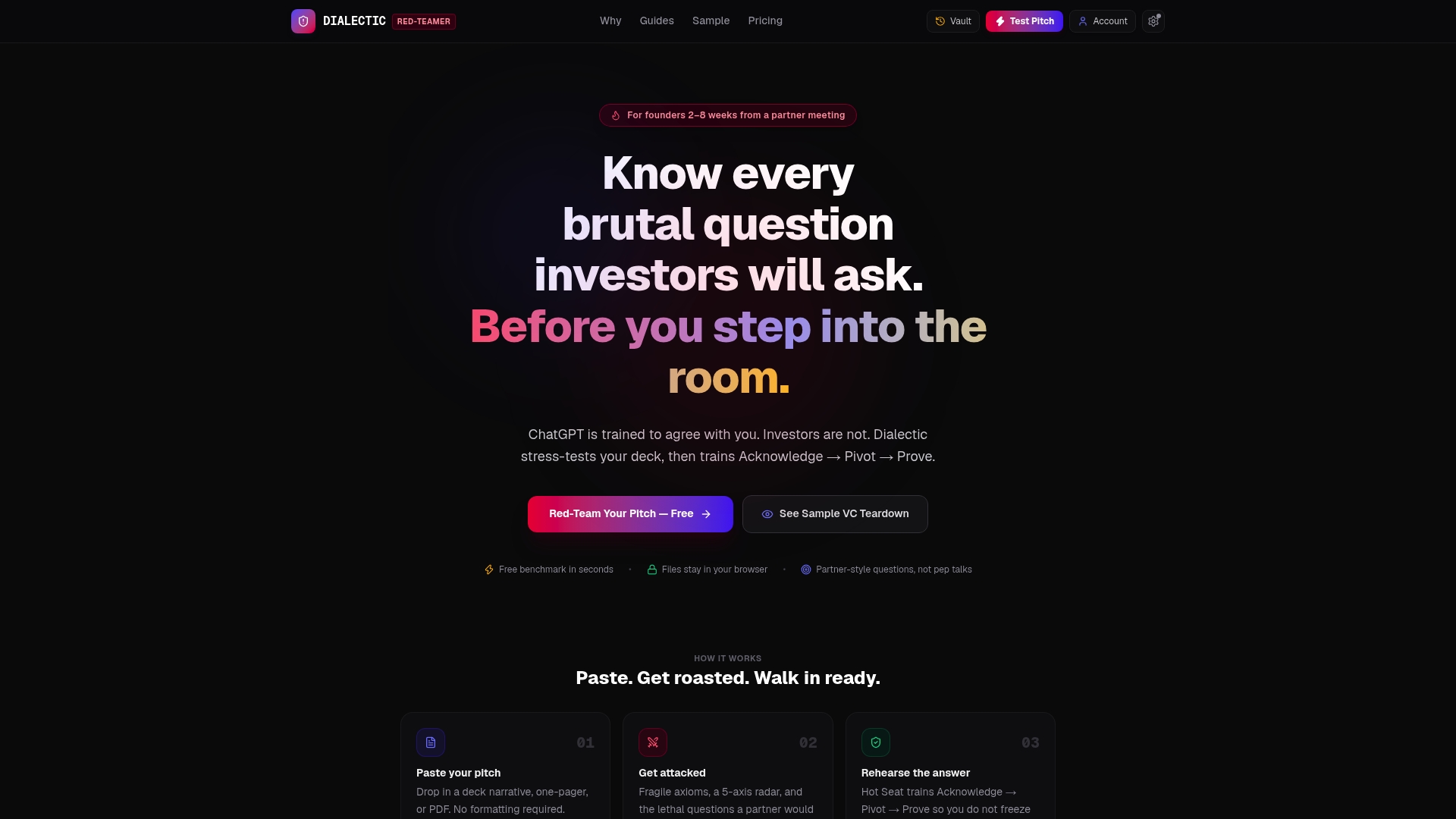
Upload your deck on Dialectic, see where it is fragile and rehearse the answers before the partners ask.
If you want to see what a red-team looks like on real material, the Nexus take-rate teardown shows a forensic CFO taking apart a board memo.
Our perspective
Most founders prepare for the meeting they hope to have: a friendly conversation where the story lands. Investors run the meeting they have to have: a search for the reason not to proceed.
We built Dialectic around that gap. Supportive feedback feels good and teaches little. Partner-style scrutiny finds the fragile assumption, the blind spot and the number you cannot defend, while you still have time to fix it.
That is why we pair the audit with rehearsal. Knowing your weak point is half the work. Defending it out loud, under questioning, and seeing your answer graded is the other half. Our Sand Hill Road pitch standard sets out the bar we hold decks to.
D
After the meeting: follow-up that keeps momentum
Rehearsal does not end when you leave the call. Pitchkit's post-meeting playbook recommends:
- Send a thank-you email within two hours, referencing something specific from the conversation.
- Deliver anything you promised immediately.
- Keep it to four or five sentences, and do not use the email to pressure for a decision.
- Log your notes within an hour: questions asked, concerns raised, what the investor engaged with most, next steps and follow-ups.
Those notes are your next rehearsal's question list. Any question you stumbled on becomes the first thing you run again before the next investor.
FAQ
What does a VC meeting mean?
It is a meeting between founders and a venture firm to evaluate whether to move forward together. In practice it is a series: an initial substantive meeting, follow-ups and a partner meeting where the firm decides. Each meeting's job is to earn the next one.
How long should I rehearse for a VC meeting?
There is no fixed number, but plan several sessions rather than one. Run the questions, fix the weak assumptions, then repeat until your answers are short and consistent. For a partner meeting, give most of the time to questions, since the questions can run 30 to 60 minutes.
What questions should I rehearse most?
Start with why now, why you, whether a large competitor could copy you, how unit economics improve with scale and what would make you wrong. Add revenue sources, acquisition cost, margins, runway and the path to profitability.
Should I use slides in a partner meeting?
First Round says it is almost always recommended to bring slides to a partner meeting, because they help guide the conversation and support detailed answers. Prepare so that you can jump to any slide when a question demands it.
Sources
- The VC Meeting Map: What to Expect After a Successful Pitch
- Partner Meeting: definition and the Monday-meeting reality
- Raising: Navigating The VC Firm
- A Recipe for First Meetings Between Founders and VCs
- What You Can Really Expect at a VC Partner Meeting
- Pitch to a Venture Capital Firm: Meeting Plan and Follow-Up
- Most Common Investor Questions
- Questions VCs Will Ask You
- Series A Preparation: The Hard Questions
- Startup Diligence Guide: The Financial Model
- Common investor questions in a seed pitch meeting
- Practicing Your Presentation
- Why and How to Prepare for Investor Meetings
- Rehearsing a VC Pitch Isn't the Same as Proving the Numbers
- From pitch to follow-up: the 7-day post-meeting playbook