
VC partner feedback is only useful if it is specific, and most of it isn't. Partners hedge, pass with polite phrases and rarely explain why. The founders who benefit are the ones who anticipate the hard questions before the meeting, ask for candid input in the right way, and turn what they hear into evidence. For the first part, a partner-style stress test of your deck, such as Dialectic's pitch deck red-team, gives you the adversarial questions before a real partner asks them.
TL;DR
- Partner debriefs usually center on the team, the market, and then product, go-to-market and differentiation.
- Useful feedback names the flawed assumption and a next step. "Too early" or "not enough traction" alone is a polite no.
- Answer hard questions by conceding the true part first, then give a number or customer fact instead of conviction.
- Ask "what would you want to see over the next few months?" rather than "what did you think?"
- Act on patterns: three investors raising the same issue is a signal, one complaint is not.
Table of Contents
- What VC partner feedback actually covers
- Specific feedback versus vague feedback
- How to respond to tough questions in the room
- How to ask for candid feedback
- Turning feedback into changes
- Getting partner-style feedback before the meeting
- Our perspective
- FAQ
- Sources
What VC partner feedback actually covers
In a partner meeting, each partner forms a view and the firm debates it afterward. NextView's Melody Koh describes the post-meeting debrief as starting with each partner's high-level sentiment, with most attention on the team and the market. The product, go-to-market strategy and competitive differentiation are debated often. Founders should then expect the lead partner to follow up within 24 to 48 hours with a clear yes, a clear no, or specific areas for more diligence.
NextView's Rob Go lists what his partners care about in a pitch: the value to the customer, distribution advantages, market context, unit economics, trust and company culture. He also argues that narrative matters more than ticking every box.
The format shapes the feedback. First Round Review reports that a seed-stage partner meeting usually lasts 60 minutes, against 30 to 45 minutes for a one-on-one, and can include 5 to 15 investors. The point partner typically writes an investment memo in advance for the others to read. That means the room has already seen your numbers. Expect questions throughout, including ones unrelated to the slide on screen.
Specific feedback versus vague feedback
Most founders hear something vague. Honest VC's guide says good feedback names the flawed assumption, separates validated from unproven or likely wrong assumptions, fits the stage and includes next steps. Its example of the specific kind is an addressable-market analysis that assumes 100% adoption in the target segment. The generic version is "your market is too small."
One investor's example of a good pass, in a guide to passing written with VC investors, focuses on a single reason: he cannot get comfortable with the level of competition in your market. One honest reason beats a list of five.
Why is so much of it vague? A Tenacious Ventures partner writes that investors hedge because explaining why takes time, clarity and guts, and risks being misquoted. In the same essay, "unclear differentiation" can mean the investor did not dig in, and "too early" can mean a lack of conviction in you or the space.

Phrases to decode
Seth Levine's reading of pitch-meeting phrases is a useful key:
| What you hear | What it usually means |
|---|---|
| "Let me noodle on this and get back to you" | A no the investor does not want to deliver in person |
| "Let me talk to my partners about it" | A no, with the partners as the reason |
| "I'd like to understand more about X" | Real interest and a willingness to do more work |
| "Let's schedule another meeting to dig into X" | Interest, and time being committed |
A "let's keep in touch" with no trigger attached is, in StartupFundraising.com's reading, just a polite no. A "no, but" with a measurable condition, such as a revenue milestone, is actionable.
How to respond to tough questions in the room
The Q&A is often where partners decide. Allied Venture Partners notes that every question carries subtext used to probe risk and test market knowledge, and recommends mock Q&A sessions. Four habits help.
- Answer the question behind the question. First Round describes investors asking one thing while wanting the answer a layer deeper. When you sense it, play it back: "I think you are asking about this."
- Concede the true part first. Deepak Gupta's objection playbook holds that defending a fair criticism costs more credibility than the criticism itself.
- Restate, name the risk, show your thinking. One steel-manning method suggests restating the concern in its strongest form, naming the legitimate risk underneath, and inviting the investor to say where they are still unconvinced, in roughly 40 to 60 seconds.
- Say what you don't know. Then say how you would find out. A number or customer quote beats conviction.
Surface awkward history early. Rob Go advises sharing unusual details or missteps in an early one-on-one, in a context showing the company is on firmer footing, rather than letting them emerge late in front of a larger group.
The weakness of reading about this is that nobody interrupts you while you read. Practicing against hostile questions is a different skill. Our boardroom rehearsal guide covers practicing verbal defense under fire, and our list of diligence questions that kill seed rounds shows what partners probe hardest.
How to ask for candid feedback
Partners rarely volunteer specifics, so the framing of your ask matters.
- At the end of a first meeting: Tran VC suggests asking "What would you want to see from us over the next few months to get more confident in the story?" instead of "What did you think?"
- To surface the blocker: Community Capital Club recommends "Based on where we are today, what would keep you from investing?" Listen for a fixable milestone versus a fundamental lack of fit, such as a firm not investing in regulated industries.
- After a pass: Hustle Fund suggests one narrow question, "What was the main issue that kept you from moving forward?" Record the exact wording and do not rebut it.
- Before the partner meeting: ask your point partner what to emphasize and which parts of the business will draw the most hesitation. First Round frames the point partner as your inside source, whose feedback is likely to be real and honest.
Opagio's Series A analysis says partners will share more if asked in a professionally safe frame, for example: "If you saw the business again in six months with one thing changed, what would that thing be?" When a partner does give specifics, spend the next four weeks addressing exactly what they said, with evidence, and lead your follow-up to that partner with the changes.
Turning feedback into changes
Not every comment deserves a rewrite. Three filters help.
Look for patterns. SheetVenture's view is that three or more investors raising the same issue independently usually signals a real problem in communication or positioning. One investor's complaint, or two passes without specifics, do not call for action.
Sort the pushback. Vestd groups objections into traction, timing, risk and fit, and says only traction and timing concerns tend to need pitch changes. Keep the core story stable. Fix slides that need clearer framing, assumptions that need stronger evidence, and sections that should be shorter or reordered.

Hold your line when the evidence supports it. The same source suggests standing firm when feedback conflicts with clear customer behavior or the objection comes from fund constraints rather than fundamentals.
Fix the model, not just the deck
Many financial questions come from a deck and model that disagree. StartGrowImprove says investors cross-check growth rate, headcount and cost, use of funds and runway, and unit economics. Its advice is to treat the model as the single source of truth and write the deck to it, with base, upside and downside cases.
Press On Ventures advises writing assumptions as documented hypotheses with the evidence behind them, such as a conversion rate tied to the last 60 days of landing page data. Bain Capital Ventures' Natalie Coletta adds defaulting to credible over heroic inputs and pre-mortem-ing the biggest risks, such as churn spikes or pricing pressure.
Getting partner-style feedback before the meeting
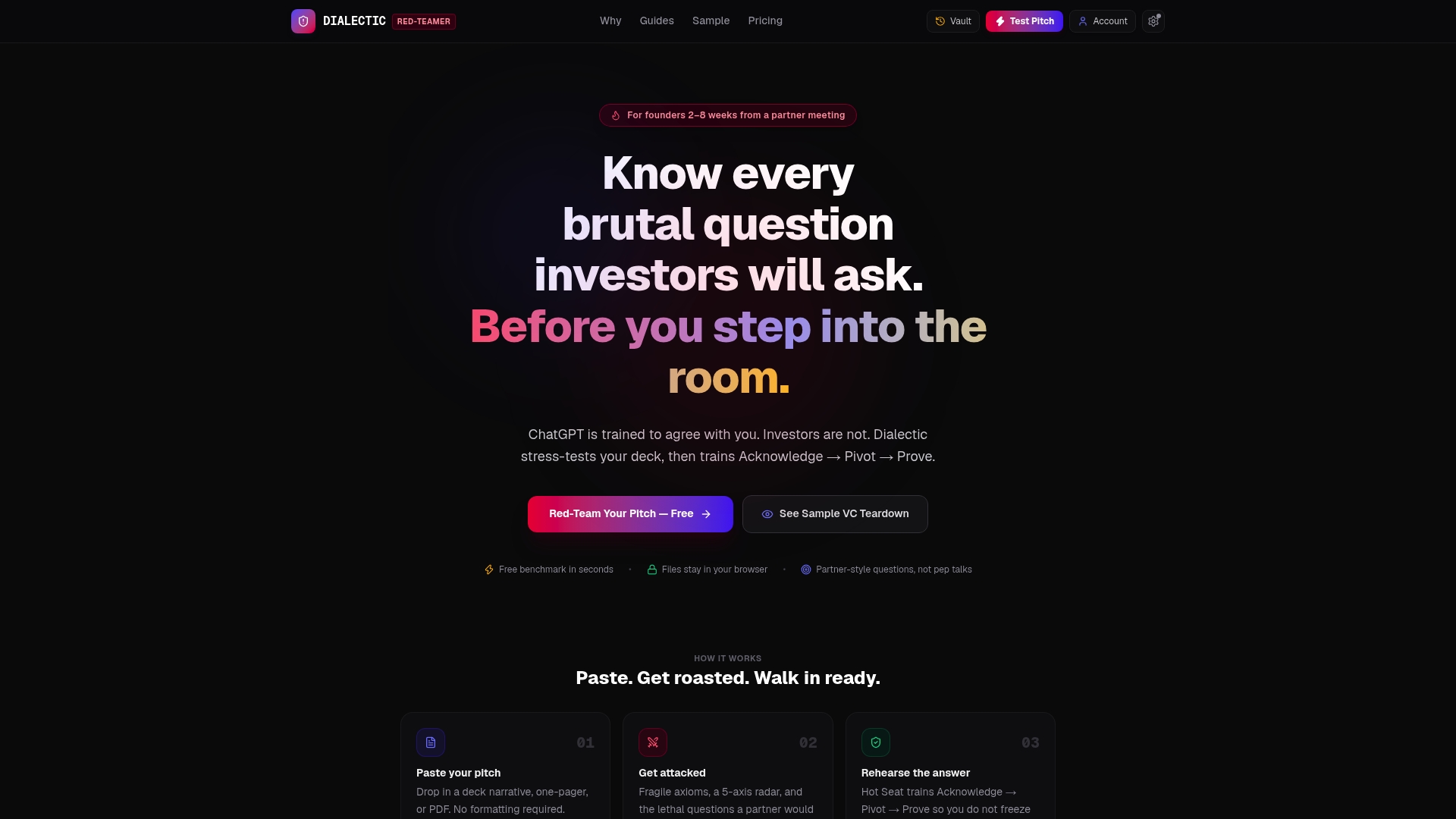
Real partner feedback arrives after you have used up a meeting. The cheaper move is to hear the lethal questions first. Dialectic is built for that. You upload a pitch deck or memo, and it scrutinizes it the way a seasoned VC partner would, with fragility and risk scoring, structured weaknesses and blind spots, and a real-time boardroom rehearsal with a graded defense. Unlike supportive AI tools, it is designed to surface fragile assumptions. Our note on why a general chatbot won't roast your pitch explains the difference.
There are three ways to start:
- Tactical Audit: $25 one-off per audit.
- Founder Pro: $49 per month.
- Venture & Studio 5 Seats: $149 per month.
You can see them all on the Dialectic site. If your meeting is tomorrow, start with the 24-hour pitch checklist.
Our perspective
Most founders treat feedback as something that happens to them after a pitch. We think it should happen before.
A partner's time is scarce, and a pass without reasons teaches you nothing. The questions that sink rounds are usually predictable: an assumption that does not survive scrutiny, a number that contradicts the deck, a competitor you cannot answer. Finding them in private costs a few hours. Finding them in the meeting can cost the round.
That is why Dialectic is built around adversarial, partner-style questioning and fragility detection rather than polite critique. Encouragement feels good, but a founder walking into a boardroom needs to have already defended the weak spots out loud. Our real-time boardroom rehearsal exists for that reason: written answers and spoken answers are different skills.
Used well, the loop is simple. Find the weakness, fix the deck or the model, rehearse the defense, and take what is left into the meeting.
D
FAQ
What does VC partner feedback usually focus on?
Most debriefs start with each partner's overall sentiment, then the team and the market. Product, go-to-market and differentiation are debated often. Unit economics and company culture also come up.
How soon should I hear back after a partner meeting?
NextView's guidance is that the lead partner typically follows up within 24 to 48 hours with a clear yes, a clear no, or areas for more diligence. If you hear nothing after a positive meeting, StartupFundraising.com lists ghosting among the negative signals.
Is "let's keep in touch" a good sign?
Only if it comes with a specific concern, a milestone that could resolve it and a time to reconnect. Without a trigger, treat it as a polite no and ask a narrow follow-up question about the main issue.
Should I change my pitch after one investor's criticism?
Usually not. Wait for a pattern, ideally three investors raising the same issue in similar language. Then fix the framing, evidence or ordering without rewriting the whole story.
Sources
- How Decisions Are Made After The Partner Meeting, NextView
- What Do My Partners REALLY Care About When You Pitch Them?, NextView
- What to expect when pitching at a VC partner meeting, First Round Review
- Honest Feedback vs Motivational Advice, Honest VC
- How to say no: a guide to passing, Signature Block
- Reputation, power and the feedback void, Tenacious Ventures
- Reading Your VC Pitch Meeting, Seth Levine
- Interpret Investor Signals and Commitments, StartupFundraising.com
- Allied Venture Partners, How to Respond to Investor Questions
- The Investor Objection Playbook, Deepak Gupta
- Investor Hostile Questions: The Steel-Manning Technique
- How to Turn Investor Feedback Into a Second Meeting, Tran VC
- How To Turn Keep Me Posted Into A Real Next Meeting, Community Capital Club
- How to Handle Investor Rejection, Hustle Fund
- Why Series A Rounds Don't Close, Opagio
- Pivot Your Pitch: 3 Investor Signals, SheetVenture
- Learning from fundraising rejection, Vestd
- When Your Pitch Deck and Financial Model Disagree, StartGrowImprove
- America's Next Top Model, Press On Ventures
- 7 Startup Fundraising Tips from Both Sides of the Table, Bain Capital Ventures